

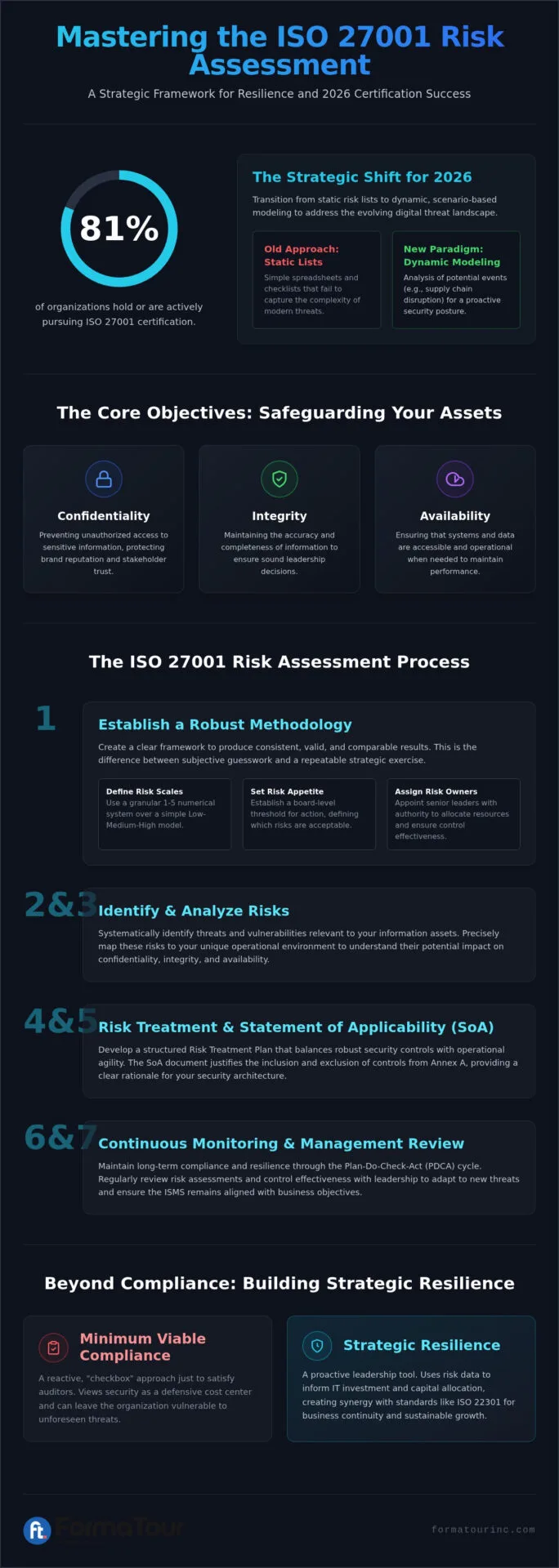
81% of organizations now hold or actively pursue ISO 27001 certification, a surge that reflects a global shift toward standardized resilience. For most executives, the challenge isn’t understanding the need for security, but rather managing the intricate ISO 27001 risk assessment process without stifling innovation. It’s common to feel that the 2022 standard updates have added a layer of complexity that threatens to turn a vital strategic exercise into a burdensome administrative hurdle.
We’re here to change that perspective. This guide offers a sophisticated framework designed to transform your risk management from a compliance requirement into a driver of organizational performance. You’ll gain a clear roadmap to the 2026 certification requirements, learn to align technical controls with high-level business objectives, and discover how to build a culture of security that supports long-term growth. We’ll start by breaking down the mandatory phases of the assessment before moving into the specific strategies that ensure audit success and operational stability.
Key Takeaways
- Transition from static risk lists to dynamic, scenario-based modeling to better address the evolving digital threat landscape of 2026.
- Master the ISO 27001 risk assessment process by defining a methodology that ensures consistent, valid, and comparable results across all organizational tiers.
- Secure both tangible and intangible assets by precisely mapping threats and vulnerabilities to your unique operational environment.
- Implement a structured Risk Treatment Plan that balances robust security controls with the operational agility required for sustainable growth.
- Maintain long-term compliance and organizational resilience through the Plan-Do-Check-Act cycle and the strategic use of management reviews.
Understanding the Strategic Value of the ISO 27001 Risk Assessment Process
The ISO 27001 risk assessment process serves as the architectural foundation of a modern Information Security Management System (ISMS). It’s a systematic methodology for identifying, analyzing, and treating risks that could jeopardize your organization’s most valuable information assets. In the 2026 landscape, this process has evolved significantly. We’ve moved beyond simple spreadsheets and static lists. Organizations now require dynamic, scenario-based risk modeling that accounts for the rapid pace of digital transformation and the increasing sophistication of global threats.
For Canadian organizations, this strategic exercise is particularly vital. A robust assessment ensures alignment with the Personal Information Protection and Electronic Documents Act (PIPEDA) and various provincial standards. Whether you’re managing health data in Ontario or navigating Quebec’s stringent privacy requirements, the risk assessment provides the evidence-based framework needed to demonstrate due diligence to regulators and stakeholders. It transforms security from a defensive cost center into a pillar of organizational resilience.
The Core Objectives: Confidentiality, Integrity, and Availability
The CIA triad remains the fundamental framework for every assessment. In premium advisory and project management environments, these objectives do more than protect data; they safeguard brand reputation and stakeholder trust. Consider a breach in data integrity during a high-stakes project. If financial projections or strategic timelines are subtly altered by an unauthorized party, the resulting leadership decisions could be catastrophic. Maintaining the accuracy and completeness of information is just as critical as preventing unauthorized access or ensuring system uptime.
Compliance vs. Strategic Resilience
Many firms pursue a “minimum viable compliance” model, checking boxes just to satisfy an auditor. Formatour Incorporated advocates for a strategic resilience model that elevates the ISO 27001 risk assessment process from a checkbox exercise to a leadership tool. This approach uses risk data to inform capital allocation and IT investment strategies. Instead of guessing where to spend your security budget, you’re making data-driven decisions that prioritize the highest-impact areas.
This methodology creates a powerful synergy with ISO 22301 business continuity consulting. By integrating these standards, you ensure that your organization doesn’t just survive a disruption but maintains operational performance throughout the event. It’s about building a visionary architecture that supports sustainable growth and long-term stability.
Step 1: Establishing a Robust Risk Assessment Methodology
Precision begins with a clear framework. The ISO 27001:2022 standard requires that your ISO 27001 risk assessment process produces consistent, valid, and comparable results. This means that if two different managers assess the same risk, they should reach similar conclusions. Achieving this level of reliability requires a documented methodology that defines exactly how risks are measured and prioritized across the enterprise. It’s the difference between a subjective guess and a repeatable strategic exercise.
Your leadership team must define risk scales that reflect the organization’s specific context. While some firms prefer a simple Low-Medium-High scale, we typically recommend a 1-5 numerical system for greater granularity. A level 1 risk might represent a minor internal inconvenience, while a level 5 risk signifies a catastrophic event that threatens the firm’s survival. These scales must be paired with a clearly defined “Risk Appetite” set at the board level. This appetite serves as the threshold for action; it tells your team which risks are acceptable and which require immediate investment. Assigning “Risk Owners” is the final piece of this governance puzzle. In a premium advisory environment, these owners are usually senior partners or department heads who possess the authority to allocate resources and the accountability to ensure controls are effective.
Asset-Based vs. Scenario-Based Approaches
Traditional models often focus exclusively on physical or digital assets, such as servers or databases. While this provides a strong inventory, it often fails to capture the complexity of modern digital transformation. Scenario-based modeling addresses this gap by analyzing potential events, such as a supply chain disruption or a sophisticated phishing campaign targeting executive leadership. A hybrid approach provides the optimal balance of asset protection and operational foresight for Canadian mid-market firms in 2026. This dual focus ensures that while your infrastructure is secure, your strategic workflows remain resilient against evolving threats. If you need assistance tailoring this framework to your specific industry, our team can help you design a custom methodology.
Defining Impact and Likelihood Criteria
To calculate a risk score, you must measure both the potential impact and the likelihood of occurrence. Impact should be viewed through a broad lens that extends far beyond immediate financial loss. You must consider regulatory fines under PIPEDA, the erosion of client confidence, and the long-term damage to your brand’s reputation. Calculating likelihood requires a blend of historical data, current threat intelligence, and an honest evaluation of existing vulnerabilities. This rigorous analysis ensures that security investments are proportionate to the actual threat level. This focus on precision shares a natural synergy with ISO 9001 quality management implementation, where risk-based thinking is used to ensure that service delivery remains consistent and high-quality, regardless of external pressures.
Step 2 & 3: Identification and Analysis of Information Security Risks
The identification phase is the diagnostic core of the ISO 27001 risk assessment process. It’s where your architectural plans meet the reality of your operational environment. This stage requires a comprehensive inventory of all information assets. While hardware and software are obvious starting points, visionary leaders must also account for intangible assets like trade secrets, client trust, and brand reputation. These elements often represent the true value of a premium advisory firm, yet they’re frequently overlooked in basic compliance exercises.
Cataloging Information Assets in a Digital-First Environment
Modern organizations operate across decentralized networks. Cloud-native assets and remote work infrastructure have expanded the attack surface, making traditional perimeter defenses insufficient. Effective asset management now requires sophisticated data classification. You should categorize information into four distinct levels:
- Public: Information intended for general consumption.
- Internal: Data restricted to employees but with low sensitivity.
- Confidential: Sensitive data that requires protection against unauthorized access.
- Restricted: Highly sensitive information, such as intellectual property, where a breach would cause severe damage.
Leading digital transformation strategy firms often integrate these classification schemes directly into automated business processes. This ensures that security isn’t a separate task but an inherent part of how data moves through the organization.
Threat and Vulnerability Mapping
One of the most persistent vulnerabilities is “shadow IT”, where employees use unauthorized tools to complete tasks. Use this checklist to identify hidden risks:
- Audit all third-party SaaS applications used by various departments.
- Review personal device usage policies for remote employees.
- Analyze unmanaged cloud storage instances.
- Evaluate unauthorized communication platforms used for internal project management.
After identification, you’ll calculate the “Risk Level” by combining the impact and likelihood scores established in your methodology. This data-driven approach allows executive leadership to validate identified risks. Their involvement ensures that the assessment reflects the firm’s strategic priorities rather than just technical concerns. It’s about ensuring the board understands the “why” behind every security investment.
Step 4 & 5: Risk Treatment and the Statement of Applicability
Once you’ve identified and analyzed your risks, the next phase of the ISO 27001 risk assessment process is to determine how you will address them. This isn’t merely a technical decision; it’s a strategic one that requires balancing security needs with organizational goals. You must decide which risks require immediate action and which can be managed through alternative means. This stage ensures that your security budget is allocated to the areas of highest impact, providing a clear return on investment for your resilience efforts.
The four standard treatment options provide a clear framework for executive decision-making:
- Treat: Implementing specific controls to reduce the risk to an acceptable level.
- Transfer: Sharing the risk with third parties, such as through comprehensive cyber insurance or outsourcing specific functions.
- Avoid: Eliminating the risk entirely by ceasing the business activity that creates it.
- Accept: Formally acknowledging the risk when the cost of treatment outweighs the potential impact, provided it falls within your established risk appetite.
The Risk Treatment Plan (RTP) transforms these decisions into a formal project management initiative. It assigns clear accountability to risk owners, sets realistic timelines for implementation, and identifies the necessary resources. This structured approach ensures that security improvements are integrated into your daily operations rather than remaining as abstract goals on a spreadsheet.
The Statement of Applicability (SoA) Explained
The Statement of Applicability (SoA) is the most critical document for an ISO 27001 auditor. it serves as the primary roadmap for your ISMS, detailing which controls from Annex A you have selected and why. A sophisticated SoA doesn’t just list controls; it provides a strategic justification for every inclusion and exclusion. If a control is deemed unnecessary, you must explain how your security posture remains intact without it. This document links your technical safeguards directly to the strategic transformation of your firm, proving that your security architecture is both intentional and comprehensive.
Implementing Annex A Controls
The 2022 revision of the standard simplified Annex A into four thematic categories: Organizational, People, Physical, and Technological. This structure encourages a more holistic view of security that extends beyond the IT department. The “People” controls are often the most challenging to implement effectively. Success in this area relies heavily on leadership training for digital transformation, which empowers managers to foster a culture of security awareness. Even with robust controls, some “residual risk” will always remain. Your goal is to ensure this remaining risk aligns with the appetite established by your board. If you find the selection of controls overwhelming, our experts can help you refine your risk treatment strategy.
Step 6 & 7: Continuous Monitoring and Leveraging Advisory Expertise
Security isn’t a static achievement. It’s a living system. The “Plan-Do-Check-Act” (PDCA) cycle ensures that your Information Security Management System (ISMS) remains healthy and responsive to change. Within this cycle, the ISO 27001 risk assessment process acts as a vital feedback loop. It’s the mechanism that identifies when old controls are no longer effective or when new business initiatives create unforeseen vulnerabilities. By treating risk management as a continuous journey, you build an organization that doesn’t just resist threats but adapts to them with precision.
The Role of Internal Audits and Management Reviews
Regular internal audits are essential for maintaining the integrity of your security framework. These assessments identify non-conformities and operational gaps that might otherwise go unnoticed until a formal certification audit. Essentially, internal audits serve as a “dress rehearsal” for the certification body, providing a safe environment to refine your processes and ensure full compliance. Management reviews complement this by elevating the findings to the executive level. This ensures that the risk assessment remains tightly aligned with your organization’s strategic transformation, allowing leadership to adjust the risk appetite and resource allocation as the business evolves. It’s a disciplined approach that guarantees your security posture remains robust against the shifting digital landscape.
Partnering with a Strategic Advisory Firm
Achieving certification is a complex undertaking that often strains internal resources. Partnering with a multidisciplinary advisory firm provides the expert guidance needed to navigate these complexities without disrupting your core operations. Formatour Incorporated offers a unique blend of boutique agility and big-firm standards, helping you adapt your risk assessments to emerging global trends and shifting regulatory landscapes. This “expert implementation” approach significantly reduces time-to-certification and minimizes operational friction. We act as your strategic mentor, ensuring that every control adds value to your business rather than just adding bureaucracy. Our focus is on the seamless integration of high-level concepts into your daily operations.
If you’re ready to build a visionary architecture for your organization, we invite you to reach out to our team. We’ll help you develop a tailored risk assessment framework that supports your long-term growth and stability. Explore our ISO 27001 implementation services to see how we can transform your security posture into a sustainable competitive advantage.
Architecting a Resilient Future with ISO 27001
Mastering the ISO 27001 risk assessment process isn’t just a compliance milestone; it’s a strategic commitment to your organization’s long-term integrity. By moving from static checklists to the scenario-based modeling discussed earlier, you ensure that your security posture evolves alongside your digital ambitions. This disciplined framework protects your brand reputation while fostering a culture of unwavering reliability and stakeholder trust. It’s about turning complex requirements into a sustainable competitive advantage that drives organizational growth.
Formatour Incorporated provides the expert guidance required to turn these high-level standards into tangible business results. We combine boutique agility with more than a decade of ISO expertise, offering a Canadian-focused multidisciplinary advisory that understands your unique operational landscape. Our role as your strategic mentor is to simplify the path to certification while maximizing your firm’s resilience and operational performance. We work as your visionary architects to integrate security into the very fabric of your daily operations.
Partner with Formatour Incorporated for Premium ISO 27001 Implementation Services and begin your journey toward a secure, high-performance future. Success is within reach when you have a steady, expert hand guiding your progress.
Frequently Asked Questions
What is the most common mistake in the ISO 27001 risk assessment process?
The most frequent error is treating the ISO 27001 risk assessment process as a static, IT-centric checkbox exercise. Many firms fail to involve senior leadership, which results in a lack of alignment with strategic business goals. This disconnect often leads to poorly allocated resources and controls that hinder operational agility. A successful assessment requires a multidisciplinary approach that considers human capital, brand reputation, and long-term organizational resilience rather than just technical vulnerabilities.
How often must an organization perform a risk assessment under ISO 27001?
ISO 27001:2022 requires organizations to conduct risk assessments at planned intervals or when significant changes are proposed or occur. In practice, most Canadian corporations perform a full review annually to ensure their Information Security Management System remains effective. You should also trigger an assessment following major infrastructure shifts, new product launches, or significant changes in the global threat landscape. This proactive approach helps maintain your certification and protect your most valuable assets.
Can we use an automated tool for our ISO 27001 risk assessment?
Automation is a growing trend that can significantly streamline the certification journey. Specialized software helps manage asset inventories, track threat intelligence, and generate necessary documentation like the Statement of Applicability. However, tools alone aren’t a substitute for expert judgment. You must still tailor the tool’s parameters to your specific operational context. Ensure that the results are validated by senior leadership to reflect your firm’s unique risk appetite and strategic goals.
What is the difference between a risk assessment and a risk treatment plan?
A risk assessment is the diagnostic phase where you identify, analyze, and evaluate potential threats to your information assets. It provides the “why” and “what” of your security posture. In contrast, the risk treatment plan is the action-oriented project management document. It details the “how” by specifying which controls you’ll implement, who owns the task, and the timeline for completion to bring risks down to an acceptable level within your organization.
Who should lead the risk assessment process within a Canadian corporation?
The process should be led by a designated Risk Owner, typically a senior executive or department head with the authority to allocate resources. While the CISO often manages the technical aspects, the board of directors must provide the strategic direction and sign off on the risk appetite. Successful Canadian firms often partner with a multidisciplinary advisory firm. This ensures the assessment meets both international standards and local regulatory requirements like PIPEDA or provincial privacy laws.
How does ISO 27001:2022 change the risk assessment process compared to previous versions?
The 2022 update simplified the control set from 114 to 93 and reorganized them into four thematic categories: organizational, people, physical, and technological. This change encourages a more holistic view of the ISO 27001 risk assessment process. It places a greater emphasis on modern challenges like cloud security and AI-enabled monitoring. Organizations must ensure their methodology accounts for these evolving digital landscapes to remain compliant and resilient in the current 2026 business environment.
What happens if we identify a risk but choose not to implement a control?
Choosing not to implement a control is a valid strategy known as “Risk Acceptance.” This occurs when the cost of mitigation outweighs the potential impact of the risk. However, you can’t simply ignore the threat. The decision must be formally documented, justified within your risk treatment plan, and approved by senior leadership. Auditors will look for evidence that this acceptance aligns with your board-approved risk appetite and doesn’t compromise your overall security posture.
How does the risk assessment process impact our Statement of Applicability (SoA)?
The risk assessment is the direct precursor to the Statement of Applicability. It identifies which risks are relevant to your firm, which in turn determines which Annex A controls are necessary. Every control listed in your SoA must be linked back to a specific risk identified during the ISO 27001 risk assessment process. If you exclude a control, the SoA must provide a clear, documented justification explaining why that safeguard isn’t required for your environment.
