

With potential penalties under Canada’s Bill C-36 and Quebec’s Law 25 reaching as high as $25 million or 5% of global revenue, the cost of a data breach has moved from a line-item risk to an existential threat. Most Canadian executives understand that securing data is no longer just an IT requirement; it’s the foundation of market trust and regulatory survival. You likely feel the pressure of aligning your operations with these shifting legal frameworks while fearing the disruption an intensive audit might bring to your daily workflow.
This guide clarifies the ISO 27001 certification process Canada requires for modern compliance, ensuring your organization achieves global standards without sacrificing operational agility. We’ll explore a strategic roadmap that harmonizes ISO/IEC 27001:2022 with local privacy mandates, identifies the right consulting partners, and builds a culture of long-term organizational resilience. By the end of this roadmap, you’ll have a clear path to transforming security from a technical hurdle into a sustainable competitive advantage.
Key Takeaways
- Understand how ISO 27001 serves as a critical shield against the evolving regulatory landscape of Bill C-27 and Quebec’s Law 25.
- Master the five essential phases of the ISO 27001 certification process Canada requires to move from strategic planning to successful audit completion.
- Learn to navigate the ‘Rule of Independence’ to select the right implementation and auditing partners without compromising your certification integrity.
- Prepare for Stage 1 and Stage 2 audits with a clear understanding of documentation requirements and evidence-based performance reviews.
- Discover how integrating security with quality and business continuity creates a resilient framework for sustained organizational growth.
The Strategic Importance of ISO 27001 in the Canadian Regulatory Landscape
The ISO/IEC 27001 standard represents the international gold standard for Information Security Management Systems (ISMS). In 2026, its relevance for Canadian firms has shifted from a competitive advantage to a regulatory necessity. With the enactment of the Protecting Privacy and Consumer Data Act (Bill C-36), the stakes for data protection have reached unprecedented levels. Organizations now face potential penalties of up to $25 million or 5% of gross global revenue for serious offenses, making a robust security framework essential for survival.
Adopting a formal ISMS isn’t just about “checking a box” for IT security. It’s a strategic commitment to organizational resilience. By following a structured risk management framework, companies can identify vulnerabilities before they become catastrophic failures. This proactive stance is the master key for both PIPEDA compliance and entering international markets where security validation is a prerequisite for trade.
Aligning with Canadian Privacy Laws
The ISO 27001 framework maps directly to the 10 fair information principles found in PIPEDA and its successor legislation. Its controls ensure that consent, accountability, and individual access are built into the fabric of your operations. This alignment is particularly critical for firms operating in Quebec, where Law 25 demands high standards for data transparency and portability. By implementing these controls, you create a defensible position against regulatory scrutiny.
The Standards Council of Canada (SCC) oversees the accreditation of certification bodies, ensuring that the ISO 27001 certification process Canada follows remains rigorous and globally recognized. Adhering to these benchmarks prepares your firm for the future of privacy, including evolving regulations in Ontario and other provinces. It transforms compliance from a reactive burden into a predictable, manageable process.
The Business Case for Canadian Executives
Security is a driver of growth, not a cost center. Engaging with the ISO 27001 certification process Canada provides often leads to reduced cyber insurance premiums, as insurers recognize the lowered risk profile of certified organizations. Additionally, certification significantly shortens sales cycles with enterprise-level clients who demand immediate proof of data integrity before signing contracts.
An ISMS serves as the strategic backbone of digital trust in 2026, providing a clear roadmap for governance and technological advancement. It empowers your leadership team to make informed decisions based on real-time risk data rather than intuition. This structured approach ensures that security investments are optimized for maximum impact and long-term structural integrity.
The 5-Phase ISO 27001 Certification Process for Canadian Firms
Achieving certification is a structured evolution that aligns your technical security with high-level business objectives. The ISO 27001 certification process Canada demands is not a mere technical exercise but a comprehensive organizational transformation. It requires a methodical approach to ensure that governance, risk management, and operational controls work in harmony.
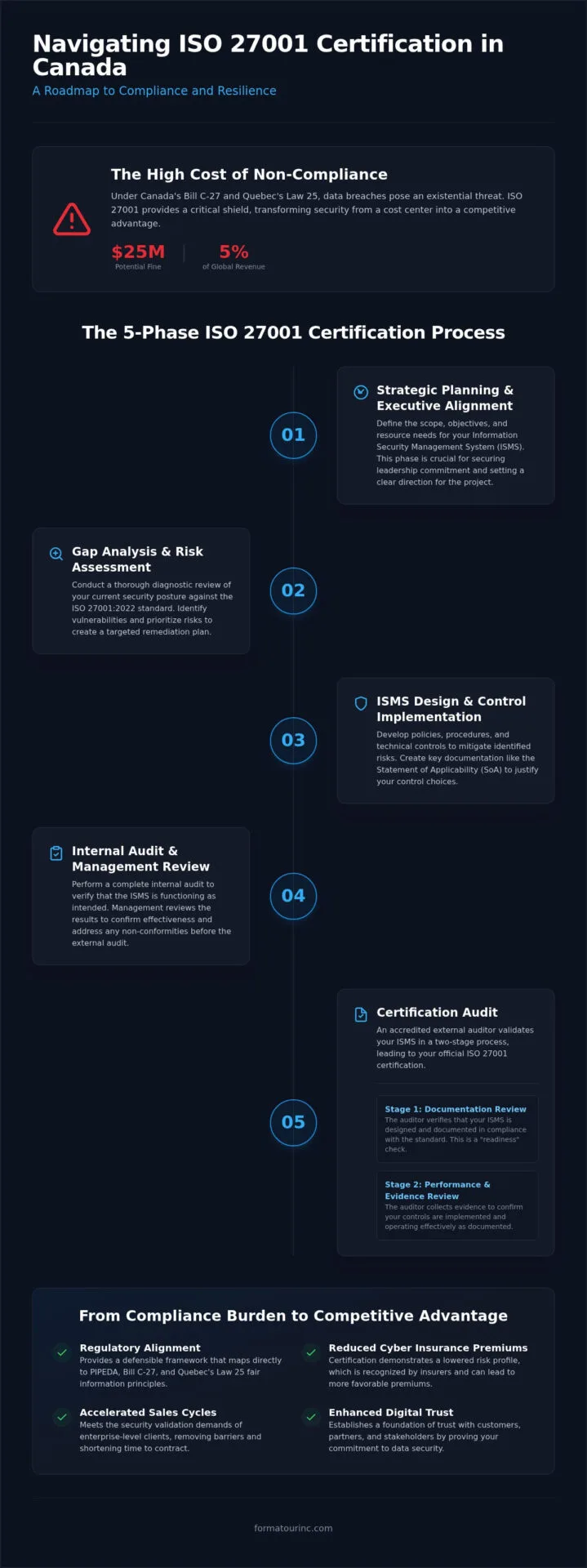
Strategic Planning and Executive Alignment represent the first phase, where leadership defines the core objectives and resource requirements of the ISMS. Phase 2, the Gap Analysis, provides a diagnostic view of your current security posture against the 2022 version of the standard. This identifies exactly where your Canadian operations require remediation. In Phase 3, teams design and deploy specific controls, while Phase 4 involves a rigorous internal audit to verify system effectiveness before the official review. Finally, the ISO 27001 certification process Canada concludes with a two-stage Certification Audit performed by an accredited body to validate your compliance.
Defining the Scope of Your ISMS
Establishing clear boundaries is vital for a successful audit. You must determine which Canadian business units, physical locations, and digital data assets fall within the ISMS. The Statement of Applicability (SoA) acts as the central document here; it justifies the inclusion or exclusion of specific security controls based on your unique environment. Precise scoping prevents “scope creep” while ensuring your most sensitive intellectual property remains protected under the certification umbrella. If you’re unsure where your current boundaries should lie, you can speak with a strategic advisor to refine your approach.
Implementation and Risk Treatment
Implementation begins with a formal risk assessment tailored to the Canadian threat landscape, including specific risks related to cross-border data flows and provincial privacy mandates. Organizations select Annex A controls that address these identified vulnerabilities, ensuring a bespoke fit for their operational needs. The Statement of Applicability serves as the definitive bridge between the outcomes of your risk treatment plan and the specific Annex A controls selected for implementation. This ensures that every safeguard is purposeful and directly linked to a documented risk, providing a clear trail of accountability for auditors.
Implementation vs. Certification: Choosing Your Partners in Canada
Understanding the distinction between implementation and certification is vital for any executive team. The ISO 27001 certification process Canada requires is governed by a strict “Rule of Independence.” This mandate ensures that the firm designing your security controls cannot be the same entity that performs the final certification audit. This separation of duties prevents conflicts of interest and guarantees that your Information Security Management System (ISMS) is evaluated with total objectivity by an accredited third party.
The Role of the Strategic Advisor
A strategic advisor acts as a visionary architect for your security framework. Rather than simply providing templates, a partner like Formatour focuses on co-development, ensuring that technical guards align with your specific executive strategy. This collaborative approach helps build long-term organizational health rather than a temporary fix for an audit. Integrating your internal team through Lead Auditor training is a critical component of this partnership, as it empowers your staff to maintain the ISMS long after the initial certification is achieved. For a deeper look at how these roles function together, explore our ISO 27001 Implementation Services: A Strategic Guide to Organizational Resilience.
Choosing between boutique agility and big-firm bureaucracy often comes down to the level of personalization your organization requires. Large international firms typically offer standardized, high-volume services that may feel disconnected from the nuances of the Canadian regulatory environment. Boutique firms provide a more “expert hand” approach, offering the flexibility to adapt to your operational pace while maintaining the rigorous standards expected by global markets. This agility is particularly beneficial for firms navigating the complexities of Bill C-27 and provincial privacy laws simultaneously.
Evaluating Certification Bodies (CBs)
The selection of a registrar, or Certification Body, is the final piece of the puzzle. You must verify that the CB is accredited by a recognized authority such as the Standards Council of Canada (SCC) or the ANSI National Accreditation Board (ANAB). Always look for the International Accreditation Forum (IAF) mark on their credentials. This mark confirms that your certificate will be recognized globally, which is essential for firms seeking an international competitive advantage.
When evaluating quotes, consider the full cost structure beyond the initial application fee. Costs are typically calculated based on the number of “audit days” required, which is determined by the size and complexity of your organization. Be sure to account for travel expenses for on-site reviews at your Canadian offices and the ongoing fees for surveillance audits in years two and three. A CB’s reputation in the industry can significantly impact how your brand’s security posture is perceived by enterprise-level clients and stakeholders.
Navigating the Audit: Stage 1, Stage 2, and Beyond
The audit phase is the definitive validation of your security governance. Within the ISO 27001 certification process Canada requires, this evaluation is divided into two distinct stages to ensure both theoretical and practical compliance. Stage 1 serves as a documentation review; the auditor examines your ISMS design and Statement of Applicability to confirm that all mandatory requirements are addressed on paper. This stage acts as a readiness gate, ensuring your organization is prepared for the more intensive scrutiny that follows.
Stage 2 shifts the focus to evidence and implementation. Auditors spend several days reviewing system logs, meeting minutes, and physical security measures to prove that your policies are functioning in the Canadian office. During this phase, the auditor may identify Non-Conformities (NCs). A “Major NC” indicates a significant breakdown in a required control, requiring immediate remediation before certification can be granted. A “Minor NC” represents a localized lapse that doesn’t jeopardize the entire system. Addressing these findings with a clear corrective action plan demonstrates your commitment to the standard and allows the certification process to proceed.
Preparing for the Stage 2 Evidence Review
Success in Stage 2 depends on the accessibility and quality of your audit evidence. You must gather comprehensive records, including employee training logs, incident response reports, and internal audit results. Auditors often conduct interviews with staff members across various departments to verify that the organization understands its security role. A typical “day in the life” of an auditor involves a mix of site walkthroughs, document sampling, and direct observation of operational workflows. If you need assistance preparing your team for this level of scrutiny, you can contact our strategic advisors for targeted audit preparation.
Continuous Improvement and Re-Certification
Certification is the beginning of a cycle, not a final destination. Organizations must move from simple compliance to high-level performance by utilizing the Plan-Do-Check-Act (PDCA) cycle. This structured approach ensures that your security measures evolve alongside emerging threats and technological shifts. Many Canadian firms find that the maturity gained through ISO 27001 provides a perfect foundation for other standards, such as the ISO 9001 Quality Management Implementation: A Strategic Executive Guide for 2026. To maintain global trust, your firm will undergo annual surveillance audits in years two and three, followed by a full re-certification audit every three years.
Why Formatour is Canada’s Partner for ISO 27001 Excellence
Formatour provides a unique balance of boutique agility and big-firm standards, positioning itself as a premium partner for organizations seeking stability and growth. We understand that the ISO 27001 certification process Canada requires isn’t just a technical checklist; it’s a strategic evolution. Our team acts as a visionary architect, co-developing solutions that integrate seamlessly into your daily operations. With over a decade of experience in strategic transformation, we guide your firm through the complexities of global systems while remaining grounded in practical Canadian application.
Our deep understanding of the local legislative environment, including the specific nuances of Bill C-27 and Quebec’s Law 25, ensures your ISMS is built for both local compliance and global expansion. We don’t just help you implement technical controls. We transform your leadership culture to value security as a core pillar of digital trust. This approach ensures that your investment in certification yields long-term structural integrity and a genuine competitive advantage in the international market.
A Multidisciplinary Path to Resilience
True organizational health requires more than a single certification. We specialize in linking your security framework with quality management and business continuity to create a holistic picture of expertise. By integrating your ISMS with ISO 22301 Business Continuity Consulting, we ensure your organization can withstand and recover from significant disruptions. This multidisciplinary view prevents operational silos and creates a unified strategy for long-term resilience.
Our Leadership Training for Digital Transformation supports this journey by equipping your executive team with the governance skills needed for a rapidly shifting landscape. These programs foster a sense of security through strategic foresight and empower leaders to champion compliance across the entire organization. We believe that sustainable development is achieved when high-level concepts are integrated into the daily rhythm of the business.
Your Next Steps Toward Certification
Your journey begins with a comprehensive consultation designed to assess your current state and define your specific strategic goals. We then co-develop a customized roadmap that respects your organizational pace and budgetary requirements. This methodical progression ensures that the ISO 27001 certification process Canada mandates becomes a catalyst for optimization rather than a source of operational disruption.
Ready to secure your organization’s future with an expert hand? Contact Formatour Incorporated for a strategic ISO 27001 assessment to begin your transformation today.
Forging a Resilient Future through Strategic Security Governance
Achieving ISO 27001 certification is a transformative journey that establishes your organization as a leader in digital trust and regulatory compliance. By following the structured ISO 27001 certification process Canada requires, you move beyond basic security protocols to build a culture of long-term organizational resilience. This roadmap ensures that your Information Security Management System aligns with both global standards and the specific demands of Canadian privacy legislation.
Formatour brings over a decade of expertise in strategic transformation and operational performance to every partnership. We provide comprehensive ISO auditing and certification support, combining Canadian-based advisory with high-level global standards to guide you through every phase of implementation. Our co-development approach empowers your leadership team, ensuring that security becomes a sustainable driver of growth rather than an operational burden.
Your path to a more secure and competitive future starts with a single strategic decision. Secure Your Organization’s Future with Formatour’s ISO 27001 Advisory Services and gain the assurance of success in an evolving digital landscape. We look forward to facilitating your progress toward excellence.
Frequently Asked Questions
How long does the ISO 27001 certification process take in Canada?
The duration of the ISO 27001 certification process Canada requires typically spans six to twelve months. This timeline depends on the maturity of your existing systems and the complexity of your organizational structure. Smaller firms with focused scopes may achieve certification faster; however, larger enterprises often require the full year to ensure all controls are properly integrated. Strategic planning and a thorough gap analysis are essential to maintaining a steady pace throughout this period.
What is the typical cost of ISO 27001 certification for a Canadian SME?
Certification costs are influenced by the size of your workforce, the number of physical sites, and the complexity of your data assets. These factors determine the number of audit days required by the certification body. Beyond the external audit fees, organizations should account for internal resource allocation and the potential need for strategic advisory services. Investing in professional guidance often reduces long-term expenses by preventing costly remediation efforts during the final audit stages.
Can we achieve ISO 27001 certification without external consulting?
It’s possible to achieve certification using internal resources; however, many firms find the technical density and documentation requirements overwhelming. Without an expert hand, organizations risk overlooking critical Annex A controls or failing to align their risk assessment with international benchmarks. Partnering with a strategic mentor ensures that your ISMS is not only compliant but also optimized for operational performance. This collaborative approach minimizes the risk of failure during the Stage 2 evidence review.
How does ISO 27001 differ from CyberSecure Canada certification?
CyberSecure Canada is a federal program designed for small and medium organizations to establish a baseline of cybersecurity. In contrast, ISO 27001 is an internationally recognized standard that provides a comprehensive framework for an Information Security Management System. While CyberSecure Canada focuses on a specific set of technical controls, ISO 27001 emphasizes continuous improvement and risk-based governance. Achieving the international standard provides a significant competitive advantage for firms operating in global markets.
Is ISO 27001 mandatory for Canadian businesses?
ISO 27001 is not currently a legal requirement for all Canadian businesses; however, it’s increasingly becoming a contractual mandate for enterprise-level partnerships. Many government agencies and international clients require proof of certification before engaging in trade. Additionally, the standard serves as a robust framework for meeting the stringent data protection requirements of Bill C-27 and Quebec’s Law 25. Implementing this standard demonstrates a commitment to due diligence that shields the organization from regulatory penalties.
What are the most common reasons Canadian firms fail their ISO 27001 audit?
Audit failures often stem from a lack of executive commitment or an inadequately defined ISMS scope. When leadership doesn’t actively participate in the governance process, the system frequently lacks the resources needed for success. Other common pitfalls include insufficient documentation of risk treatment decisions and a failure to perform regular internal audits. Ensuring that your Statement of Applicability is fully supported by operational evidence is critical to navigating the Stage 2 review without major non-conformities.
How often do we need to perform internal audits for ISO 27001?
Internal audits must be conducted at planned intervals, typically at least once per year, to ensure the ISMS remains effective. These reviews serve as a proactive measure to identify vulnerabilities before the external surveillance audit occurs. A methodical internal audit schedule allows the organization to refine its controls and demonstrate a commitment to the Plan-Do-Check-Act cycle. This consistent oversight is vital for maintaining the structural integrity of your security framework over the three-year certification period.
Does ISO 27001 cover Canadian privacy laws like PIPEDA?
The ISO 27001 certification process Canada follows is highly compatible with PIPEDA and its ten fair information principles. While the standard is focused on security, its controls for accountability, consent, and data integrity provide a solid foundation for privacy compliance. By aligning your ISMS with these international benchmarks, you create a defensible position against provincial and federal privacy audits. This integration ensures that your organization meets the high standards for data transparency required in the modern digital landscape.
