

What if your internal audit program functioned as a primary driver of competitive advantage rather than a recurring administrative burden? Most Canadian executives view the audit cycle with a sense of weary obligation, seeing it as a hurdle to clear for recertification rather than a tool for structural growth. You likely recognize that while compliance is mandatory, a traditional approach to oversight often fails to yield the strategic insights necessary for true optimization. This guide demonstrates how specialized ISO 9001 internal auditor training Canada offers can transform your team into a sophisticated engine for operational excellence and organizational resilience.
We’ll examine the critical shifts arriving with the ISO 9001:2026 update, including the new emphasis on ethical behavior and quality culture. You’ll discover how to move beyond basic checklists to develop a competent, certified team that secures your recertification while actively identifying risks before they impact your bottom line. By aligning your auditing practices with these modern international benchmarks, you ensure your organization remains a leader in a complex global market. This transition represents a strategic opportunity to move from simple governance to a culture of continuous improvement.
Key Takeaways
- Reframe internal auditors as strategic observers who identify growth opportunities rather than simple compliance errors. This shift aligns your quality management system with high-level business objectives and long-term stability.
- Utilize specialized ISO 9001 internal auditor training Canada to master the 19011 auditing framework and prepare for 2026 standard revisions. Technical competence is the essential foundation of a reliable and modern audit program.
- Focus on auditing for operational performance to uncover process bottlenecks and opportunities for automation. Effective audits act as a diagnostic tool for driving digital transformation and organizational efficiency.
- Select training partners that offer boutique agility and multidisciplinary expertise in both ISO standards and executive leadership. The right provider will tailor delivery models to fit the specific demands of a busy executive schedule.
- Build a sophisticated audit team that serves as a pillar for organizational resilience and steady growth. This approach ensures seamless recertification while fostering a culture of continuous improvement across all departments.
The Evolving Role of ISO 9001 Internal Auditors in Canada (2026)
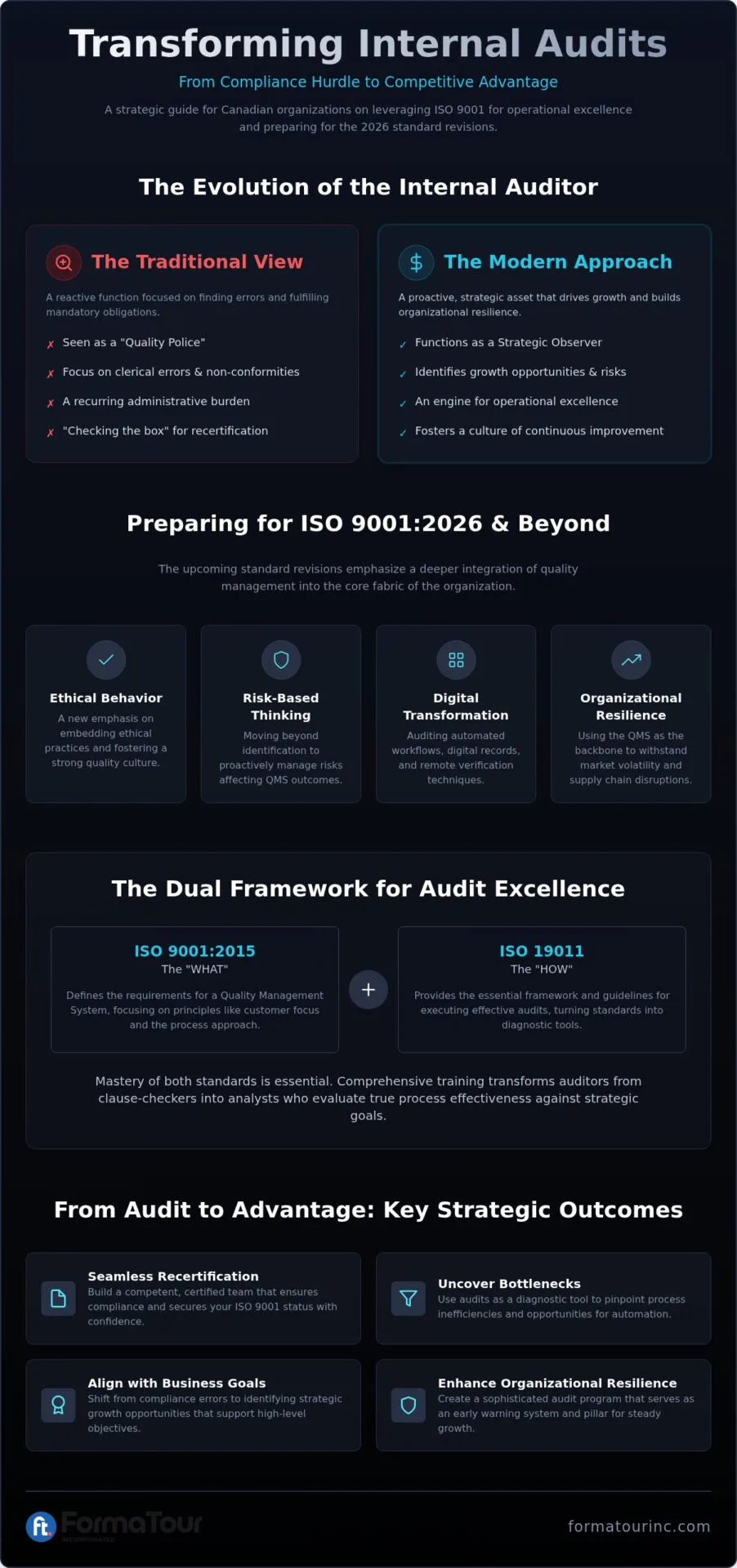
The year 2026 marks a pivotal transition in how Canadian organizations approach quality management. The traditional image of the internal auditor as a “quality police” officer, focused solely on identifying clerical errors, has become obsolete. Today, the most successful firms view their auditors as strategic observers. These professionals don’t just identify non-conformities; they provide the intelligence needed to maintain stability in a volatile market. Specialized ISO 9001 internal auditor training Canada empowers your team to move beyond basic compliance and toward high-level advisory roles that support executive goals.
In the current economic climate, a Quality Management System (QMS) is the backbone of organizational resilience. Canadian businesses face increasing pressure from global supply chains to demonstrate not just adherence to rules, but a deep commitment to risk-based thinking. “Checking the box” might have sufficed a decade ago, but competitive firms now realize that a stagnant QMS is a significant liability. High-performance organizations use their audits to ensure they can withstand disruptions while maintaining the precision their clients expect. This shift is particularly relevant as the industry prepares for the 2026 updates to international standards, which place greater emphasis on ethical behavior and quality culture.
Why Internal Auditing is a Strategic Asset
Internal audits serve as a critical early warning system for operational drift. When conducted with a strategic mindset, they reveal subtle inefficiencies before they escalate into systemic failures. These findings provide executives with actionable data, bridging the gap between daily operations and long-term governance. By integrating audit results into decision-making, leadership can foster a culture where continuous improvement is a shared responsibility rather than a department-specific task. This proactive stance ensures that the ISO 9001:2015 standard remains a living, breathing part of the company’s DNA.
Canadian Regulatory and Market Trends for 2026
The Canadian manufacturing and technology sectors have seen a sharp rise in quality expectations, driven largely by requirements in government procurement and international trade. As digital transformation reshapes how data is recorded and verified, the role of the auditor must evolve to match. Documentation is increasingly automated, requiring auditors to understand digital workflows and remote verification techniques. For firms seeking to lead, partnering with experts like Formatour Incorporated ensures their teams are prepared for these technological shifts. The 2026 Canadian QMS landscape is defined by the seamless integration of digital integrity and human expertise to build a foundation of unwavering organizational resilience.
Mastering the ISO 9001:2015 and ISO 19011 Curriculum
A robust internal audit program relies on the seamless integration of technical requirements and methodological execution. While the ISO 9001:2015 standard defines the ‘what’ of quality management, ISO 19011 provides the essential ‘how’ for the auditing process itself. Comprehensive ISO 9001 internal auditor training Canada ensures your team doesn’t just memorize clauses but understands how to apply them as diagnostic tools. According to the American Society for Quality (ASQ), the standard is built on quality management principles including a strong customer focus and the process approach. For an auditor, this means looking past tactical conformance to evaluate whether processes actually achieve their intended outcomes.
Effective auditing requires a shift from binary “yes/no” checklists to a deeper analysis of process effectiveness. Your auditors should identify if a system is merely following a procedure or if that procedure is optimized for the organization’s current strategic goals. This distinction separates a routine compliance check from a high-value internal audit that drives performance and identifies opportunities for structural optimization. It’s the difference between maintaining a certificate and maintaining a competitive edge.
Core Competencies of a Certified Internal Auditor
Mastering the audit interview is a sophisticated skill that requires more than just a list of questions. It’s about creating a collaborative atmosphere where employees feel empowered to share systemic challenges. Auditors must use these interactions to uncover the root causes of operational drift rather than just surface-level symptoms. A skilled auditor distinguishes between a minor clerical flaw and a critical system failure that threatens organizational resilience. They view every department through the lens of the “Plan-Do-Check-Act” (PDCA) cycle, ensuring that the “Check” phase leads to meaningful “Act” interventions that improve the bottom line.
Evidence-Based Auditing in a Digital World
As Canadian firms embrace digital transformation, the nature of audit evidence has fundamentally changed. Auditors now need the technical literacy to verify automated processes and navigate digital record-keeping systems without compromising data integrity. Ensuring that quality data remains secure during an audit is paramount, often requiring a cross-disciplinary understanding of information security. This is where the synergy between quality and security becomes clear, much like the strategies found in ISO 27001 implementation services. Establishing this level of expertise requires a structured approach to professional development. If you’re ready to elevate your team’s capabilities, you might consider how a tailored training program can align with your specific operational needs.
Beyond Compliance: Auditing for Operational Performance
Strategic auditing transcends the traditional boundary of basic regulatory adherence. While many organizations treat the audit cycle as a necessary friction, visionary leaders recognize it as a diagnostic tool for business health. High-quality ISO 9001 internal auditor training Canada provides the framework to transition your team from passive observers to active catalysts for growth. By focusing on the international standard for a quality management system (QMS) as a baseline for performance, auditors can identify where processes have become bloated or redundant. This approach ensures that every hour spent on an audit contributes directly to the organization’s bottom line and long-term stability.
The synergy between quality oversight and a broader digital transformation strategy is particularly potent in the 2026 economic landscape. As firms increasingly automate their core functions, internal audits serve as the primary mechanism for identifying bottlenecks in these new digital workflows. An auditor trained with a strategic mindset doesn’t just check if a process is documented; they evaluate if that process is optimized for speed and accuracy. This level of scrutiny prevents the automation of inefficient legacy habits, ensuring that technological investments yield the highest possible return on investment.
Linking Quality to Process Optimization
When internal audits focus on performance, they become an essential component of business process automation. Findings from these sessions often reveal significant waste in manual hand-offs or data silos that hinder productivity. Auditors support strategic transformation by highlighting where lean principles can be applied to reduce operational drag. Operational auditing serves as a vital tool for boutique agility, enabling firms to pivot their internal resources with precision and speed. This proactive identification of inefficiencies turns the audit report into a roadmap for structural optimization.
The Auditor as a Change Agent
Successful auditors act as a bridge between the technical nuances of the shop floor and the strategic vision of the C-suite. They’re trained to translate complex quality data into the language of executive decision-making, which is a core pillar of ISO 9001 Quality Management Implementation. By presenting findings as opportunities for risk mitigation and growth, they inspire leadership action rather than defensive responses. This communication style ensures that audit results inform executive leadership development programs, fostering a top-down culture of excellence that permeates every level of the organization.
Selecting and Implementing Training Programs in Canada
Choosing the right partner for ISO 9001 internal auditor training Canada requires a balance of technical depth and logistical flexibility. Executives must evaluate delivery models that align with their operational reality while ensuring the curriculum isn’t just a generic recitation of clauses. Whether you opt for immersive on-site seminars, interactive virtual-live sessions, or a hybrid approach, the goal remains the same: developing a team capable of sophisticated governance. While global “training mills” often provide a standardized experience, they frequently lack the boutique agility needed to address the unique complexities of your specific business environment.
Maximizing the return on your training investment starts long before the first session begins. You’ll achieve better results by selecting participants who possess both technical aptitude and strong communication skills. Preparing your team involves clearly defining how their new auditing capabilities will support the organization’s 2026 strategic objectives. Canadian-based instructors are particularly valuable in this process. They bring a deep understanding of local market dynamics and the specific regulatory expectations faced by firms operating within the national landscape. This local expertise ensures that the training is grounded in practical, relevant application rather than abstract theory.
Customizing Training for Your Industry
Generic training programs often fail because they don’t account for the specific risks inherent to your sector. Tailoring audit scenarios to reflect your company’s actual strategic projects allows auditors to practice in a high-stakes, familiar context. This customization ensures that your quality management efforts align seamlessly with broader ISO 22301 business continuity goals, creating a unified approach to organizational resilience. When training mirrors reality, your auditors transition more quickly from students to high-value contributors.
Post-Training: Building a Sustainable Audit Program
The conclusion of a training course is merely the beginning of your team’s development. Establishing a mentor-based approach allows seasoned professionals to guide new auditors through their first live sessions, ensuring consistency and confidence. It’s vital to integrate these internal audits into your annual strategic planning cycle so that findings directly inform executive decisions. You can measure the success of your program through specific performance KPIs, such as the speed of non-conformity resolution or the number of process optimizations identified. If you’re ready to build a world-class audit team, contact our advisory team today to discuss a customized training roadmap.
Elevate Your Quality Standards with Formatour Advisory
Formatour Incorporated serves as a premier Canadian advisory firm, specifically designed for organizations that demand more than a simple certificate. We position quality management as a cornerstone of strategic growth, moving beyond the transactional nature of high-volume training providers. By choosing Formatour for your ISO 9001 internal auditor training Canada, you gain access to a partnership rooted in over a decade of experience in strategic transformation. We don’t just provide instructors; we provide seasoned mentors who understand how to align international standards with your specific operational pillars and long-term vision.
Our approach is defined by boutique agility, allowing us to offer the personalized attention that global certification giants often overlook. We recognize that your internal audit team is a vital asset for maintaining stability in a shifting economic landscape. Our advisory-led model ensures that every training session is relevant to your unique challenges, providing the strategic foresight needed to anticipate market changes. This commitment to excellence helps your leadership team transform compliance into a sustainable competitive advantage.
Our Multidisciplinary Advisory Advantage
We believe that true organizational resilience requires a holistic view of governance. Our multidisciplinary expertise allows us to integrate ISO 9001 with other critical frameworks, such as ISO 27001 for information security, ISO 14001 for environmental management, and ISO 22301 for business continuity. This integrated perspective ensures that your quality management system doesn’t exist in a silo but supports a comprehensive shield against operational risk. Furthermore, our Executive Leadership Development Programs provide the necessary support for your management team to lead these quality initiatives effectively. We combine big-firm standards with the flexible, responsive service of a boutique consultancy.
Partnering for Strategic Transformation
The journey toward a high-performance audit program begins with a clear understanding of your current state. We guide you through every stage of the process, starting with a thorough gap analysis and moving toward comprehensive internal auditor certification. Our team works alongside yours to co-develop a training roadmap that reflects the 2026 Canadian market dynamics and your specific industry requirements. This collaborative process ensures that your auditors are not just technically competent but are also visionary architects of your company’s future. If you are ready to move from basic compliance to a culture of excellence, we invite you to contact Formatour Incorporated for a strategic consultation and begin your transformation today.
Architecting a Future of Operational Precision
Transforming your internal audit team into a strategic asset is no longer an optional luxury; it’s a fundamental requirement for Canadian firms seeking to lead in 2026. By shifting focus from simple box-checking to deep operational analysis, you empower your organization to identify risks and optimize processes with surgical precision. This transition ensures that your quality management system remains a resilient engine for growth rather than a stagnant administrative burden. Comprehensive ISO 9001 internal auditor training Canada provides the technical foundation and strategic mindset necessary to bridge the gap between compliance and true excellence.
Formatour Incorporated brings over a decade of Canadian advisory excellence to every engagement, offering a multidisciplinary approach that spans quality, security, and business continuity. We combine big-firm standards with boutique agility to deliver personalized solutions that align with your executive goals. Our expertise ensures your team is prepared for the evolving global landscape while maintaining the highest levels of technical integrity. It’s time to elevate your standards and turn oversight into a competitive edge. Secure Your Strategic Advantage with Formatour ISO Training. Your journey toward a more resilient and optimized future begins with a single, decisive step.
Frequently Asked Questions
What is the difference between ISO 9001 internal auditor and lead auditor training?
Internal auditor training focuses on evaluating your own organization’s quality management system, while lead auditor training is designed for those managing audit teams or performing external audits for certification bodies. Lead auditor courses are typically longer, often lasting five days, and involve more rigorous examination requirements. For most Canadian firms, internal auditor training provides sufficient depth for maintaining compliance and driving process improvement within the company.
How long does ISO 9001 internal auditor training usually take in Canada?
Standard ISO 9001 internal auditor training Canada programs typically range from two to three days. This duration allows for a comprehensive review of the ISO 9001:2015 clauses and the ISO 19011 auditing guidelines. Some accelerated workshops may condense the material into an intensive two-day format, while more advanced programs focused on strategic optimization might extend to three days to include hands-on case studies and practical exercises.
Is formal training mandatory for ISO 9001 internal auditors?
Formal training isn’t strictly mandatory under the ISO 9001 standard, but demonstrating auditor competence is a core requirement. Organizations must provide evidence that their internal auditors are capable of performing effective assessments. While you can technically use self-taught staff, third-party registrars often look for recognized certificates of training as proof that your audit team possesses the necessary skills and technical knowledge to conduct valid audits.
Can ISO 9001 internal auditor training be conducted remotely for Canadian teams?
Yes, remote training is a highly effective and common delivery model for Canadian organizations with distributed teams. Virtual-live seminars use interactive platforms to simulate the classroom experience, allowing for real-time collaboration and instructor feedback. This model reduces travel costs and fits seamlessly into the busy schedules of modern executives while maintaining the same level of certification validity as traditional on-site sessions.
How often should internal auditors undergo refresher training?
Refresher training is typically recommended every two to three years or whenever a major update to the ISO 9001 standard occurs. With the expected 2026 revisions, many Canadian firms are currently scheduling updates to ensure their teams understand new requirements regarding quality culture and ethical behavior. Regular updates help auditors maintain their proficiency and stay informed about evolving best practices in management system oversight and organizational resilience.
What are the prerequisites for attending an ISO 9001 internal auditor course?
Most ISO 9001 internal auditor training Canada courses require a basic understanding of the ISO 9001:2015 standard before enrollment. Participants don’t need prior auditing experience, but they should be familiar with their own organization’s internal processes and quality objectives. Some providers offer pre-course reading materials or introductory modules to ensure all attendees start with a consistent foundation of quality management principles and terminology.
