

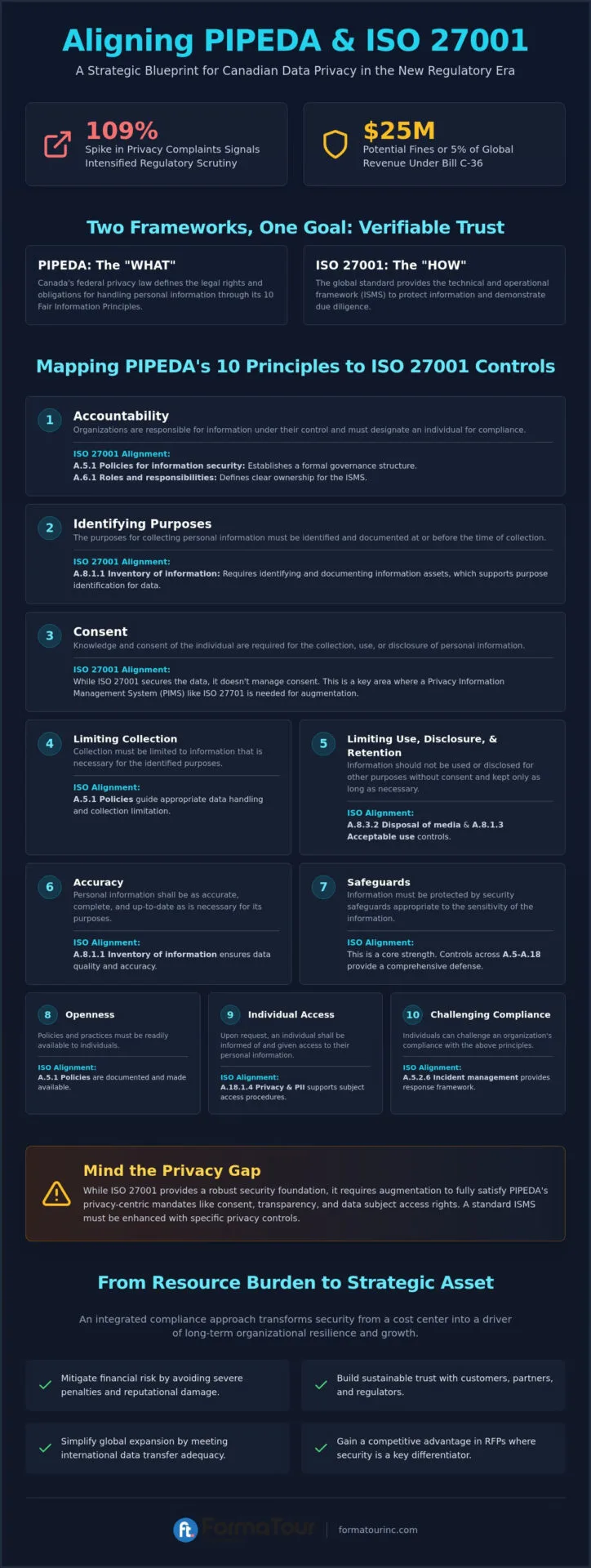
A staggering 109% spike in privacy complaints over the past year has signaled a definitive shift in the Canadian regulatory environment, making passive data protection a risk no organization can afford. As Bill C-36 introduces the Protecting Privacy and Consumer Data Act, the challenge of aligning PIPEDA compliance and ISO 27001 has moved from a technical checkbox to a core requirement for executive leadership. You’re likely navigating the friction between complex legal mandates and the practical need for robust technical controls, all while facing the prospect of administrative penalties that can now reach $25 million or 5% of global revenue.
We understand that true security isn’t just about avoiding fines; it’s about building a foundation for sustainable growth. This guide reveals how to leverage ISO 27001:2022 as the strategic engine to automate your compliance journey and fortify your organizational resilience. We’ll outline a clear integration roadmap that transforms Canadian privacy requirements into a competitive advantage, ensuring your security posture supports both local trust and global expansion in 2026.
Key Takeaways
- Understand how the 2026 regulatory landscape in Canada demands a shift from reactive privacy measures to a proactive, standards-based governance framework.
- Learn how to bridge the gap between legal requirements and technical execution by mapping PIPEDA compliance and ISO 27001 Annex A controls to the ten Fair Information Principles.
- Identify the specific “Privacy Gaps” where standard security protocols require targeted augmentation to satisfy Canadian-specific data transparency and accountability mandates.
- Gain a streamlined implementation roadmap designed to integrate privacy assessments directly into your Information Security Management System for maximum efficiency.
- Discover how a boutique advisory approach transforms compliance from a resource burden into a strategic asset for long-term global organizational resilience.
The Convergence of PIPEDA Compliance and ISO 27001 in 2026
The Canadian regulatory environment has reached a critical inflection point where data protection is no longer a discretionary operational expense. The Personal Information Protection and Electronic Documents Act (PIPEDA) stands as the primary federal legislation governing how private sector organizations handle data. In the 2026 digital economy, achieving PIPEDA compliance and ISO 27001 certification is the most effective way to demonstrate a commitment to both legal duty and technical excellence. While PIPEDA defines the “what” of privacy rights, ISO 27001 provides the “how” through a globally recognized Information Security Management System (ISMS). These two frameworks function as two sides of the same coin; one ensures the legal right to privacy, while the other provides the technical security necessary to protect that right.
Pressure from the Office of the Privacy Commissioner (OPC) is intensifying. With a recorded 109% increase in complaints during the 2025-2026 fiscal year, the OPC has pivoted from a model of voluntary compliance toward rigorous enforcement. The introduction of Bill C-36 and the Protecting Privacy and Consumer Data Act (PPCDA) underscores this shift, bringing potential fines of up to $25 million for serious offenses. Organizations can’t rely on fragmented security policies anymore. They need a unified architecture that scales with evolving threats and legislative updates to protect their reputation and their bottom line.
Who Must Comply with PIPEDA?
The Strategic Value of ISO 27001 for Canadian Firms
Implementing an ISMS isn’t just about avoiding penalties. It’s a powerful differentiator in the global marketplace. International partners and enterprise clients increasingly demand ISO 27001 certification during RFP processes to verify a vendor’s security maturity. By aligning your operations with this international standard, you simplify the path toward “adequacy” status for global data transfers, particularly when dealing with jurisdictions like the European Union. This alignment transforms security from a technical hurdle into a driver of operational performance. It signals to stakeholders that your organization possesses the structural integrity to handle sensitive information with precision and care.
Mapping ISO 27001 Controls to PIPEDA’s 10 Fair Information Principles
The true value of PIPEDA compliance and ISO 27001 integration lies in the structural alignment of legal principles with operational controls. While the Office of the Privacy Commissioner of Canada outlines what organizations must achieve through its ten Fair Information Principles, ISO 27001 provides the rigorous methodology to execute those requirements. This mapping transforms abstract legal mandates into a concrete set of 93 controls found in Annex A of the 2022 standard. By adopting this framework, firms move beyond a “best efforts” approach toward a verifiable system of governance that satisfies both Canadian regulators and international partners.
The Safeguards principle serves as the technical heart of privacy protection in 2026, ensuring that theoretical rights are translated into resilient, physical, and digital barriers against unauthorized access. ISO 27001 utilizes a risk-based approach that directly mirrors PIPEDA’s requirement for “appropriate” safeguards. Instead of implementing generic security measures, organizations perform a formal risk assessment to identify specific threats to personal information. This alignment ensures that the level of protection is always proportional to the sensitivity of the data being handled, which is a core expectation of Canadian privacy law.
Principle 1: Accountability and the ISO Leadership Clause
PIPEDA Principle 1 requires an organization to be responsible for all personal information under its control, including data transferred to third parties. This mandate finds its perfect operational counterpart in ISO 27001 Clause 5, which focuses on Leadership and Commitment. A compliant ISMS requires the designation of clear roles and responsibilities. This typically involves appointing a Privacy Officer who works in tandem with an ISMS Management Representative. Together, they ensure that privacy objectives are integrated into the organization’s broader strategic goals. The documentation required by ISO 27001, such as the Statement of Applicability and various policy records, provides the definitive audit trail necessary to prove accountability during an OPC investigation.
Principle 7: Safeguards and ISO Annex A Controls
The most significant overlap between the two frameworks occurs within the technical and organizational safeguards. ISO 27001:2022 organizes its controls into four distinct themes: Organizational, People, Physical, and Technological. This structure allows firms to address modern threats like AI-driven social engineering and cloud-native vulnerabilities with precision. Key controls such as encryption (A.8.24), access control (A.8.3), and logging (A.8.15) provide the specific technical measures that satisfy Principle 7. For organizations seeking a precise evaluation of these technical overlaps, a professional consultation on ISMS readiness can clarify the path forward. These controls ensure that personal information is protected against loss, theft, and unauthorized modification throughout its entire lifecycle.
The Privacy Gap: Where ISO 27001 Needs PIPEDA Augmentation
It’s a common operational pitfall to assume that a robust security perimeter satisfies every privacy mandate. While ISO 27001 excels at ensuring the confidentiality, integrity, and availability of data, it doesn’t inherently address the ethical and legal rights of the individual. Security is the shield; privacy is the set of rules governing who gets to stand behind it and why. Achieving PIPEDA compliance and ISO 27001 certification requires acknowledging this distinction. A system can be perfectly encrypted and yet remain non-compliant if it collects information without valid consent or keeps it longer than any reasonable business purpose justifies.
To bridge this structural gap, organizations often integrate ISO 27701. This extension transforms a standard Information Security Management System (ISMS) into a Privacy Information Management System (PIMS). It introduces specific requirements for data controllers and processors that align more closely with PIPEDA’s focus on “Purpose Limitation” and “Consent.” Without these additions, an organization might have world-class firewalls but still face heavy penalties for failing to disclose exactly how a user’s data is being utilized in the 2026 digital economy.
Consent, Limiting Collection, and Purpose Identification
ISO 27001 focuses on protecting data assets regardless of their origin. PIPEDA Principle 3 (Consent) demands that organizations obtain explicit or implied agreement before processing begins. You must integrate these consent workflows directly into your ISMS service design. This involves operationalizing “Limiting Collection” to ensure you only ingest the minimum data footprint required. While ISO Risk Assessments identify threats, Privacy Impact Assessments (PIAs) are necessary to evaluate how these data collection practices affect individual rights. Combining these two assessments creates a holistic view of both security and privacy risks.
Individual Access and Challenging Compliance
A significant gap exists regarding individual agency. PIPEDA Principle 9 grants individuals the right to access their personal information and challenge its accuracy. Your ISMS needs the infrastructure to handle “Subject Access Requests” (SARs) within the mandated 30-day window. This requires clear data mapping to locate specific records quickly. Additionally, Principle 10 (Challenging Compliance) aligns with ISO’s internal audit requirements but adds a layer of public accountability. Your internal audits shouldn’t just check if controls are working; they must verify that individuals have a clear, accessible path to rectify their data or file a formal complaint.
A Roadmap for Integrated Compliance and Certification
Achieving PIPEDA compliance and ISO 27001 certification requires a methodical approach that synchronizes legal obligations with technical security. It isn’t enough to simply layer one framework on top of the other. You need a unified roadmap that treats privacy and security as a single strategic objective. This integration minimizes operational friction and ensures that your organization remains resilient against the heightened regulatory scrutiny of 2026.
- Step 1: Combined Gap Analysis. Begin with a holistic assessment that identifies where existing security controls meet privacy principles and where specific PIPEDA requirements remain unaddressed.
- Step 2: Define ISMS Scope. Extend the boundaries of your management system to encompass every repository of personal data, ensuring no regulatory blind spots remain.
- Step 3: Integrated Policy Development. Draft procedures that satisfy both the technical rigor of ISO 27001 and the transparency requirements of Canadian law.
- Step 4: Training and Awareness. Foster a culture of “Privacy by Design” by educating staff on their specific roles in protecting individual rights.
- Step 5: Audit and Review. Execute internal audits that test both the effectiveness of technical controls and the organization’s adherence to privacy promises.
Designing Integrated Policies and Procedures
Your documentation should serve as a practical guide for daily operations rather than a static shelf-filler. A unified Incident Response Plan is essential; it must incorporate specific PIPEDA breach notification rules, such as the requirement to report “real risk of significant harm” to the OPC. Similarly, your data retention schedules must align with the principle of limiting use and disclosure, ensuring information is securely destroyed once its purpose is fulfilled. For a deeper look at structuring these systems, explore our ISO 27001 Implementation Services.
The Role of Executive Leadership in Compliance Success
Strategic transformation starts with a clear tone-at-the-top. Leadership must view compliance not as a burden, but as a pillar of organizational performance and global trust. This involves allocating resources for long-term resilience rather than seeking short-term fixes. When executives champion these standards, it signals to international partners that the firm is a reliable global citizen. To strengthen this visionary approach, consider our Leadership Training for Digital Transformation. If you’re ready to align your governance with international benchmarks, our team provides expert advisory on integrated compliance to guide your journey.
Driving Strategic Resilience with Formatour Incorporated
Successfully navigating the intersection of PIPEDA compliance and ISO 27001 requires more than a technical checklist; it demands a sophisticated advisory partner capable of aligning governance with growth. Formatour Incorporated provides a premium advisory framework that transcends basic certification. We operate on the principle of “Boutique Agility, Big-Firm Standards,” ensuring that every organization receives high-level, expert-led guidance without the rigid constraints of traditional large-scale firms. Our role is to act as a seasoned strategic mentor, guiding your leadership through the complexities of the Canadian regulatory landscape while building a foundation for international expansion.
We position compliance as a definitive catalyst for digital transformation and process optimization. By integrating rigorous security standards into your daily operations, we help you identify inefficiencies and automate workflows that traditionally drain resources. This approach transforms a legal obligation into an operational engine. When security and privacy are woven into the fabric of your organizational architecture, you don’t just avoid penalties; you enhance your overall performance and build unwavering trust with stakeholders in the 2026 digital economy.
Our Multidisciplinary Advisory Approach
Our methodology is multidisciplinary by design, combining technical auditing precision with executive leadership development. We recognize that an Information Security Management System (ISMS) is only as effective as the culture that supports it. Our team develops customized roadmaps that address the specific nuances of Canadian privacy laws while maintaining alignment with global benchmarks. We ensure your ISMS remains a living system that evolves alongside emerging threats and legislative shifts. This comprehensive strategy ensures that your investment in compliance drives tangible value, fostering an environment where technological advancement and human capital work in perfect synchronization.
Beyond Certification: Sustaining a Resilient Organization
True organizational resilience is a continuous journey rather than a destination. Beyond the initial certification, we assist firms in integrating their security frameworks with ISO 9001 for quality management and ISO 22301 for business continuity. This holistic ecosystem ensures that your organization remains stable and productive even during significant market disruptions. Our commitment to your long-term success includes access to international seminars and specialized studies, providing your team with the strategic foresight required to lead in a competitive global market. To begin your journey toward a secure and optimized future, Partner with Formatour for Strategic Compliance and transform your regulatory posture into a pillar of excellence.
Future-Proofing Your Organization for the 2026 Regulatory Shift
The transition to more rigorous privacy standards in 2026 offers a unique opportunity to refine your internal processes and strengthen stakeholder trust. Integrating PIPEDA compliance and ISO 27001 creates a unified governance model that addresses both technical vulnerabilities and legal obligations with precision. This approach doesn’t just shield you from escalating penalties; it transforms your security posture into a competitive advantage that facilitates international expansion. By treating privacy as a strategic pillar, you ensure your organization is prepared for the complexities of a data-driven global market.
Formatour Incorporated provides the steady, expert hand needed to guide your organization through this complex landscape. As a Canadian-based multidisciplinary advisory, we focus on strategic transformation and organizational resilience through comprehensive ISO implementation and auditing services. We help you move beyond static certification toward a dynamic system that empowers your team and optimizes your operations. Our expertise ensures that your compliance journey supports long-term growth and operational excellence.
The most resilient organizations are those that act today to secure their future. Secure Your Organization with Formatour’s ISO 27001 Advisory and take the first step toward a more robust, compliant, and growth-oriented future. You have the potential to lead with confidence in the evolving digital economy.
Frequently Asked Questions
Does ISO 27001 cover all PIPEDA requirements?
ISO 27001 doesn’t cover every requirement because it focuses primarily on information security rather than broad privacy rights. While the standard provides a robust framework for technical and organizational safeguards, it doesn’t inherently address principles such as obtaining valid consent or providing individuals with a right to access their data. Organizations must augment their management system with specific privacy controls to achieve full PIPEDA compliance and ISO 27001 alignment.
What are the penalties for PIPEDA non-compliance in 2026?
Penalties have increased dramatically under the 2026 legislative updates, with tier-two offenses reaching the greater of $25 million or 5% of gross global revenue. The Protecting Privacy and Consumer Data Act (PPCDA) introduced these administrative monetary penalties to compel stricter adherence. Even under the legacy PIPEDA framework, statutory penalties remain at $100,000 per offense, making the financial risk of a data breach more significant than ever for Canadian businesses.
How long does it take for a Canadian firm to achieve ISO 27001 certification?
Achieving ISO 27001 certification typically requires a timeframe of six to twelve months for most Canadian organizations. This duration depends heavily on the firm’s current security maturity, the complexity of its operations, and the availability of internal resources. A methodical implementation involves conducting a gap analysis, developing necessary documentation, and performing an internal audit before the final certification body assesses the management system for compliance.
Do I need to be ISO 27001 certified to be PIPEDA compliant?
Certification isn’t a legal prerequisite for compliance, but it serves as definitive evidence of your organization’s commitment to data protection. PIPEDA requires firms to implement “appropriate safeguards” relative to the sensitivity of the information they hold. An ISO 27001 certification provides a globally recognized benchmark that proves to the Office of the Privacy Commissioner and international partners that your security controls meet high international standards.
What is the difference between PIPEDA and the new CPPA/Bill C-27?
The Protecting Privacy and Consumer Data Act (PPCDA) introduced in June 2026 represents a significant modernization of the legacy PIPEDA framework. While PIPEDA established the initial ten fair information principles, the new legislation introduces a dedicated Digital Safety and Data Protection Commission and significantly higher financial penalties. It aligns Canadian law more closely with international standards like the GDPR, emphasizing individual agency and more rigorous enforcement mechanisms for the private sector.
Can ISO 27001 help with provincial privacy laws like BC PIPA or Alberta PIPA?
ISO 27001 provides a comprehensive security foundation that effectively satisfies the safeguard requirements of provincial laws like BC PIPA and Alberta PIPA. These provincial acts share similar objectives with federal law, requiring organizations to protect personal information from unauthorized access or disclosure. By implementing an international standard, firms establish a high watermark of security that simplifies compliance across multiple jurisdictions within Canada and supports seamless inter-provincial commerce.
How much does ISO 27001 implementation cost for a Canadian SME?
Implementation costs vary significantly based on the size of the organization and the complexity of its information systems. Factors such as the number of employees, the volume of personal data processed, and the existing technical infrastructure all influence the total investment required. Organizations should view these costs as a strategic investment in organizational resilience, as a robust security posture often leads to improved operational efficiency and reduced long-term risk.
What is the role of a Privacy Officer in an ISO 27001 framework?
The Privacy Officer acts as the strategic bridge between legal mandates and the technical controls within an ISO 27001 framework. They ensure that the Information Security Management System specifically addresses the lifecycle of personal information, from collection through to secure destruction. By collaborating with the ISMS management representative, the Privacy Officer ensures that PIPEDA compliance and ISO 27001 objectives are integrated into the organization’s broader governance and digital transformation goals.
