

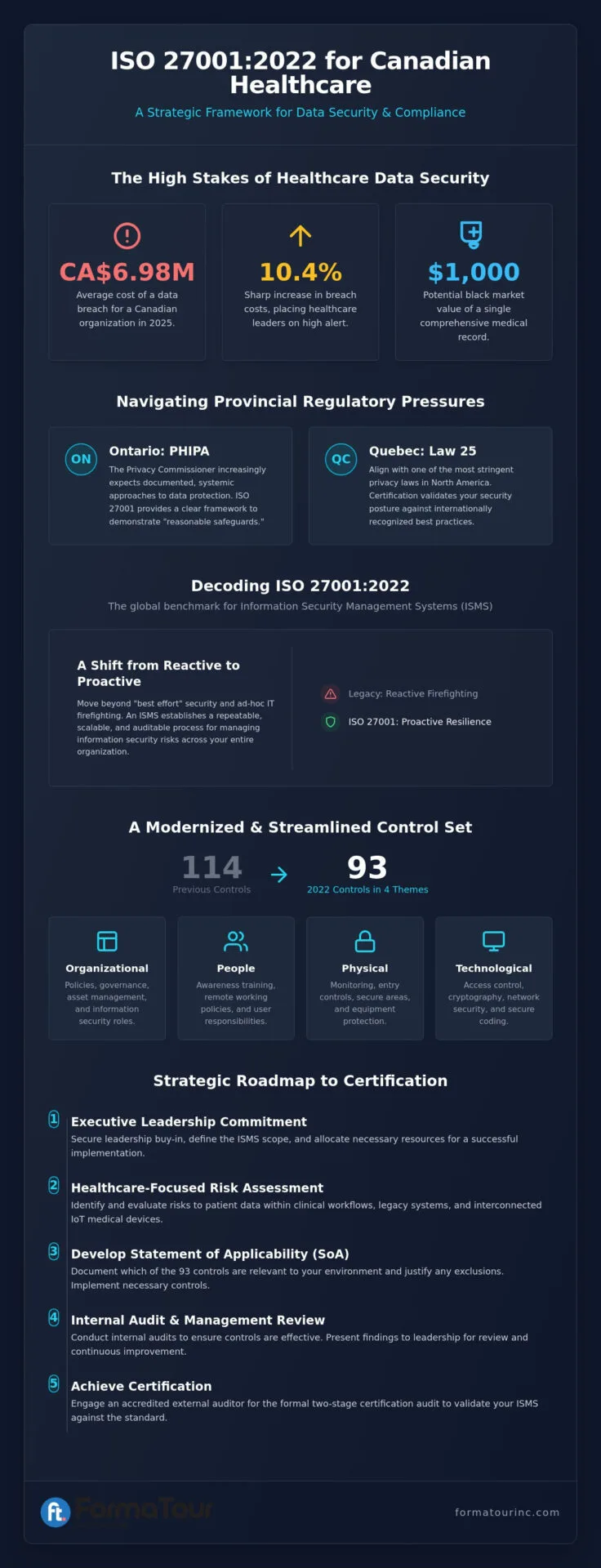
In 2025, the average cost of a data breach for a Canadian organization reached CA$6.98 million, reflecting a sharp 10.4 percent increase that places healthcare leaders on high alert. Within this high-stakes environment, implementing ISO 27001 for healthcare providers in Canada has evolved from a technical option into a critical pillar of strategic governance. You’re likely already feeling the pressure of defending against sophisticated ransomware while attempting to align with the intricate requirements of PHIPA in Ontario or Law 25 in Quebec. It’s a complex landscape where internal resources for high-level auditing are often stretched thin.
This guide serves as your strategic mentor, illustrating how the ISO 27001:2022 standard provides a definitive framework to secure patient data and ensure multi-jurisdictional compliance. You’ll discover how to transition from reactive security measures to a proactive, scalable Information Security Management System that builds demonstrable trust with patients and partners. We’ll provide a clear roadmap to international certification, helping you transform security from an operational burden into a foundation for organizational resilience and growth.
Key Takeaways
- Recognize the strategic importance of securing clinical data against the rising frequency of ransomware attacks within the Canadian healthcare sector.
- Learn how implementing ISO 27001 for healthcare providers in Canada creates a scalable framework that meets the rigorous demands of the 2022 standard update.
- Discover how to map international security controls to specific provincial mandates, including PHIPA in Ontario and Law 25 in Quebec.
- Identify the essential phases of the certification roadmap, beginning with executive leadership commitment and a healthcare-focused risk assessment.
- Understand the value of a collaborative advisory model that pairs international benchmarks with the agility required for modern clinical environments.
The Information Security Challenge for Canadian Healthcare Providers
Canadian healthcare facilities aren’t just providers of care; they’re custodians of some of the world’s most lucrative digital assets. Cybersecurity researchers report that medical records can sell for as much as $1,000 per person on the black market. This high valuation explains why the sector remains the primary target for ransomware operators. When a breach occurs, the impact extends far beyond the average CA$6.98 million financial loss. It erodes patient trust and disrupts clinical workflows, potentially compromising patient safety. Adopting ISO 27001 for healthcare providers in Canada with a strategic partner like Formatour Incorporated represents a shift from reactive IT firefighting to a robust, proactive Information Security Management System (ISMS).
Organizations must move past “best effort” security. A structured framework like ISO/IEC 27001 provides an international benchmark that validates security posture within a complex, localized regulatory environment. This strategic alignment ensures that clinical excellence is matched by data integrity. It transforms security into a competitive advantage rather than a mere compliance checkbox, allowing leadership to focus on growth and patient outcomes with quiet confidence.
Provincial Regulatory Pressures: PHIPA, PIPA, and Beyond
Healthcare providers operate within a complex patchwork of Canadian health privacy legislation. From Ontario’s PHIPA to Quebec’s stringent Law 25, the legal standard of care has shifted significantly. “Reasonable safeguards” are now interpreted through the lens of established international standards. The Information and Privacy Commissioner (IPC) increasingly looks for documented, systemic approaches to data protection during security audits. Without a certified ISMS, demonstrating compliance becomes a fragmented and resource-intensive task that often fails to meet modern legal expectations.
Operational Risks of Legacy Systems in Modern Healthcare
The gap between clinical workflows and data protection is often widened by legacy infrastructure. Modern healthcare relies on interconnected medical devices and IoT systems that were never designed with current threat levels in mind. Balancing immediate patient data accessibility with stringent security controls is a delicate operation. ISO 27001 for healthcare providers in Canada helps bridge this gap by identifying vulnerabilities in these interconnected systems. It provides a structured method to manage risks without hindering the delivery of essential medical services, ensuring organizational resilience in an era of digital transformation.
Decoding ISO 27001:2022: A Framework for Clinical Excellence
ISO/IEC 27001:2022 stands as the definitive global benchmark for Information Security Management Systems (ISMS). For clinical leaders, it provides a structured methodology to identify, manage, and mitigate risks across the entire patient data lifecycle. The 2022 update introduced a more streamlined control set, shifting from the previous 114 controls to 93 controls categorized into four intuitive themes: Organizational, People, Physical, and Technological. This reorganization allows for a more holistic approach to security that aligns seamlessly with modern clinical operations and digital workflows.
Implementing ISO 27001 for healthcare providers in Canada ensures that risk management isn’t a one-time event but a repeatable, scalable process. Central to this framework is the Statement of Applicability (SoA). The SoA acts as a strategic roadmap, documenting which controls are relevant to your specific clinical environment and how they’re implemented. This transparency is vital for building trust with provincial health authorities and patients alike. By following the Canadian Institute for Health Information’s security practices, organizations can see how international standards are operationalized to protect personal health information at scale across the country.
The ISMS as a Strategic Clinical Asset
A mature ISMS elevates information security from the server room to the boardroom. It supports digital transformation by providing a stable foundation for the adoption of cloud-based electronic health records and telehealth platforms. When security is integrated into the patient journey, it becomes an enabler of care rather than a barrier. This strategic alignment helps hospitals and clinics maintain operational continuity even during peak demand or external threats, ensuring that patient safety remains the top priority.
Key ISO 27001 Controls for Patient Data Protection
- Access Control: Precisely managing permissions for clinicians, administrative staff, and third-party vendors to ensure data is only accessible on a “need-to-know” basis.
- Cryptography: Implementing robust data masking and encryption for electronic health records (EHR) to protect data both at rest and in transit.
- Incident Management: Establishing clear protocols for responding to outages or breaches, ensuring that clinical services can be restored with minimal disruption to patient care.
As you look to refine your security posture, engaging with a strategic advisor can help you navigate the nuances of the 2022 control structure while tailoring the framework to your unique operational needs.
Aligning ISO 27001 with Canadian Health Privacy Legislation
Canadian healthcare providers operate within a fragmented legal environment where provincial mandates frequently overlap with federal requirements. Implementing ISO 27001 for healthcare providers in Canada offers a unified method to bridge these gaps effectively. By mapping the controls in Annex A to specific requirements in Ontario’s Personal Health Information Protection Act (PHIPA), organizations demonstrate that their technical and administrative safeguards meet the necessary legal thresholds. This alignment extends to Quebec’s Law 25 and British Columbia’s PIPA. The framework provides a structured response to stringent breach notification and data sovereignty demands, which is critical given that reported incidents in Quebec have increased by 559 percent over the past three years.
The synergy between an ISO-based risk assessment and a Health Privacy Impact Assessment (PIA) provides a powerful advantage. While a PIA focuses on privacy risks for specific projects, the ISO framework offers the overarching governance that ensures those risks are managed consistently across the enterprise. This comprehensive approach to ISO 27001 for healthcare providers in Canada also satisfies federal requirements under the Personal Information Protection and Electronic Documents Act (PIPEDA). It’s an essential strategy for providers operating across borders or engaging in commercial activities that fall under federal oversight.
From Compliance to Patient Trust
Achieving certification is a clear signal of due diligence to patients, partners, and provincial regulators. It transforms security from a hidden operational cost into a visible clinical asset. For many providers, this status significantly accelerates procurement processes with provincial health authorities. These authorities often require rigorous, third-party proof of security posture before finalizing contracts. Being an ISO-certified healthcare provider offers a distinct marketing advantage. It provides tangible evidence that patient confidentiality is a foundational organizational value rather than a secondary concern.
Streamlining Multi-Provincial Operations
Managing diverse regulatory demands across different provinces often creates an overwhelming administrative burden. A single, robust ISMS allows organizations to centralize their security governance while addressing localized nuances through specific control applications. This unified framework reduces the audit burden by providing a single source of truth for all security practices. It also future-proofs the organization against evolving legislation, such as the proposed reforms in Bill C-36. By establishing a flexible system, providers can adapt to new digital safety and data protection standards as they emerge without rebuilding their entire security program.
A Strategic Roadmap to ISO 27001 Certification for Providers
Achieving ISO 27001 for healthcare providers in Canada begins with a clear, unwavering commitment from executive leadership. This isn’t merely a technical project for the IT department. It’s a fundamental shift in how the organization values and protects its digital assets. Leaders must first define the scope of the Information Security Management System (ISMS), ensuring it encompasses all critical clinical and administrative touchpoints that handle sensitive patient data.
Once the foundation is set, the process follows a logical and highly structured progression:
- Step 2: Conduct a healthcare-specific gap analysis and risk assessment to pinpoint exactly where current practices fall short of the 2022 standard.
- Step 3: Develop the necessary policies, procedures, and technical controls, such as implementing phishing-resistant multi-factor authentication.
- Step 4: Perform an internal audit and management review to verify the system’s effectiveness and ensure full readiness for external scrutiny.
- Step 5: Engage an accredited external body for the formal certification audit, followed by a permanent commitment to the continuous improvement cycle.
The Healthcare Gap Analysis: Identifying Vulnerabilities
A thorough gap analysis examines the complex data flows between clinics, diagnostic labs, and community pharmacies. In many Canadian settings, “shadow IT” creates significant risk when clinical departments adopt unsanctioned applications to solve immediate workflow issues. Evaluating third-party risk is equally vital, especially as more providers rely on cloud-based healthcare SaaS platforms for patient management. Mapping these dependencies is essential for building a truly resilient infrastructure that protects the entire clinical ecosystem.
Training and Cultural Transformation in Medical Settings
The most robust technical controls can fail without a supportive organizational culture. Empowering clinical staff through ISO 27001 lead auditor training or specialized awareness programs transforms employees from potential vulnerabilities into active defenders. Overcoming resistance requires demonstrating that security doesn’t disrupt patient care; it protects the integrity of the medical mission. A “security-first” mindset across a multidisciplinary team ensures that data protection becomes a natural, seamless part of the clinical lifecycle.
If you’re ready to begin your journey toward a more secure clinical environment, our team is here to guide your certification roadmap and ensure your organization’s long-term resilience.
Formatour Incorporated: Elevating Healthcare Security and Resilience
Formatour Incorporated serves as a premium advisory partner for organizations navigating the complexities of ISO 27001 for healthcare providers in Canada. We provide more than just a compliance checklist; we act as a strategic mentor for clinical leaders. Our model combines the rigorous benchmarks of a global consultancy with the boutique agility required to address localized Canadian challenges. This duality ensures that your security framework is both robust and adaptable to your specific clinical environment, fostering a culture of quiet confidence and reliability.
We recognize that information security is inseparable from broader organizational health. Our experts support your overarching digital transformation strategy, ensuring that technological growth doesn’t outpace your defensive capabilities. Additionally, we provide integrated solutions for ISO 22301 business continuity. This holistic approach ensures that Canadian healthcare providers can maintain essential services during unforeseen disruptions, reinforcing the resilience of the entire care network through strategic foresight and operational optimization.
A Partner in Strategic Transformation
We focus on the co-development of solutions rather than off-the-shelf implementation. By leveraging executive leadership development, we empower your team to drive long-term growth and structural integrity. Your Information Security Management System (ISMS) shouldn’t be a static document. It must evolve alongside the shifting Canadian healthcare landscape, from new provincial privacy laws to emerging digital health trends. We ensure your system remains a living clinical asset that adapts to the needs of a modern, data-driven provider.
Start Your Resilience Journey
Engaging with Formatour Incorporated begins with a preliminary ISO readiness assessment. This initial step provides a clear view of your current posture and a roadmap for the multidisciplinary advisory required in complex healthcare projects. Our Canadian experts are available for confidential consultations to discuss your unique needs. We help you build a foundation of trust that resonates with patients and provincial partners alike, guiding you through every facet of ISO 27001 for healthcare providers in Canada with precision and intelligence.
Securing the Future of Canadian Clinical Excellence
Adopting a proactive security posture ensures that clinical excellence is never undermined by digital vulnerability. By integrating ISO 27001 for healthcare providers in Canada, your organization establishes a repeatable governance framework that simplifies provincial compliance and secures the patient journey. This isn’t just about passing an audit; it’s about building a culture where data integrity is as fundamental to your mission as the medical care you provide. You’ve seen how a mature ISMS provides the structural integrity needed to navigate a complex regulatory landscape with confidence.
Formatour Incorporated acts as your strategic mentor through this vital transition. As a premium Canadian multidisciplinary advisory firm, we bring deep expertise in strategic healthcare transformation and comprehensive ISO implementation and auditing to every partnership. Secure your healthcare operations with Formatour’s ISO 27001 advisory services to ensure your organization remains resilient, compliant, and ready for the future of digital health. We’re here to help you co-develop a security system that empowers your team and protects your patients for years to come.
Frequently Asked Questions
Is ISO 27001 mandatory for healthcare providers in Canada?
ISO 27001 isn’t currently a mandatory legal requirement for healthcare providers in Canada under provincial or federal statutes. However, it’s becoming a standard expectation during procurement processes with provincial health authorities and digital health partners. Many organizations choose to pursue certification to demonstrate they’ve implemented “reasonable safeguards” as required by provincial privacy laws. It serves as a definitive framework that builds trust with patients while providing a clear competitive advantage in the clinical sector.
How does ISO 27001 differ from a Privacy Impact Assessment (PIA)?
A Privacy Impact Assessment (PIA) is a project-specific tool used to identify and mitigate privacy risks associated with a specific system or program. In contrast, implementing ISO 27001 for healthcare providers in Canada establishes a comprehensive, enterprise-wide management system. While a PIA focuses on the “what” of privacy, the ISO framework provides the “how” of security. This ensures that privacy protections are sustained through consistent governance and technical controls across the entire organization.
Can a small medical clinic achieve ISO 27001 certification?
How long does it take for a Canadian healthcare organization to get certified?
Most Canadian healthcare organizations complete the certification process within 6 to 12 months. This timeline varies based on your current security maturity and the complexity of your clinical systems. Smaller clinics might move faster, while large hospitals with extensive legacy infrastructure often require a more measured approach. Working with a strategic mentor ensures that each phase of the implementation is handled efficiently without disrupting patient care or essential medical workflows.
Does ISO 27001 compliance satisfy PHIPA requirements in Ontario?
ISO 27001 provides the technical and administrative framework needed to meet the “reasonable safeguards” requirement of PHIPA. While certification doesn’t grant automatic legal immunity, it serves as powerful evidence of due diligence during an audit by the Information and Privacy Commissioner. It aligns your security practices with international benchmarks, making it much easier to demonstrate that your clinic protects personal health information according to Ontario’s legal standards and expectations.
What are the main costs associated with ISO 27001 for healthcare?
Can ISO 27001 help protect against healthcare ransomware attacks?
ISO 27001 provides a multi-layered defense that significantly reduces the risk of successful ransomware attacks. By implementing controls for incident management, regular backups, and phishing-resistant multi-factor authentication, providers can detect and contain threats early. The framework’s emphasis on continuous monitoring ensures that vulnerabilities are addressed before they’re exploited. This proactive approach is essential for maintaining clinical continuity and protecting sensitive medical records from unauthorized encryption or theft.
How does ISO 27001 support medical device security?
The framework supports medical device security by incorporating Internet of Things (IoT) and operational technology into the ISMS scope. Implementing ISO 27001 for healthcare providers in Canada requires rigorous asset management and access controls for all connected devices. This ensures that ventilators, infusion pumps, and imaging systems are protected from unauthorized access. By treating medical devices as critical information assets, providers can mitigate the risks associated with increasingly interconnected clinical infrastructure.
