

A security framework should never be a static checklist that gathers dust on a shelf; it is the architectural blueprint for a resilient, high-performance organization. With the global average cost of a data breach reaching $4.44 million, the stakes for your governance strategy have never been higher. You have likely felt the tension of trying to map complex technical requirements to your primary business goals while fearing that a single oversight might lead to a failed audit. It is a common challenge to find the transition to the 2022 standard more complex than it needs to be.
This guide provides the clarity you require by having the ISO 27001 Annex A controls explained through a strategic lens. You will gain the insights necessary to master the 93 modernized controls and implement them in a way that empowers your team rather than slowing them down. We will examine the four new thematic pillars, break down the 11 latest control additions, and provide a clear roadmap for a successful certification that aligns perfectly with your operational excellence. By the end of this article, you’ll see how these controls serve as a foundation for sustainable growth and a more secure corporate future.
Key Takeaways
- Understand the strategic shift from 114 to 93 safeguards with the ISO 27001 Annex A controls explained for modern executive leadership.
- Categorize security efforts across the four new thematic pillars to create a comprehensive and logical governance framework.
- Master the risk assessment process to develop a Statement of Applicability that reflects your organization’s specific operational needs.
- Align technical requirements with organizational resilience to transform compliance into a tangible competitive advantage.
- Discover how a multidisciplinary advisory approach ensures your security roadmap supports long-term digital transformation.
Decoding ISO 27001 Annex A: The Strategic Foundation of Security
Annex A serves as the tactical toolkit for managing information security risks within a modern organization. While Clauses 4 through 10 of the standard define the mandatory requirements for establishing and maintaining the Information Security Management System (ISMS), Annex A offers the specific safeguards needed to treat identified vulnerabilities. Having the ISO 27001 Annex A controls explained through this strategic lens helps executives understand that these measures are not arbitrary. They represent the practical application of the high-level security goals set by leadership. Without this connection, an ISMS remains a theoretical framework rather than a functioning defense mechanism.
These controls directly support the “CIA triad,” which focuses on Confidentiality, Integrity, and Availability. By selecting a precise mix of safeguards, an organization ensures that sensitive data remains private, accurate, and accessible only to authorized users. This alignment transforms a technical standard into a protective shield for the organization’s most valuable digital assets. For a broader perspective on the standard’s history and global structure, this ISO/IEC 27001 overview details how the framework has evolved to meet complex security demands. At Formatour Inc., we view this alignment as the first step in a broader journey toward strategic transformation and operational resilience.
The 2022 Update: Themes vs. Domains
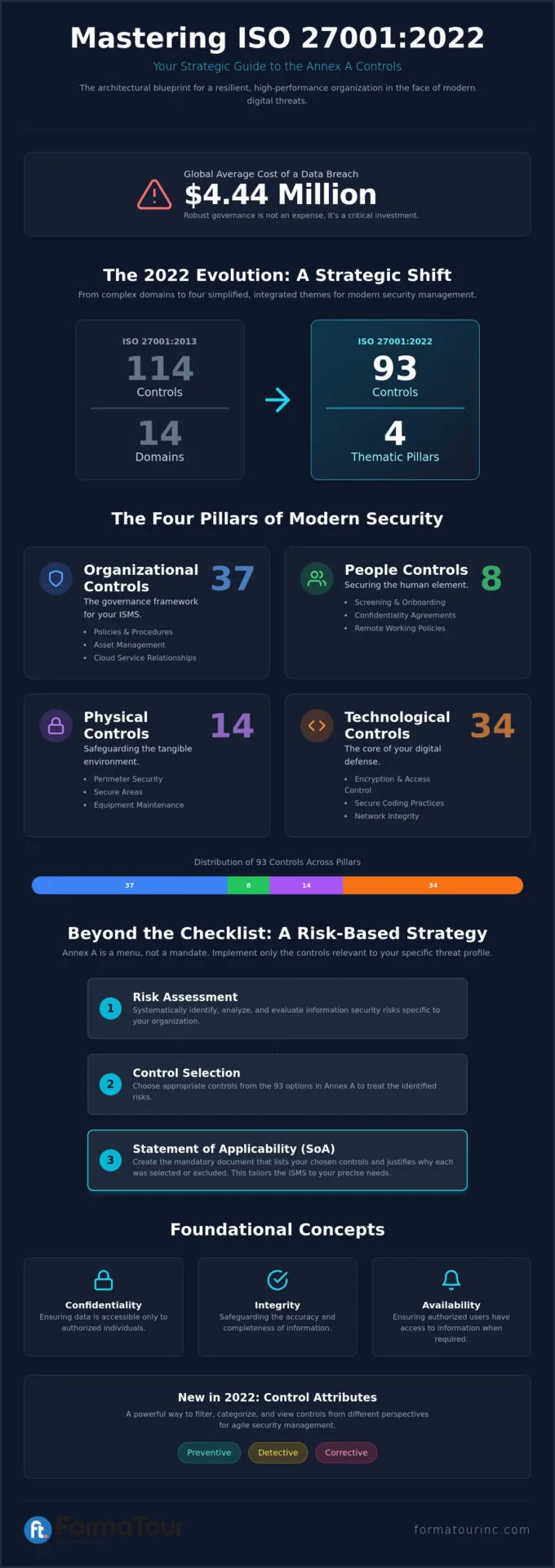
The transition to the ISO/IEC 27001:2022 version introduced a significant structural refinement that favors executive oversight. The previous 14 domains were condensed into four simplified themes: Organizational, People, Physical, and Technological. This consolidation reduces administrative complexity and encourages a more integrated approach to security management across different business units. A vital addition is the concept of “Attributes,” which allows teams to filter and categorize controls based on specific operational needs, such as “Preventive,” “Detective,” or “Corrective” functions. This evolution reflects a shift toward a more agile, modern security posture that prioritizes efficiency alongside protection.
Why Annex A is Not a Mandatory Checklist
Certification does not require the implementation of all 93 controls. Instead, the standard mandates a risk-based approach where leadership selects only the safeguards relevant to their specific threat profile. Over-implementing controls can create unnecessary friction, slowing down operational performance and inflating costs without providing meaningful protection. The selection process culminates in the Statement of Applicability (SoA), a document that justifies why certain controls were chosen and why others were excluded based on the organization’s unique risk appetite. Annex A serves as a globally recognized benchmark for selecting proportionate safeguards that balance rigorous security with the need for business agility.
The Four Pillars of Modern Security: Navigating the 93 Controls
The ISO/IEC 27001:2022 standard organizes its 93 controls into four distinct themes. This structural shift moves away from technical silos toward a holistic governance model. Having the ISO 27001 Annex A controls explained as strategic pillars allows executives to allocate resources more effectively across the entire organization. These themes are not merely categories; they represent the functional areas where security must be integrated to ensure long-term resilience.
- Organizational Controls (37): These address the governance framework, including policies, asset management, and cloud service relationships.
- People Controls (8): These focus on the human element, covering screening, confidentiality agreements, and remote working.
- Physical Controls (14): These safeguard the tangible environment, from perimeter security to facility safety.
- Technological Controls (34): These provide the digital defense, involving encryption, secure coding, and network integrity.
Organizational and People Controls: Building a Security Culture
Building a security culture requires more than technical settings; it demands active engagement from every team member. People controls act as the critical link between human capital and digital safety. Instead of relying on generic policy templates, organizations should develop strategic documentation that reflects their unique operational reality. Integrating these safeguards with executive leadership development ensures that security becomes a core value rather than a secondary compliance task. This approach empowers managers to lead by example, fostering an environment where security is naturally woven into the corporate fabric. When leadership prioritizes these organizational controls, the entire firm moves toward a more mature security posture.
Physical and Technological Controls: Protecting the Infrastructure
Protecting the infrastructure in a cloud-first world requires a sophisticated blend of physical and technological safeguards. As remote and hybrid work becomes the norm, traditional perimeter security must evolve into a decentralized model. Achieving ISO 27001 Certification serves as a testament to an organization’s ability to maintain high standards across these complex environments. Technological controls should be designed to enhance process automation, ensuring that security measures do not create bottlenecks in delivery. Additionally, the intersection of physical security and business continuity management ensures that the organization remains operational even during unforeseen disruptions. For those seeking to refine their implementation strategy, our team can help you explore tailored security solutions for your firm.
Selecting Controls Through Risk Assessment: The SoA Process
The transition from identifying risks to implementing specific safeguards is where many organizations falter. The Statement of Applicability (SoA) acts as the definitive record of this transition, serving as the most critical document within your ISMS. Having the ISO 27001 Annex A controls explained through a risk-centric lens ensures that your security posture is tailored to your unique operational profile. For Canadian businesses, this means identifying threats within the local regulatory environment while maintaining a robust framework for information security that satisfies global partners. This selection process is the core of our ISO 27001 implementation services, ensuring that every chosen control provides a tangible return on investment.
Auditors require clear, logical justifications for any excluded controls. If your organization doesn’t engage in custom software development, for instance, the controls related to secure coding may be documented as not applicable. This transparency prevents compliance bloat and focuses resources on the specific controls that truly mitigate your recognized risks. A well-justified SoA demonstrates to auditors and stakeholders that your security strategy is deliberate rather than reactive.
The Lifecycle of an Annex A Control
A control’s value is realized through a continuous lifecycle that begins with risk identification and extends through implementation to ongoing monitoring. Internal audits play a vital role in this process by verifying that each safeguard remains effective as the threat landscape shifts. This iterative approach ensures that your security measures evolve alongside your business operations. The SoA acts as a security contract with stakeholders, providing an authoritative statement of which risks the organization has chosen to address and the specific methods employed to do so.
Strategic Control Selection for Global Operations
Executives managing global operations must balance international benchmarks with local Canadian requirements, such as PIPEDA or sector-specific mandates. The 2022 update facilitates this by allowing you to use “Attributes” to categorize controls as Preventive, Detective, or Corrective. This classification helps leadership understand the functional impact of their security investments at a glance. While Annex A provides the mandatory requirements, organizations should leverage ISO 27002 for the detailed implementation guidance necessary to meet these standards. This integrated approach ensures that your security framework is both globally minded and locally compliant.
Bridging the Gap: From Technical Controls to Organizational Resilience
Technical compliance is often viewed as a destination, yet for the visionary executive, it is merely the starting line. True organizational resilience requires moving beyond the binary “pass or fail” mentality of an audit to create a culture of adaptive security. Having the ISO 27001 Annex A controls explained through this lens reveals that these safeguards are not just IT requirements; they are essential business functions. When you integrate Annex A with ISO 22301 business continuity, you create a comprehensive defense that protects your brand’s reputation and operational integrity simultaneously.
Executive governance is the catalyst that transforms a list of controls into a resilient framework. Leadership must actively oversee the ISMS to ensure it remains aligned with the firm’s strategic direction. A common pitfall occurs when organizations implement “perfect” technical controls in isolation. Without executive oversight and a focus on human factors, even the most sophisticated encryption can fail due to poor process governance or internal oversight. Resilience is built when technical measures, people, and processes operate in a synchronized, well-governed ecosystem.
Security as a Driver of Operational Performance
Security investments should be measured by their ability to drive operational performance and open new market opportunities. Robust controls significantly reduce downtime, which is critical when the average time to identify and contain a breach is 241 days. By achieving a high level of security maturity, your organization gains a competitive edge that facilitates premium global partnerships. The ROI of a resilient ISMS is found not only in the avoidance of the $4.44 million average cost of a data breach but also in the increased efficiency of your internal operations. This strategic alignment ensures that security acts as an accelerator for growth rather than a bottleneck.
Future-Proofing Your Controls for 2026 and Beyond
Modernizing your implementation strategy is essential as we move toward 2026 and the increased integration of AI and process automation. Controls must be dynamic, adapting to new technological frontiers while maintaining the core principles of the standard. Digital transformation plays a central role in this evolution, allowing for more automated monitoring and real-time risk assessment. By applying the Plan-Do-Check-Act (PDCA) cycle to your Annex A implementation, you ensure a process of continuous improvement that keeps your defenses ahead of emerging threats. If you are ready to move beyond basic compliance toward true operational strength, contact our advisory team today to begin your strategic transformation.
The Formatour Approach: Premium ISO 27001 Implementation
Formatour Inc. offers a sophisticated multidisciplinary advisory service that bridges the gap between boutique agility and big-firm standards. We recognize that having the ISO 27001 Annex A controls explained is merely the baseline; the real challenge is translating those requirements into a high-performance operational framework. Our team focuses on co-developing security solutions that respect your unique organizational culture while meeting international benchmarks. By positioning the ISMS as a strategic asset, we help you transform compliance from a perceived bureaucratic hurdle into a catalyst for trust and stability. We also prioritize team empowerment through Lead Auditor Training, ensuring your internal talent has the expertise to maintain and optimize your security posture long after the initial certification.
Our role is that of a seasoned strategic mentor. We guide you through the complexities of global standards with a steady, expert hand. This partnership ensures that your security journey is not a solitary effort but a collaborative transformation. By integrating high-level concepts into your daily operations, we foster a feeling of security and the assurance of success. Your organization gains the structural integrity needed to navigate a rapidly changing digital landscape with quiet confidence.
From Gap Analysis to Certification
Our methodical approach begins with a comprehensive gap analysis to identify exactly where your current safeguards fall short of the 2022 requirements. We work closely with your leadership to close these vulnerabilities through targeted transformations that prioritize both security and efficiency. This preparation ensures that your team enters the certification audit with unwavering confidence and a deep understanding of their roles. Sustainable compliance is our ultimate goal. We provide the tools and foresight necessary to maintain your ISO 27001 status year-over-year, evolving your controls as new technological threats emerge in the landscape of 2026.
Why Formatour is the Partner for Canadian Executives
Canadian executives require a partner who understands the specific nuances of the local business environment while maintaining a global perspective. Our deep expertise extends beyond information security into ISO 9001 quality management and other multidisciplinary standards. This broad capability allows us to view your organization as a holistic system where security, quality, and environmental management work in harmony. You receive direct access to senior advisors who specialize in strategic transformation and operational excellence. We don’t just provide a checklist; we act as a visionary architect for your organization’s resilience. Our focus remains on co-developing solutions that lead to measurable success and long-term structural integrity.
Empowering Your Organization Through Strategic Security Governance
Transitioning to the 2022 standard represents a significant shift from checking boxes to building deep structural integrity. It’s an opportunity to align your security posture with your broader business goals. We’ve examined how the four thematic pillars and the 93 modernized controls create a clear roadmap for stability and growth. Having the ISO 27001 Annex A controls explained through this executive lens allows you to move beyond technical confusion toward strategic foresight. This clarity ensures that your investments protect your reputation and your bottom line.
Formatour Inc. serves as your premium Canadian partner, bringing over a decade of experience in ISO 27001, 9001, and 22301. We specialize in strategic transformation and organizational resilience, ensuring your security framework supports sustainable operational performance. Our multidisciplinary approach focuses on co-developing solutions that empower your internal teams for long-term success. Secure your organization’s future with Formatour’s ISO 27001 advisory services and transform your compliance journey into a tangible competitive advantage. Your path to a secure, high-performance future begins with a single, deliberate step toward predictable excellence.
Frequently Asked Questions
What is the main difference between Annex A and ISO 27002?
Annex A provides the normative list of security controls required for certification, while ISO 27002 serves as a code of practice offering detailed implementation guidance. Having the ISO 27001 Annex A controls explained as a high-level requirements list helps executives understand the “what,” whereas ISO 27002 provides the technical “how” for your teams. While Annex A is a brief summary found within the ISO 27001 standard, ISO 27002 expands on each control with practical examples and best practices.
How many controls are in the ISO 27001:2022 Annex A?
The ISO/IEC 27001:2022 version contains exactly 93 controls, a reduction from the 114 controls found in the 2013 edition. These are organized into four simplified themes: Organizational, People, Physical, and Technological. This consolidation reflects a more integrated approach to digital security, merging several redundant requirements to streamline the management process for modern enterprises. The updated structure allows leadership to view security as a holistic business function rather than a collection of isolated technical tasks.
Is it mandatory to implement all 93 Annex A controls?
Implementation is not mandatory for all 93 controls; instead, the selection must be based on a formal risk assessment. Your organization only implements the safeguards necessary to treat the specific risks identified within your unique business context. This risk-based approach prevents over-implementation, ensuring that security measures enhance operational performance rather than creating unnecessary bureaucratic friction or technical debt. You must justify any exclusions in your official documentation to satisfy audit requirements.
What is a Statement of Applicability (SoA) in ISO 27001?
The Statement of Applicability (SoA) is a central document that identifies which Annex A controls are relevant to your organization and explains why they were selected or excluded. It serves as a master record for auditors, demonstrating the logical link between your risk assessment and your chosen security safeguards. A well-crafted SoA provides stakeholders with a clear overview of the organization’s security posture and governance strategy, acting as a definitive contract of your security commitments.
How do the 2022 Annex A changes affect my current 2013 certification?
As of July 2026, all certifications based on the ISO/IEC 27001:2013 version have expired and are no longer valid. Organizations must have already transitioned to the 2022 version to maintain their certified status and global credibility. This shift requires a thorough update of your ISMS to reflect the 93 modernized controls and the new thematic structure. Maintaining an expired certification leaves your organization vulnerable to audit failure and potential exclusion from premium global partnerships.
Can Annex A controls be used for other standards like ISO 22301?
Annex A controls are highly compatible with other standards, particularly ISO 22301 for business continuity. Several controls, such as ICT readiness and physical security monitoring, directly support the resilience goals of a continuity management system. This interoperability allows executives to create a unified governance framework that addresses quality, security, and resilience through a single, multidisciplinary advisory approach. Integrating these standards reduces administrative overlap and strengthens overall organizational health.
What are the new ‘Attributes’ in the 2022 version of Annex A?
Attributes are new metadata tags assigned to each control to help organizations categorize and filter their security efforts more effectively. When you have the ISO 27001 Annex A controls explained through these five categories, you can better understand your operational capabilities across themes like Control Type and Cybersecurity Concepts. By using these attributes, leadership can quickly identify which controls are “preventive” versus “detective,” allowing for a more strategic and balanced allocation of security resources.
How often should Annex A controls be reviewed and audited?
Annex A controls should be reviewed at least annually or whenever significant changes occur within the organization’s technical or operational landscape. Regular internal audits are essential to verify the ongoing effectiveness of these safeguards and to ensure they remain aligned with the evolving threat environment. This continuous monitoring cycle, supported by professional auditing, maintains the integrity of the ISMS. It prepares the firm for successful recertification while ensuring that security remains a dynamic part of the organizational strategy.
