

Hiring the same firm to build your ISO system and audit it isn’t just a shortcut; it’s a fundamental conflict of interest that can invalidate your entire compliance effort. Many leaders feel overwhelmed by the “alphabet soup” of ISO acronyms and the high stakes of a potential audit failure. You aren’t alone in feeling that the distinction between accreditation bodies and certification bodies vs consulting firms is often presented as intentionally opaque. It’s a complex landscape where a single misstep in choosing a partner can lead to wasted resources and a system that lacks true operational integrity.
This guide clarifies the ecosystem so you can move forward with absolute confidence. You’ll learn the critical legal boundaries that separate those who implement your processes from those who verify them. We provide a clear hierarchy of the ISO framework and a risk-free roadmap to achieving your goals. We’ll also examine the strategic value of advisory firms and how the right structure transforms certification from a mere badge into a powerful engine for organizational growth.
Key Takeaways
- Establish a clear understanding of the ISO hierarchy to distinguish between the organizations providing oversight and those conducting field evaluations.
- Navigate the legal requirements of ISO 17021 by understanding the essential separation between accreditation bodies and certification bodies vs consulting firms.
- Differentiate the roles of strategic architects who design your management systems from the independent evaluators who verify compliance without bias.
- Secure a risk-free roadmap for your ISO journey by prioritizing strategic development and internal audits before engaging a formal certification body.
- Leverage a multidisciplinary advisory approach to transform standard compliance into a catalyst for digital transformation and operational excellence.
The ISO Ecosystem: Defining Accreditation, Certification, and Consulting
Understanding the structural nuances of the ISO world requires a clear view of the hierarchy that governs global standards. Many executives find themselves confused by the interplay of accreditation bodies and certification bodies vs consulting firms, yet this distinction is the bedrock of a credible management system. Without a defined separation of powers, the integrity of a certificate is compromised; it leaves an organization vulnerable to audit failures or international rejection. Recognition of these roles ensures that your investment in compliance yields genuine operational resilience rather than a mere paper exercise.
The Three-Tier Hierarchy of Governance
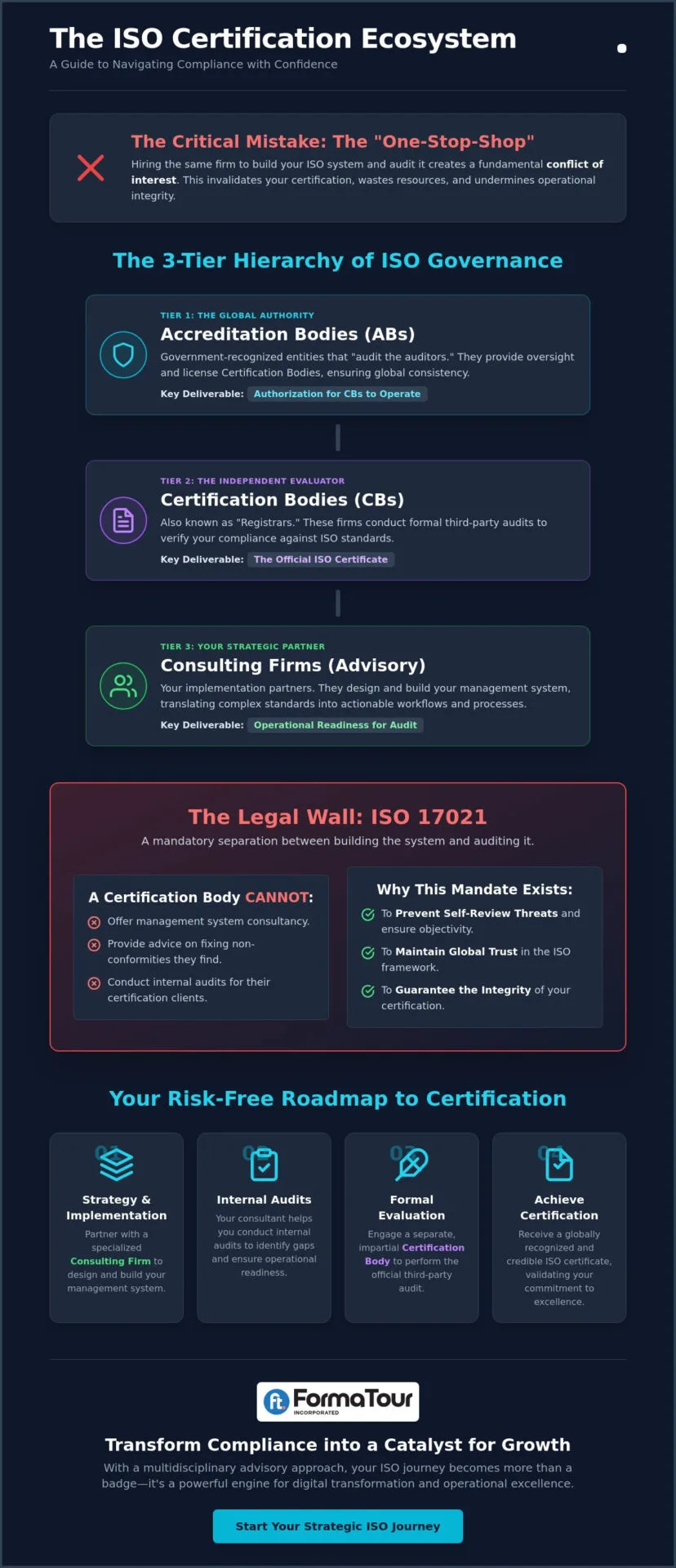
The system operates through three distinct layers of authority to ensure objectivity and technical competence. At the pinnacle are Accreditation Bodies (ABs), such as the Standards Council of Canada (SCC). These government-recognized entities do not audit your business. Instead, they audit the auditors. As of January 2026, the Global Accreditation Cooperation Incorporated oversees this global network, providing the essential license that allows lower-tier organizations to operate. This oversight ensures that a certificate issued in Toronto carries the same weight as one issued in Tokyo.
The second tier consists of Certification Bodies (CBs), often referred to as registrars. These firms perform the formal third-party audits and issue the final ISO certificate. Finally, the third tier comprises Consulting Firms. These are the strategic advisors who provide ISO 27001 implementation services and design the operational architecture your business needs to succeed. They are your partners in transformation, working on the ground to build the systems that the CB will eventually evaluate.
Key Roles and Responsibilities at a Glance
A functional “Church and State” separation must exist between those who build the system and those who judge it. A consulting firm acts as your architect, translating complex standards into actionable workflows and documentation. Conversely, a certification body serves as the impartial inspector. They cannot legally provide advice on how to fix a non-conformity they discover, as doing so would create a self-review threat. The ISO Ecosystem: Defining Accreditation, Certification, and Consulting relies on this mutual independence to maintain global trust and ensure that certifications are earned through merit.
| Entity | Primary Function | Key Deliverable |
|---|---|---|
| Accreditation Body (AB) | Oversight and Licensing | Authorization for CBs |
| Certification Body (CB) | Independent Evaluation | The ISO Certificate |
| Consulting Firm (Advisory) | Implementation and Strategy | Operational Readiness |
This hierarchy ensures that no single entity has total control over the process. While a consultant helps you achieve operational performance consulting goals, the certification body provides the external validation required by stakeholders. By maintaining these boundaries, organizations protect themselves from the risks of biased auditing and ensure their management systems are built on a foundation of international best practices.
The Legal Wall: Why Your Certification Body Cannot Be Your Consultant
The integrity of an ISO certificate rests upon a strict, non-negotiable separation of powers. While it might seem convenient to hire a single firm to both build and audit your management system, this “one-stop-shop” approach is a significant red flag for savvy executives. The structural divide between accreditation bodies and certification bodies vs consulting firms is a legal mandate designed to prevent the self-review threat. Without this wall, an audit becomes a hollow exercise in grading one’s own homework, which ultimately devalues the certification in the eyes of global stakeholders.
ISO 17021 and the Mandate for Impartiality
ISO/IEC 17021-1:2015 serves as the foundational standard for auditing integrity, mandating that certification bodies operate with absolute impartiality. This standard explicitly prohibits registrars from offering management system consultancy to the very organizations they intend to audit. The Legal Wall: Why Your Certification Body Cannot Be Your Consultant exists to ensure that every audit provides a truly independent perspective. Accreditation bodies enforce this boundary through periodic oversight audits, and any certification body found violating this principle risks losing its license to operate.
The Business Risk of Conflated Roles
Choosing a partner that attempts to bypass these boundaries introduces profound organizational vulnerability. True ISO 9001 quality management implementation requires a strategic architect who can identify inefficiencies without the fear of impacting a future audit score. When implementation and evaluation are conflated, the result is often a “checklist compliance” culture that fails to drive actual performance. This lack of objectivity can lead to hidden risks that only surface during a crisis, long after the certificate has been framed.
The consequences of a discovered conflict of interest are severe. If an accreditation body determines that a certification body provided consultancy to its audit client, the resulting certificates are often voided immediately. This leaves the organization without valid compliance credentials and forces a complete restart of the certification process. To ensure your system is built on a foundation of genuine excellence and legal stability, it’s essential to consult with a professional advisory partner who respects the necessary boundaries of the ISO ecosystem. By maintaining this separation, you protect your reputation and ensure that your management system serves as a reliable engine for growth.
Strategy vs. Evaluation: The Value of a Multidisciplinary Advisory Firm
Designing a management system is an act of organizational architecture. While the legal distinctions between accreditation bodies and certification bodies vs consulting firms define the boundaries of the industry, their practical value lies in how they interact to create a resilient business. A certification body provides a snapshot of compliance at a specific point in time. In contrast, a multidisciplinary advisory firm serves as a long-term mentor that integrates these standards into the very fabric of your operations. This partnership ensures that the system doesn’t just pass an audit but actually drives sustainable growth.
Resilient organizations recognize that a “checkbox” approach to ISO standards often results in a system that is technically compliant but operationally hollow. Success requires a strategy that bridges the gap between high-level leadership goals, daily operations, and IT infrastructure. By engaging an advisor who understands this interplay, you transform the certification process from a regulatory burden into a strategic asset that improves your competitive position in the global market.
The Advisory Firm as a Strategic Mentor
True advisory goes beyond simple documentation assistance. It involves aligning ISO requirements with your unique business objectives through operational performance consulting. Advisors act as architects, guiding leadership through the complexities of a digital transformation strategy while maintaining strict adherence to international standards. They focus on building internal competency through executive education and lead auditor training. This holistic approach ensures that your team possesses the skills to maintain and optimize the system long after the initial implementation phase concludes.
The Certification Body as an Independent Validator
The certification body provides the essential “outside-in” perspective required for global credibility. Their role is purely evaluative; they measure your established system against the rigid criteria of the ISO standard without bias. A “clean” audit from a reputable, non-conflicted registrar carries immense weight with international partners because it signifies verified assurance of your management practices. It’s essential to understand that a CB’s gap analysis is not a substitute for implementation consulting. While they can identify where your system falls short, they cannot legally provide the specific solutions or “how-to” guidance needed to bridge those gaps. This independence is what gives the final certificate its market value and ensures that your organization meets the highest benchmarks of governance.
The 2026 Executive Roadmap: Sequencing Your ISO Journey
Achieving international certification is a marathon that requires a disciplined sequence of events. Success depends on understanding the specific timing of when to engage each player in the ecosystem. While the initial impulse may be to contact a registrar immediately, the most effective roadmaps prioritize strategic implementation before formal evaluation begins. By correctly sequencing the involvement of accreditation bodies and certification bodies vs consulting firms, you ensure that your management system is mature enough to withstand the scrutiny of a high-stakes audit.
- Phase 1: Strategic Advisory Selection. Identify a partner to serve as your architect and mentor.
- Phase 2: Management System Development. Build the documentation and processes for your QMS, ISMS, or BCMS.
- Phase 3: Certification Body Engagement. Select and contract your independent validator.
- Phase 4: The Internal Audit. Conduct a full “dress rehearsal” to identify and close any remaining gaps.
- Phase 5: The External Certification Audit. Complete the formal Stage 1 and Stage 2 assessments.
When to Hire Your Consultant vs. Your Registrar
Timing is everything. You should ideally hire your consultant on Day 1 to guide the architecture of your system. This early partnership prevents the “rushed audit” trap, where organizations schedule an auditor before their processes have actually matured. In contrast, you should typically engage your Certification Body (CB) around Day 90. This delay allows you to use your advisor’s expertise to vet and select the most credible registrar for your specific industry. Your consultant can help you interpret the CB’s requirements without the pressure of an imminent deadline, ensuring that your system is truly ready for evaluation.
Managing the Transition and the Audit Process
The transition from implementation to audit requires a shift in mindset. During the external audit, your advisor’s role is one of support rather than interference. They help you navigate the auditor’s questions and provide the necessary context for your processes. If the auditor identifies any non-conformities (NCs), your advisor is there to help you develop and implement corrective actions. Beyond the initial certificate, long-term success involves sustaining the system through post-certification maintenance. Many organizations find that ISO 22301 business continuity consulting provides the necessary framework to ensure the system remains resilient against future disruptions. To begin your own strategic implementation, reach out to our expert advisory team today. We provide the steady hand needed to guide you through every phase of this complex journey.
Formatour Incorporated: Premium Advisory for Global Standards
Excellence in the modern marketplace requires a partner who understands that compliance is a strategic foundation rather than a final destination. Formatour Incorporated represents the synthesis of boutique agility and the rigorous standards expected of a global strategic advisory. We recognize that the operational divide between accreditation bodies and certification bodies vs consulting firms is not merely a legal requirement but a cornerstone of organizational integrity. As a Canadian firm with a global perspective, we provide the steady, expert hand necessary to transform complex international benchmarks into tangible business results. Our approach empowers leadership teams to move beyond the confusion of ISO acronyms and focus on what truly matters: sustainable growth and unwavering reliability.
Beyond Compliance: Strategic Transformation
Our multidisciplinary methodology ensures that compliance is never an isolated activity. We specialize in integrating ISO 9001 Quality Management and ISO 27001 Information Security into a cohesive framework that supports your broader digital transformation goals. By focusing on process automation and optimization during the implementation phase, we help you build systems that are as efficient as they are compliant. This strategic foresight allows Canadian firms to compete more effectively on the world stage, backed by a resilience framework that includes ISO 22301 Business Continuity and proactive risk management. We don’t just build systems; we architect the future of your operations.
Your Partner in Organizational Excellence
We serve as your strategic mentor through every stage of the ISO journey, maintaining a strict “Church and State” separation to protect your audit integrity. Our team provides the deep technical expertise required for successful implementation while ensuring your organization is fully prepared for external evaluation. Our comprehensive service suite includes:
- Audit Readiness: Rigorous internal auditing and gap analysis to ensure a successful “dress rehearsal.”
- Executive Development: Empowering your leadership through specialized development programs and international seminars.
- Strategic Vetting: Facilitating the selection of reputable, non-conflicted Certification Bodies that align with your industry prestige.
- Project Management: Guiding complex studies and international projects with precision and intelligence.
By prioritizing structural integrity and professional development, we help you foster a culture of predictable excellence. We’re dedicated facilitators for organizations that refuse to settle for superficial solutions. To begin your own journey toward international recognition and operational health, Contact Formatour Incorporated to begin your strategic transformation journey. Let us provide the visionary architecture your business deserves.
Securing Your Path to Global Excellence
Realizing a world-class management system requires more than technical compliance; it demands a clear understanding of the governance that ensures its integrity. By respecting the functional boundaries between accreditation bodies and certification bodies vs consulting firms, you protect your organization from conflicts of interest and ensure your certificate carries true global weight. Success is found in the deliberate sequence of your journey, moving from strategic architecture to independent validation with a steady, expert hand. This structural clarity isn’t just about passing an audit; it’s about building a foundation for organizational health that lasts.
Formatour Incorporated provides this essential guidance through multidisciplinary expertise in ISO 27001, 9001, and 22301. As a Canadian-based boutique advisory, we combine localized agility with the highest global standards to drive strategic transformation and executive leadership development. We don’t just prepare you for an audit; we architect a system that enhances your operational performance and long-term resilience. Partner with Formatour Incorporated for Strategic ISO Implementation and take the first step toward a more secure, optimized future. Your organization’s potential is vast, and the right partnership will help you unlock it with confidence.
Frequently Asked Questions
Can a certification body also provide gap analysis services?
Yes, a certification body can perform a gap analysis, provided they don’t offer specific solutions. They identify where your system fails to meet the standard’s criteria but are legally barred from telling you how to fix those issues. This distinction is vital in the relationship between accreditation bodies and certification bodies vs consulting firms, as the latter are the ones permitted to design and implement the necessary corrective actions.
What is the difference between an ISO consultant and an ISO auditor?
An ISO consultant acts as a strategic architect who designs and implements your management system to drive performance. Conversely, an ISO auditor from a certification body serves as an independent evaluator. While the consultant works alongside you to build the system, the auditor arrives only at the end to inspect it against the standard’s rigid requirements without providing any advisory or implementation interference.
How do I verify if a Certification Body is properly accredited?
You verify a Certification Body’s status by looking for an accreditation symbol from a recognized entity like the Standards Council of Canada (SCC). Most reputable registrars display these logos on their websites and certificates. You should also cross-reference their name on the official IAF CertSearch database or the specific accreditation body’s online directory to ensure their license is current and covers your specific industry scope.
Is it mandatory to hire a consulting firm for ISO certification?
What happens if my Certification Body is found to be providing consulting to me?
If a certification body provides consulting to an audit client, the resulting certificate is usually voided immediately by the accreditation body. This violation of ISO 17021 creates a conflict of interest that destroys the audit’s credibility. The organization is then forced to restart the entire process with a new, independent partner, leading to wasted investment and a loss of trust among stakeholders.
Can a consultant perform my internal audits before the official certification?
Yes, a consultant can and should perform your internal audits. This “dress rehearsal” is a critical phase in the implementation journey. It allows the advisor to identify non-conformities and refine processes before the formal external audit begins. This proactive approach ensures your team is prepared and your management system is robust enough to meet the scrutiny of an independent registrar during the final assessment.
How long does the implementation process take compared to the certification audit?
Implementation is a long-term commitment that typically spans 6 to 12 months, depending on the organization’s complexity. This phase involves culture shifts, documentation, and process optimization. The certification audit itself is much faster, usually concluding within a few days for Stage 1 and Stage 2. The disparity in time highlights why implementation maturity is the most critical factor in achieving a successful and sustainable outcome.
