

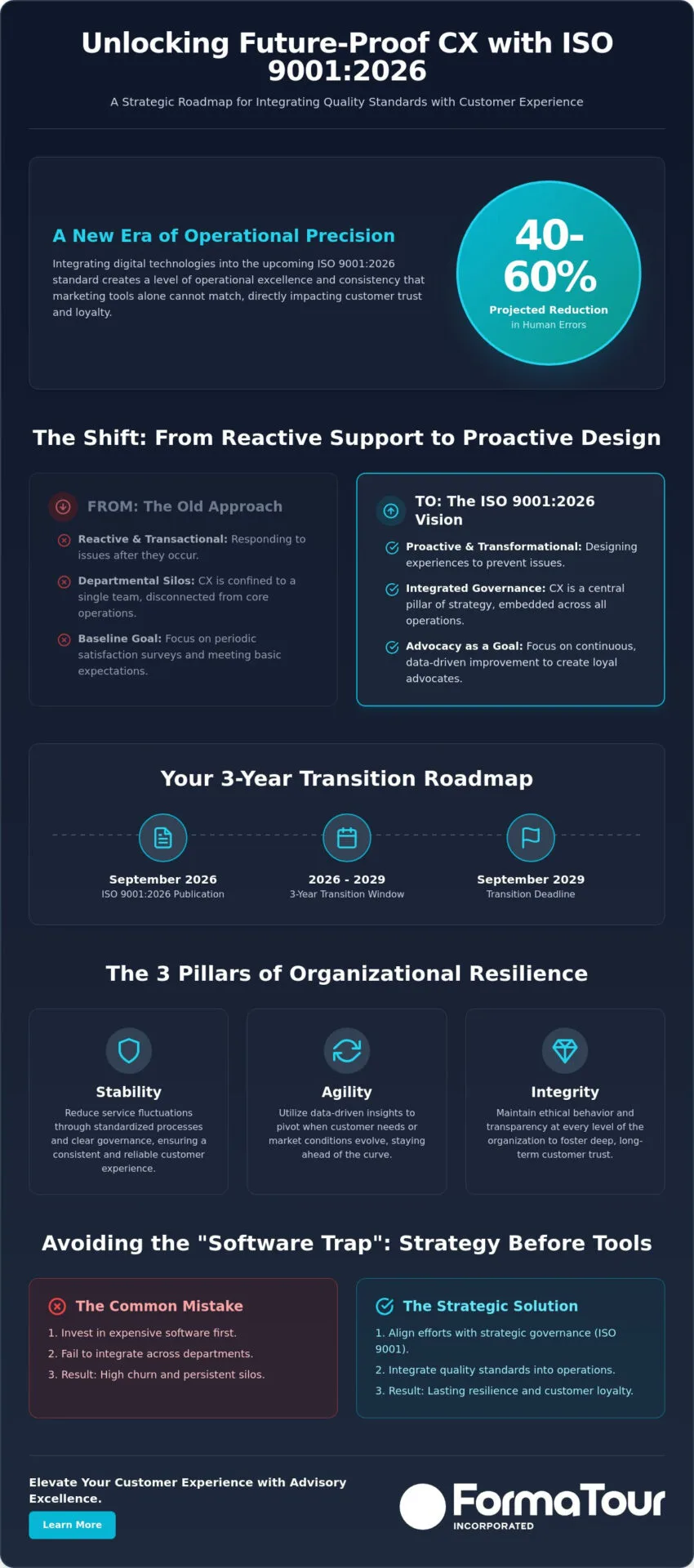
Integrating digital technologies into the upcoming ISO 9001:2026 standard is projected to reduce human errors by 40% to 60%, creating a level of operational precision that marketing tools alone cannot match. You’ve likely realized that investing in expensive software doesn’t automatically solve high churn or break down departmental silos. It’s a common challenge to find that your focus on customer experience remains confined to a single department, failing to influence the broader strategic landscape of the organization.
We’ll show you how to move beyond periodic satisfaction surveys toward a continuous, data-driven strategy that embeds quality into every touchpoint. You’ll discover a clear roadmap to integrate CX into your operational performance, seamlessly aligning international quality standards with the expectations and emotions of your clients. This guide explores how to leverage the 2026 revisions to build organizational resilience and secure a loyal customer base through strategic foresight and disciplined execution.
Key Takeaways
- Understand the evolution toward proactive experience design as established by the upcoming ISO 9001:2026 standards.
- Discover how to leverage ISO 9001 to transform customer experience into a measurable driver of organizational resilience and trust.
- Learn to navigate the “software trap” by aligning digital transformation efforts with high-level strategic governance.
- Access a structured executive framework for conducting gap analyses that bridge the divide between compliance and service excellence.
- Explore how a multidisciplinary advisory model integrates international quality standards with sustainable business growth.
Defining Customer Experience in the Era of Strategic Transformation
Modern leadership recognizes that a single purchase doesn’t define a relationship. Instead, it’s the cumulative weight of every touchpoint that determines market standing and long term viability. Customer Experience is the sum of all interactions across the organizational lifecycle. This holistic view is deeply embedded in the ISO 9000 family of standards, where quality management serves as the bedrock for organizational consistency and reliability.
The transition toward the ISO 9001:2026 revision, scheduled for publication in September 2026, marks a pivotal shift for global leaders. It moves the needle. The new standard demands a move from reactive customer support toward a proactive model of experience design. Organizations will have until September 2029 to transition, giving them a three year window to align their operational performance with the evolving expectations of their clients. This evolution ensures that Customer experience is no longer a peripheral marketing concern but a central pillar of governance.
The Evolution from Transactional to Transformational CX
Digital maturity has fundamentally altered how Canadian firms interact with their partners. Precision alone is no longer enough to secure a competitive edge. It must be paired with empathy to create premium advisory relationships that feel both personal and professional. We’re seeing a shift where mere satisfaction is considered a baseline rather than a goal. True growth stems from advocacy. This becomes a core KPI when Customer experience is treated as a strategic asset. At Formatour Incorporated, we see this transformation as an opportunity to co-develop solutions that turn standard service delivery into a transformational partnership.
CX as a Driver of Organizational Resilience
Customer loyalty acts as the ultimate insurance policy during periods of market volatility. When an organization delivers a consistent experience, it builds long term brand equity that can withstand economic disruptions. This resilience isn’t accidental. It requires a seamless bridge between executive vision and frontline execution. By integrating quality standards into daily operations, firms ensure that the promise made in the boardroom is the reality delivered on the ground. A resilient strategy focuses on three key areas:
- Stability: Reducing service fluctuations through standardized processes and clear governance.
- Agility: Utilizing data-driven insights to pivot when customer needs or market conditions evolve.
- Integrity: Maintaining ethical behavior and transparency at every level of the organization to foster deep trust.
Success in this area reinforces the brand’s role as an active participant in its clients’ progress. It fosters a feeling of security and predictable excellence that software alone cannot provide.
The Strategic Pillars of Trust: Linking CX to ISO Standards
Trust provides the essential infrastructure for every premium relationship. While many firms rely on digital automation to manage interactions, true loyalty is forged through the reliability of the underlying system. Certification isn’t merely a badge of compliance; it’s a strategic declaration of your commitment to the customer’s long term security and satisfaction. By integrating the ISO 9001:2015 standard into your core operations, you move beyond superficial engagement to create a foundation of unwavering reliability. This structured approach ensures that your promises aren’t just marketing claims but operational certainties.
ISO 9001: The Blueprint for Consistent Customer Satisfaction
A superior customer experience depends on the systematic elimination of variance. When service delivery is unpredictable, trust erodes rapidly. ISO 9001 allows organizations to map and standardize the ‘Golden Path’, the sequence of interactions that consistently leads to successful outcomes. This process goes far beyond simple documentation. It involves using rigorous internal audits as a diagnostic tool to identify and eliminate subtle friction points that frustrate clients and stall progress. For leaders seeking a comprehensive roadmap to bridge this gap, our guide on ISO 9001 Quality Management Implementation provides deeper insights into aligning these standards with long term strategic growth.
Security as an Experience: Why ISO 27001 Matters
Information security has evolved from a back office technical necessity into a core component of the brand promise. In an era of frequent data breaches, protecting customer data is a fundamental act of respect and governance. ISO 27001 certification provides the transparency required to differentiate your firm in a crowded market. It proves that you prioritize the integrity of client information as highly as the quality of your physical or digital services. Integrating these security protocols into your broader strategy ensures that safety becomes a tangible, comforting part of the overall customer experience. Organizations ready to fortify their operational resilience can explore our specialized ISO 27001 Implementation Services to effectively bridge the gap between technical compliance and market trust.
Reducing friction requires more than just a friendly interface. It demands process optimization that simplifies the client’s journey at every stage. By standardizing excellence, you reduce the cognitive load on your clients, making every interaction feel intuitive and effortless. This structural integrity is what allows a premium brand to scale its operations without losing the sophisticated personal touch that customers value. If you’re ready to transform your operational pillars into enduring drivers of loyalty, consulting with a strategic advisor can help you align your vision with international benchmarks of excellence.
Beyond the Dashboard: Why CX Software Requires Strategic Transformation
Many organizations fall into the ‘Software Trap’ by assuming that a high performance dashboard can substitute for a robust organizational culture. While digital tools provide valuable data, they rarely address the underlying procedural gaps that frustrate clients. Research from McKinsey indicates that approximately 70% of digital transformations fail to achieve their stated goals or significantly move customer experience metrics. This disconnect occurs when technology is implemented without the guidance of a comprehensive quality framework. Tools execute strategy, but leadership defines experience.
Process Automation vs. Personal Touch
Digital maturity requires a nuanced understanding of which touchpoints benefit from automation and which require human intervention. Routine tasks, such as order tracking or data entry, are prime candidates for optimization. However, complex advisory moments must retain their ‘Boutique Agility’ to remain effective. Leaders should view technology as a facilitator that frees up human capital for higher value interactions. For a deeper look at balancing these elements, explore The 2026 Executive Guide to Digital Transformation to see how strategy firms are evolving.
Leadership Development: The Invisible CX Engine
The success of any customer experience initiative depends on the ability of leaders to model centric behaviors. It’s not enough to mandate quality; it must be lived at every level of governance. Investing in international seminars and professional development provides the strategic foresight needed to anticipate market shifts. This commitment to continuous learning ensures that the organization remains resilient and forward thinking. Our specialized Leadership Training for Digital Transformation helps executives bridge the gap between technical adoption and cultural excellence, ensuring a measurable return on investment.
Implementing a Resilient CX Strategy: An Executive Framework
Achieving excellence in the modern market is not the result of chance. It’s the outcome of a deliberate, five-step framework that aligns organizational behavior with international benchmarks. By adopting a structured approach, you ensure that customer experience becomes a permanent operational asset rather than a temporary marketing success. This framework provides the strategic foresight needed to navigate the transition to the new ISO 9001:2026 requirements before the September 2029 deadline.
The implementation process follows a logical progression designed to foster growth and stability:
- Gap Analysis: Conduct an ISO-aligned audit of current customer journeys to identify where processes fall short of executive intent.
- Benchmark Definition: Establish quality benchmarks that reflect the organization’s long term vision for growth and integrity.
- Resilience Integration: Incorporate ISO 22301 standards to ensure service delivery remains uninterrupted during disruptions.
- Process Optimization: Execute digital transformation initiatives that simplify the journey and reduce human error.
- Continuous Improvement: Establish a feedback loop through lead auditor training to ensure the system evolves with the market.
This methodical progression transforms quality management from a compliance exercise into a powerful engine for market differentiation. It ensures that every department is aligned with a unified view of the client’s needs.
Auditing Your Customer Journey
Mapping every interaction from initial discovery to long term retention allows leaders to identify ‘moments of truth’ where trust is either built or broken. By using ISO standards to create objective measurement criteria, firms move past subjective feedback toward data-driven insights. This clarity allows for the precise allocation of resources to the touchpoints that most significantly impact perceived value. It creates a unified view of the customer that spans across siloed departments, ensuring a consistent brand voice at every stage.
Resilience as a Service: ISO 22301 Integration
Stability is a core component of a premium brand promise. Integrating ISO 22301 Business Continuity Consulting into your service delivery model ensures that customer experience remains stable even during business disruptions. Communicating this resilience as a value proposition provides clients with the assurance of success they require in a volatile landscape. It positions your organization as a reliable partner capable of maintaining high standards regardless of external pressures. If you are ready to fortify your organization against market shifts, connect with our executive team to begin your strategic transformation.
Elevating Your Customer Experience with Formatour’s Advisory Excellence
Formatour Incorporated recognizes that the space between executive intent and operational execution is where most customer experience strategies either thrive or fail. We combine the personalized agility of a boutique firm with the sophisticated standards of global consulting. This unique positioning allows us to co-develop solutions that are strategically ambitious yet grounded in daily operations. For Canadian organizations, this means a customized implementation plan that respects local market conditions while meeting rigorous international benchmarks of excellence.
Our multidisciplinary approach effectively bridges the gap between ISO compliance and market growth. We don’t treat certification as a checkbox for governance; we view it as a catalyst for organizational excellence. By integrating ISO 9001 Quality Management with Process Automation and Optimization, we ensure that your digital evolution is supported by a foundation of structural integrity. This alignment transforms your operational performance into a distinct competitive advantage, fostering a feeling of security for your clients and stakeholders alike.
The Formatour promise is rooted in the belief that quality is a strategic asset. We don’t just help you meet standards; we help you set them within your industry. Our active participation in your progress ensures that every optimization leads to a tangible outcome, pairing specific actions with measurable results. This commitment to predictable excellence is what makes us a premium partner for organizations seeking stability and growth in a volatile global market. We provide the expert hand needed to guide you through complex organizational landscapes with quiet confidence.
Comprehensive Advisory for Strategic Growth
We offer a holistic perspective on organizational health that extends from ISO certification to executive leadership development. A superior customer experience is not the result of a single department’s efforts; it’s the byproduct of a unified quality culture. Our advisory services include international seminars and project management studies designed to provide your team with global strategic foresight. We partner with you for the long term, ensuring that your path toward digital excellence is both sustainable and results-oriented.
Take the Next Step in Your CX Transformation
Now is the time to evaluate your current maturity and prepare for the future of quality standards. Schedule a strategic consultation to discover how our expert guidance can help you navigate the transition to the new ISO 9001:2026 requirements. Explore our full suite of ISO implementation and auditing services to find the right fit for your unique growth objectives. Contact Formatour Incorporated today for a personalized advisory plan and begin the journey of transforming your operations into a hallmark of excellence.
Securing the Future of Your Quality Culture
Transforming your organization into a beacon of reliability requires a shift from reactive service to proactive governance. We’ve explored how the integration of quality standards provides the structural integrity necessary to sustain long term growth. By aligning your executive vision with rigorous benchmarks, you ensure that every interaction reinforces your brand’s value. True excellence stems from the seamless pairing of leadership development with disciplined process optimization. This approach guarantees that Customer experience remains a core driver of resilience rather than a fluctuating marketing metric.
Formatour Incorporated brings over a decade of experience in strategic transformation to every partnership. As a premium Canadian multidisciplinary advisory firm, we specialize in the implementation of ISO 27001, 9001, and 22301 standards. We’re dedicated to guiding you through the complexities of digital maturity and international benchmarks. Our team acts as an active participant in your progress, ensuring that your strategic foresight leads to tangible operational success. Elevate your organizational performance with Formatour’s strategic advisory services and secure your position as a market leader. We look forward to co-developing the solutions that will define your future success.
Frequently Asked Questions
What is the primary difference between customer service and customer experience?
Customer service is a reactive, transactional function focused on resolving specific issues or inquiries. In contrast, customer experience encompasses the entire psychological and emotional journey across every touchpoint of the organizational lifecycle. While service is a single event, experience is the cumulative perception of value and reliability. Managing this journey requires a move from isolated support to a proactive, data-driven strategy that integrates quality into every facet of the business.
How does ISO 9001 certification improve the customer experience?
ISO 9001 certification improves the journey by standardizing the sequence of interactions that lead to successful outcomes. It provides a rigorous framework for identifying and eliminating process variances that cause friction and frustration. By institutionalizing a focus on the client, the standard ensures that quality is not accidental but an operational certainty. This structural integrity allows organizations to scale their services without losing the precision and reliability that premium clients expect.
Why do digital transformation initiatives often fail to improve CX?
Digital transformation initiatives frequently fail because organizations prioritize software adoption over strategic governance and cultural alignment. Tools are designed to execute strategy, but they cannot fix inefficient processes or a lack of leadership vision. When technology is implemented in a vacuum, it often adds layers of complexity rather than simplifying the journey. Success requires aligning process automation with human-centric design and a robust quality management system to move meaningful metrics.
Can organizational resilience standards like ISO 22301 protect customer relationships?
Organizational resilience standards like ISO 22301 protect relationships by ensuring that service delivery remains stable during unexpected business disruptions. Stability is a core component of trust, and clients value partners who can maintain high standards regardless of market volatility. By integrating continuity protocols, you communicate a value proposition of unwavering reliability. This proactive approach to risk management fosters a feeling of security, reinforcing the long-term bond between the organization and its stakeholders.
What role does executive leadership play in shaping customer perceptions?
Executive leadership serves as the primary architect of an organization’s quality culture and ethical behavior. Leaders must model the behaviors they expect from the frontline to ensure a unified view of the client across all departments. Their role is to define the strategic vision and provide the necessary resources for continuous improvement. Without active participation from the top, initiatives for customer experience excellence remain siloed and fail to impact the broader organizational performance.
How can process automation enhance rather than detract from the customer journey?
What are the key KPIs for measuring strategic customer experience success in 2026?
Key KPIs for 2026 include continuous experience metrics, organizational resilience levels, and advocacy rates rather than simple satisfaction scores. The upcoming ISO 9001:2026 revision emphasizes a move toward data-driven decision-making and the integration of digital technologies like AI. Organizations should measure the reduction in process variance and the speed of response to quality issues. These indicators provide a more holistic picture of organizational health and the long-term sustainability of the brand’s market position.
Is a boutique advisory firm better than a large consulting firm for CX strategy?
A boutique advisory firm often provides a superior level of agility and personalized implementation compared to the rigid frameworks of larger consulting entities. Boutique partners offer direct access to senior experts who have a deep understanding of complex global systems and local market nuances. This collaborative approach allows for the co-development of solutions that are specifically tailored to your organizational needs. It ensures that strategic concepts are seamlessly integrated into daily operations for predictable, long-term impact.
