

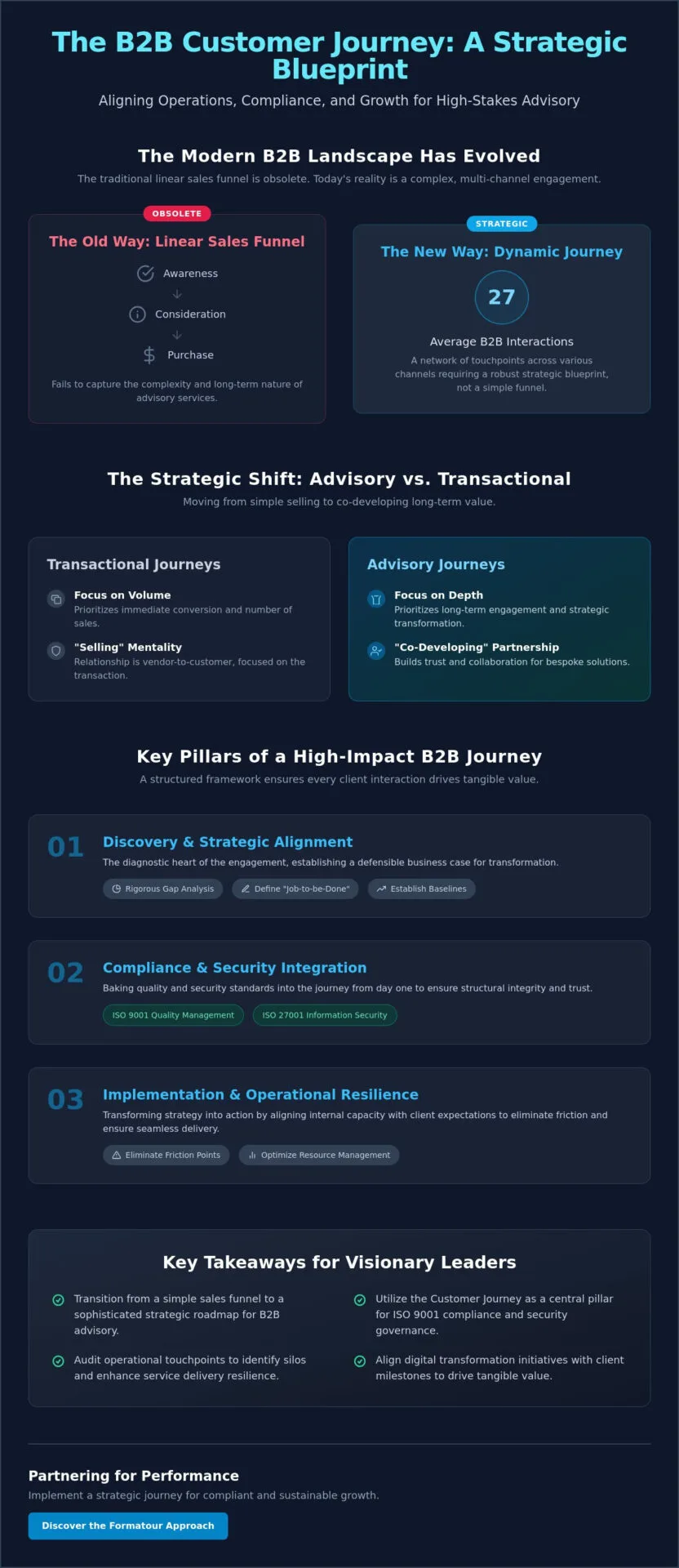
With B2B buyers now navigating an average of 27 distinct interactions across various channels before a purchase is finalized, the traditional linear sales funnel has become an obsolete relic of simpler times. You likely recognize the persistent tension that arises when a sophisticated sales promise meets the complex realities of operational delivery. This disconnect doesn’t just frustrate clients; it actively undermines your ISO 9001 quality standards and threatens the structural integrity of your digital transformation efforts. Maintaining visibility across these high-stakes touchpoints is no longer optional for organizations seeking sustainable growth and unwavering reliability.
We’ll demonstrate how to transform the Customer Journey from a mere marketing visualization into a robust strategic blueprint that ensures operational excellence and seamless compliance. You’ll discover how to bridge the gap between initial engagement and long-term service delivery through rigorous process optimization and strategic foresight. This article provides a structured roadmap to align your client experience with international benchmarks, fostering the resilience needed to improve retention and secure your position as a visionary leader in an increasingly complex global market.
Key Takeaways
- Transition from a simple sales funnel to a sophisticated strategic roadmap tailored for the complexities of high-stakes B2B advisory.
- Discover how to utilize the Customer Journey as a central pillar for ISO 9001 compliance and information security governance.
- Master a framework for auditing operational touchpoints to identify silos and enhance service delivery resilience.
- Align your digital transformation initiatives with client-facing milestones to ensure technological upgrades drive tangible value.
- Implement a multidisciplinary strategy that integrates human capital development with international benchmarks for sustainable growth.
Redefining the Customer Journey for Strategic Advisory
The traditional marketing funnel, once the standard for retail interactions, fails to capture the intricate dynamics of high-stakes B2B advisory. In professional services, the Customer Journey is not a path to a single transaction; it’s a strategic roadmap for long-term organizational transformation. This evolution requires leaders to act as visionary architects who design every interaction with surgical precision. When you guide a client through complex digital transformation or ISO 9001 quality management, each touchpoint must reinforce a sense of unwavering reliability. Moving beyond simple transactions allows you to build a partnership rooted in long-term stability and mutual growth.
Advisory vs. Transactional Journeys
Premium consulting thrives on a long-tail engagement model that prioritizes depth over volume. Unlike transactional sales, which focus on immediate conversion, advisory journeys rely on the steady accumulation of trust through high-level authority. This shift moves the relationship from “selling” to “co-developing” bespoke solutions. When stakeholders feel like active participants in their own progress, the customer experience becomes a collaborative venture rather than a passive service. This partnership approach is essential for maintaining stability during the multi-phased delivery of executive leadership development or process optimization projects.
The ROI of a Mapped Service Journey
Mapping your service delivery provides a clear framework for quantifying operational performance. It allows you to identify and eliminate friction points that often derail complex implementations, such as ISO 27001 information security management. By aligning internal capacity with client expectations, you ensure that every promise made during the sales phase is fulfilled during operational delivery. This alignment doesn’t just improve client satisfaction; it streamlines internal workflows and optimizes resource management. A Strategic Customer Journey is a dynamic blueprint that transforms intangible service promises into a tangible asset for organizational resilience.
At Formatour Incorporated, we recognize that growth is a byproduct of structural integrity. By treating the journey as a partnership for long-term stability, we help organizations bridge the gap between high-level strategy and daily operational excellence. This methodical approach ensures that your path to growth is both compliant and sustainable.
The 5 Pillars of a High-Impact B2B Customer Journey
Successful B2B engagements aren’t built on a single interaction. They rely on a series of structural pillars that support the weight of complex organizational change. A high-impact Customer Journey functions as an operational blueprint, ensuring that every phase of the client lifecycle delivers measurable value. While many organizations focus solely on the initial sale, true market leaders understand that the journey’s integrity is tested during implementation and long-term service delivery. This methodical approach transforms a simple service agreement into a resilient partnership designed for sustainable growth.
Stage 1: Discovery and Strategic Alignment
The Initial Discovery phase serves as the diagnostic heart of the engagement. Here, the focus shifts from general features to identifying the specific “Job-to-be-Done” for C-suite stakeholders. This requires a rigorous gap analysis to align the client’s current state with their future objectives. By establishing this baseline early, you create a defensible business case for strategic transformation. This phase is also where you lay the groundwork for ISO 9001 quality management implementation, ensuring that quality standards are baked into the project from day one. For those new to these concepts, the Nielsen Norman Group provides an excellent primer in their Journey Mapping 101 guide.
Strategic onboarding follows discovery, setting the foundation for compliance and digital transformation. It’s during this transition that expectations must be reconciled with organizational capacity to prevent future delivery friction.
Stage 3: Implementation and Operational Resilience
The Implementation stage is often where momentum stalls as organizations face the “trough of disillusionment” inherent in digital transformation. Maintaining progress requires a steady hand and a clear focus on operational resilience. It’s vital to ensure business continuity during structural changes to prevent service disruptions that could erode trust. Integrating ISO 22301 business continuity consulting into the delivery phase provides a safety net, allowing the organization to adapt without compromising stability. If you’re currently managing a complex transition, it may be beneficial to discuss your strategic alignment with an expert partner.
Integrating Compliance: Mapping the Journey to ISO Standards
Organizations often treat compliance and client experience as separate silos. This is a strategic error. A well-constructed Customer Journey serves as the ultimate evidence for ISO 9001 audits, demonstrating a controlled, process-oriented approach to service delivery. By mapping every interaction, leaders can satisfy Clause 5 requirements regarding leadership and commitment. This visibility ensures that quality isn’t just a manual on a shelf; it’s a lived reality for every client. When you document how each touchpoint meets specific standard requirements, you create a transparent audit trail that reinforces organizational integrity.
ISO 9001 and the Quality-Driven Journey
The ISO 9001 standard emphasizes a process approach, viewing the organization as a set of interrelated activities. When you treat the journey as a series of quality-controlled steps, you naturally fulfill requirements for customer satisfaction. Utilizing client feedback loops at specific milestones allows for continuous improvement and real-time optimization. This same level of structural integrity extends to sustainability goals, making ISO 14001 certification services a natural extension of a quality-driven roadmap. A detailed Customer Journey Map provides the clarity needed to manage these complex intersections effectively.
Security-First Journeys: The ISO 27001 Intersection
Information security must be woven into the fabric of the advisory cycle. Every touchpoint represents a potential data exchange that requires governance and protection. Mapping these interactions to ISO 27001 requirements ensures that client data remains protected during every phase of digital transformation. This security-first mindset builds unwavering reliability, positioning your organization as a secure partner in an increasingly volatile market. Integrating ISO 27001 implementation services acts as a journey safeguard, ensuring that business growth never comes at the expense of structural integrity.
Environmental management integrity is similarly preserved through a mapped Customer Journey. By identifying where operational processes impact environmental benchmarks, organizations can optimize for both efficiency and sustainability. This holistic view ensures that compliance isn’t a bureaucratic burden but a strategic advantage that drives long-term resilience. Moving from a reactive posture to a proactive architectural approach allows you to co-develop solutions that satisfy both the client and the auditor. It’s this commitment to international benchmarks that separates market leaders from their competitors.
Auditing Your Journey: A Framework for Operational Excellence
Operational excellence requires a shift from passive observation to active governance. While many organizations prioritize superficial metrics like email open rates or response times, a sophisticated audit focuses on the structural integrity of every interaction. You must identify operational silos where information becomes trapped, leading to a disconnect between a high-level sales promise and actual service delivery. A rigorous touchpoint audit evaluates the Customer Journey through three critical lenses: security, quality, and efficiency. This process ensures that your organization remains a premium partner capable of delivering unwavering reliability at every stage of engagement.
The Journey Audit Checklist
A methodical evaluation requires a structured approach to identify hidden vulnerabilities within your service delivery model. Consider these three essential checks to maintain high-level authority:
- Consistency Check: Does your brand voice remain professional and authoritative across all departments, or does the tone shift abruptly after the contract is signed?
- Compliance Check: Are specific regulatory requirements and ISO standards met at each touchpoint, providing a clear audit trail for future governance?
- Friction Check: At what specific stage do strategic projects typically stall, and can process automation eliminate these bottlenecks to improve momentum?
Leadership’s Role in Journey Optimization
True optimization begins at the executive level. It’s not enough to map a process; leaders must foster a culture where every team member acts as a steady, expert hand guiding the client through complex landscapes. This involves a transition from tactical management to strategic journey stewardship, where the focus remains on long-term impact rather than short-term gains. Training your teams to view these interactions through the lens of leadership training for digital transformation ensures that your human capital is aligned with your technological advancements.
Leveraging process automation and optimization allows you to remove manual errors that disrupt the client experience. By refining these workflows, you reinforce the feeling of security and success that defines your brand identity. To begin refining your organizational roadmap and eliminating hidden silos, you can consult with our strategic advisory team today. This proactive approach transforms the Customer Journey into a high-performance engine for business growth and operational resilience.
Partnering for Performance: The Formatour Implementation Approach
Formatour Incorporated represents a unique intersection of global expertise and personalized agility. We understand that a high-impact Customer Journey requires more than a simple software solution; it demands a multidisciplinary synthesis of strategy, compliance, and human capital. By combining the rigorous standards of a large international firm with the responsive nature of a boutique consultancy, we provide the steady, expert hand needed to guide your organization through complex transformations. Our commitment to co-developing solutions ensures that every operational pillar is built on a foundation of structural integrity and long-term resilience.
Bespoke Advisory for Complex Transformations
A one-size-fits-all approach to mapping the Customer Journey often fails within the nuanced Canadian market. Organizations here face unique regulatory landscapes and cultural dynamics that require a customized touch. Whether your objective is achieving ISO 9001 quality management certification or managing a large-scale strategic project, the roadmap must be tailored to your specific organizational capacity. We replace generic templates with precision and intelligence, ensuring a seamless integration of high-level concepts into your daily operations. This bespoke methodology allows us to identify and address the specific friction points that hinder your progress toward international benchmarks.
Initiate Your Strategic Transformation
Transforming your organizational architecture begins with a comprehensive assessment of your current state. Our premium advisory team works closely with your leadership to conduct a deep-dive journey audit, uncovering the operational silos that frequently disrupt the client experience. We don’t simply deliver a report; we partner with you to develop a strategic roadmap for sustained growth and unwavering compliance. This collaborative process empowers your team to maintain excellence long after the initial implementation is complete. We focus on empowering your internal talent, ensuring that your digital transformation consulting leads to lasting, autonomous success.
The path to operational excellence is a deliberate choice. By aligning your service delivery with global standards and executive vision, you secure a competitive advantage that is both stable and scalable. It’s time to move beyond tactical fixes and embrace a holistic strategy for success. Contact Formatour Incorporated to refine your strategic customer journey and begin your transition toward a more resilient future.
Architecting Your Path to Sustainable Excellence
Transforming your organization requires a deliberate shift from reactive management to proactive architecture. You’ve explored how aligning every interaction with ISO 9001 and ISO 27001 standards does more than satisfy auditors; it builds a foundation of trust and unwavering reliability. A well-governed Customer Journey acts as a strategic engine that drives efficiency and ensures your operational delivery consistently matches your executive vision. By auditing touchpoints for quality and security, you turn a marketing concept into a resilient operational asset.
Formatour Incorporated provides over a decade of ISO implementation expertise to help you navigate these complex landscapes. As a Canadian-based multidisciplinary advisory, we combine premium international standards with the boutique agility necessary for bespoke transformation. We’re dedicated to co-developing solutions that foster organizational resilience and long-term success. Partner with Formatour Incorporated for Strategic Transformation to refine your roadmap and secure your competitive advantage. Your path to growth is ready for its next evolution.
Frequently Asked Questions
What is the difference between a customer journey and a service blueprint?
A customer journey focuses on the client’s external perspective and emotional experience across various touchpoints. In contrast, a service blueprint is an internal document that maps the technical processes and “behind-the-scenes” actions required to support those interactions. While the journey tells the story of the client’s experience, the blueprint provides the operational architecture that makes that experience possible.
How does ISO 9001 influence the customer journey mapping process?
ISO 9001 requires organizations to manage interrelated processes to ensure consistent quality and client satisfaction. This standard provides a rigorous framework for mapping interactions, as it demands documented evidence of process controls and feedback loops. By aligning your map with these requirements, you transform a creative exercise into a compliant system for continuous improvement and operational excellence.
Can a customer journey map help with ISO 27001 information security compliance?
Mapping the Customer Journey allows you to identify every specific point where sensitive data is exchanged between your organization and the client. This visibility is crucial for applying ISO 27001 controls to protect information at each stage of the advisory cycle. It ensures that security isn’t an afterthought but a structural component of the client experience that builds long-term trust.
What are the common pitfalls in B2B customer journey mapping for advisory firms?
The most frequent error is treating the map as a static marketing asset rather than a dynamic operational roadmap. Many firms focus exclusively on the acquisition phase while neglecting the complex implementation and onboarding stages where the relationship is actually tested. This oversight leads to a disconnect between high-level sales promises and the reality of service delivery, undermining organizational reliability.
How often should an organization audit its customer journey for operational excellence?
Organizations should conduct a formal audit of their Customer Journey at least once a year or whenever significant structural changes occur. Regular reviews are necessary to ensure that touchpoints remain aligned with evolving international benchmarks and technological advancements. This methodical approach allows you to identify new “operational silos” before they disrupt the client experience or compromise your compliance status.
What role does digital transformation play in modernizing the customer journey?
Digital transformation provides the tools and data analytics necessary to eliminate manual friction and provide real-time insights into client behavior. It allows organizations to move from a reactive posture to a proactive architectural approach, using process automation to deliver consistent value. Modernizing these touchpoints ensures that your organization remains competitive and capable of meeting the sophisticated needs of global stakeholders.
How can executive leadership development improve the client journey?
Executive leadership development ensures that senior stakeholders have the strategic foresight to govern the journey as a high-value asset. When leaders are trained to view client interactions through the lens of organizational health, they foster a culture of precision and accountability. This high-level alignment ensures that every department works as a steady, expert hand to guide clients through complex landscapes.
Is customer journey mapping relevant for firms seeking ISO 22301 certification?
It’s essential for identifying the critical touchpoints that must remain functional during an unexpected business disruption. By understanding which interactions are vital to the client’s success, you can prioritize recovery efforts and resource allocation as required by ISO 22301 standards. This integration ensures that your business continuity plans are grounded in the practical reality of maintaining the client experience during a crisis.
