

A strategic plan that ignores operational risk isn’t a roadmap; it’s a liability. For many leaders, the disconnect between high-level vision and daily execution leads to a strategy model that crumbles under the weight of regulatory shifts or unforeseen disruptions. You likely view compliance as a burden to be managed rather than a structural advantage. However, the most resilient global organizations treat international standards as the very foundation of their long-term growth.
We understand the frustration of seeing a visionary plan fail because it didn’t account for operational realities or the $4.45 million average cost of a data breach. You deserve a clear framework for decision-making that bridges the gap between your aspirations and your operations. This guide promises to help you master the architectural blueprints of high-performance strategy. You’ll learn how to integrate resilience and compliance into your core growth model, ensuring your vision is supported by ISO-standard excellence. We’ll explore the essential models for scaling and show how aligning with standards like ISO 9001:2026 creates a culture of predictable, sustainable success.
Key Takeaways
- Distinguish between a strategy model and a strategic framework to build a robust architecture that connects high-level vision with operational reality.
- Evaluate high-performance systems like the 2026 Balanced Scorecard and Hoshin Kanri to achieve total organizational alignment.
- Discover why international standards like ISO 27001 and ISO 9001 are strategic accelerators that provide a common language for global growth.
- Use a specialized selection matrix and a five-step implementation process to ensure your strategic transformation remains resilient and measurable.
What is a Strategy Model? Defining the Architecture of Success
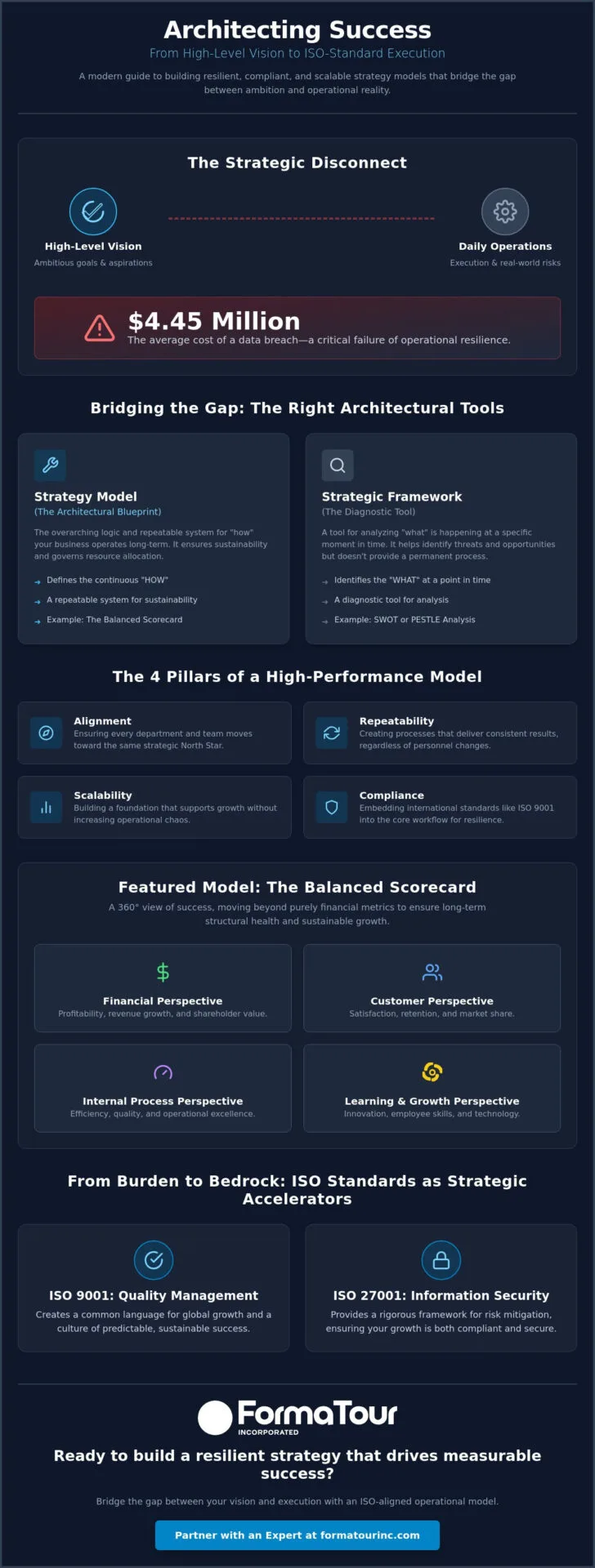
A strategy model serves as the architectural blueprint that bridges the gap between high-level executive ambition and daily operational execution. It provides a structured approach to mapping an organization’s long-term vision to its tangible performance metrics. In the foundational context of What is a Strategy Model?, we define it as the logic that governs resource allocation, team alignment, and risk mitigation. Traditionally, these models were rigid and linear, often failing when faced with sudden market shifts. Modern architectures have evolved into dynamic, resilience-focused structures that allow for rapid adaptation without sacrificing core governance or stability.
Strategy Model vs. Strategic Framework: Clearing the Confusion
Many leaders use the terms “model” and “framework” interchangeably, yet this lack of precision often leads to fragmented execution. A strategy model provides the overarching logic and the continuous “how” of your business operations. It’s a repeatable system designed for long-term sustainability. In contrast, strategic frameworks like SWOT or PESTLE are diagnostic tools. They function as the “what” by helping you analyze a specific moment in time. While a SWOT analysis might identify a competitive threat, it doesn’t provide the permanent process required to mitigate that threat across your entire global footprint. A robust model ensures strategy isn’t a one-time boardroom exercise but a living part of the corporate DNA.
The Role of a Model in Building Organizational Resilience
A high-performance model typically includes several critical pillars:
- Alignment: Ensuring every department moves toward the same North Star.
- Repeatability: Creating processes that deliver consistent results regardless of personnel changes.
- Scalability: Building a foundation that supports growth without increasing operational chaos.
- Compliance: Embedding international benchmarks like ISO 9001 or ISO 27001 into the core workflow.
At Formatour Incorporated, we specialize in helping organizations move beyond static plans. We co-develop these complex architectures to ensure that your vision is supported by a resilient, ISO-aligned operational model that drives measurable success.
Core Strategy Models for High-Performance Organizations
Selecting the right strategy model defines how an organization translates ambitious intent into measurable impact. While there are many popular strategic planning models, high-performance entities prioritize systems that integrate governance with growth. These architectures don’t just track progress; they ensure that every operational layer is synchronized with the executive vision. In an era of rapid digital transformation, the choice of model dictates whether a firm remains agile or becomes obsolete.
The Balanced Scorecard: Beyond Financial Metrics
The Balanced Scorecard (BSC) remains a cornerstone for modern leadership by moving beyond purely financial metrics. It evaluates success through four distinct perspectives: Financial, Customer, Internal Process, and Learning and Growth. This multi-dimensional view ensures that short-term gains don’t compromise long-term structural health. Integrating the BSC with ISO 9001 Quality Management Implementation provides a rigorous framework for ensuring that internal processes meet international standards of excellence. In 2026, adapting the BSC for digital-first environments means prioritizing real-time data flow and technological agility over static quarterly reviews. It’s about moving from historical reporting to predictive performance management.
Hoshin Kanri: Strategic Alignment from Vision to Execution
Organizations seeking top-to-bottom alignment often turn to Hoshin Kanri. This strategy model utilizes the “Catchball” process, a collaborative technique where goals are tossed back and forth between different levels of the hierarchy. This inclusive approach ensures that every employee understands their role in the broader vision. It’s an exceptionally effective tool for executive leadership development because it empowers middle management to take ownership of strategic pillars. For global operations, Hoshin Kanri offers long-term sustainability by creating a unified language of progress across diverse regions and business units.
Scenario Planning: Modeling for Uncertainty
Modeling for uncertainty is no longer optional. Scenario planning allows leaders to build “what-if” scenarios directly into their core strategy, preparing the organization for various futures. This proactive stance is essential for ISO 22301 Business Continuity Consulting, where the goal is to maintain operations during significant disruption. Moving from scenario analysis to tactical response requires a clear decision-making matrix that triggers specific actions based on environmental shifts. When your model accounts for volatility, you’re never caught off guard by market fluctuations.
For firms struggling with internal process fragmentation, the Alignment Model offers a path to synchronization. Conversely, the Issue-Based Model serves organizations facing rapid change by focusing on immediate strategic challenges. If you’re ready to refine your organization’s architectural blueprint, you can consult with our strategic advisors to identify the best fit for your specific goals.
The Compliance Gap: Integrating ISO Standards into Your Strategy
The most common objection to international compliance is the belief that it acts as a barrier to agility. Executives often view frameworks like ISO 27001 as bureaucratic friction that slows down a fast-moving organization. This perspective is a strategic oversight. In reality, international standards function as strategic accelerators. They provide a common language for global operations, allowing diverse teams to collaborate with predictable precision. When you embed these standards into your strategy model, you aren’t just checking a box for an auditor; you’re building a foundation of trust that facilitates rapid scaling and market entry.
An ISO-integrated approach significantly reduces the hidden costs of operational risk. By establishing rigorous benchmarks, you minimize the likelihood of catastrophic failures that derail long-term goals. For instance, with the average cost of a data breach reaching $4.45 million according to the IBM Cost of a Data Breach Report, security is no longer an IT concern. It’s a fundamental requirement for financial stability. Integrating these protections into your core architecture ensures that digital transformation remains a source of growth rather than a source of vulnerability.
ISO 27001 as a Strategic Pillar
Information security must be treated as a strategic differentiator rather than a simple cost center. Utilizing ISO 27001 implementation services allows an organization to build a security foundation that supports aggressive growth. This transition requires leadership to foster a culture where security is seen as a shared responsibility. When security is woven into the strategy model, it empowers teams to innovate within a safe environment, knowing that intellectual property and customer data are protected by international best practices.
Operational Performance and Quality Standards
Operational excellence is the natural outcome of aligning your strategy with quality and environmental standards. ISO 9001 and the recently updated ISO 14001:2026 provide the structural integrity needed to ensure that daily activities support high-level vision. These certifications act as verifiable proof points of strategic success, signaling to stakeholders that the organization is committed to sustainable excellence. Incorporating ISO 14001 certification services into your corporate strategy demonstrates a forward-thinking approach to ESG (Environmental, Social, and Governance) requirements. This alignment transforms compliance from a burden into a powerful tool for competitive advantage and long-term resilience.
By closing the gap between strategy and compliance, you create a cohesive system where every process is optimized for performance. This integration ensures that your organization remains stable during periods of rapid transformation, providing the steady hand needed to navigate complex global landscapes.
Selecting and Implementing the Right Strategy Model
Leaders must avoid the common pitfall of over-complication. Many organizations fall into the trap of building models so complex they become impossible to execute at the operational level. Without genuine executive buy-in and a shift away from static reporting, even the most advanced architecture will stagnate. Success requires a commitment to dynamic data and a willingness to refine the model as market conditions shift.
Assessing Organizational Maturity for Strategy Selection
Strategic maturity is a spectrum that ranges from “Reactive” to “Resilient.” In a reactive state, strategy is often an afterthought to crisis management, leading to fragmented execution. A resilient organization, however, has seamlessly integrated its strategy and operations, allowing it to absorb shocks without losing momentum. Executives should evaluate their current effectiveness by asking specific questions:
- Is our decision-making decentralized and supported by real-time data?
- Do our metrics predict future trends or merely report past failures?
- Is there a clear link between our high-level vision and ISO-standard operations?
Often, a digital transformation strategy firm is necessary to bridge the gap between these stages. These partners provide the objective foresight and technical expertise required to elevate your structural logic.
The Implementation Roadmap: Moving from Vision to Reality
The transition to a new strategy model follows a methodical five-step roadmap: Assessment, Design, Pilot, Scale, and Audit. This progression ensures you maintain operational continuity while shifting your core logic. Success hinges on “boutique agility,” which is the ability to deploy high-level international standards with a customized, responsive approach that big-firm consultants often lack. During this rollout, leadership training for digital transformation becomes critical. It prepares your executive team to guide the organization through the friction of change with a steady, expert hand.
Internal auditing serves as the final safeguard in this roadmap. It ensures the new model remains effective, compliant, and deeply embedded in the daily workflow. If you seek a partner to navigate this complex transition and ensure your growth is built on a foundation of excellence, you can schedule a strategic consultation with our advisors today.
Strategic Transformation with Formatour: A Boutique Advisory Approach
Formatour Incorporated stands as a premium partner for organizations that refuse to settle for generic, surface-level solutions. We provide a multidisciplinary advisory service that distinguishes itself through an “Expert Implementation” approach. Unlike generic consultants who deliver static reports, we act as an active participant in your progress. We ensure that your chosen strategy model is not just a theoretical document but a functioning operational reality. We bridge the gap between executive ambition and ground-level execution by co-developing solutions that are both resilient and compliant with international benchmarks.
Our holistic model integrates ISO certification, executive education, and process optimization into a single, cohesive framework. This synergy allows your organization to scale with confidence, knowing that your growth is supported by the structural integrity of global standards. We invite you to engage in a strategic consultation to evaluate your current organizational resilience and identify the specific architectural improvements required for your next phase of growth.
Multidisciplinary Advisory for Global Resilience
With deep Canadian roots and a sophisticated global perspective, our firm understands the nuances of navigating international standards. We have spent over a decade guiding organizations through complex landscapes, helping them harmonize strategic transformation with rigorous operational performance auditing. This dual focus ensures that every shift in your strategy model is validated by measurable results. By combining high-level foresight with practical application, we provide the steady hand needed to maintain stability during periods of rapid digital transformation.
Executive Leadership: The Catalyst for Strategic Success
A strategy model is only as effective as the leaders who execute it. Formatour’s executive leadership development programs empower your senior team to act as the primary catalysts for organizational success. We focus on the human capital required to sustain a resilient architecture, offering executive coaching and international seminars that build strategic foresight. This professional development ensures that your leadership team possesses the intelligence and precision to guide the organization through future disruptions. Investing in your leadership is the most effective way to guarantee long-term strategic stability and predictable excellence.
The path to high-performance growth requires a partner who understands the intersection of strategy, compliance, and leadership. We are dedicated to your collaborative success and the seamless integration of these complex concepts into your daily operations. Contact Formatour Incorporated to refine your strategy model for 2026 and beyond.
Architecting Your Path to Sustainable Excellence
Building a resilient organization requires more than just a visionary goal. It demands a sophisticated strategy model that integrates international standards into the very fabric of your daily operations. By bridging the gap between high-level executive ambition and operational precision, you transform compliance from a perceived burden into a powerful engine for global growth. We’ve discussed how the right architecture provides the structure needed for top-to-bottom alignment and long-term stability.
Formatour Incorporated brings more than 10 years of multidisciplinary advisory expertise to this complex journey. We specialize in ISO 27001, 9001, and 22301 certifications, offering the boutique agility required to implement big-firm consulting standards with a personalized, responsive touch. Our approach ensures your leadership is empowered to guide the organization through digital transformation with quiet confidence and unwavering reliability.
Your path to organizational health and market leadership is clear. Partner with Formatour for Strategic Transformation and begin building the architectural blueprint for your future success. You possess the vision; we provide the steady, expert hand to make it a permanent reality.
Frequently Asked Questions
What is the difference between a strategy model and a strategy framework?
A strategy model represents the overarching logic and repeatable system that governs your business operations, while a framework is a diagnostic tool used for specific analysis. You can think of the model as the engine of your organization and the framework as the diagnostic scanner used to check its performance. Executives often face fragmented execution when they mistake a one-time SWOT analysis for a permanent operational structure.
How do I know if my current strategy model is failing?
You’ll know your system is failing if high-level vision consistently fails to translate into daily operational results or if minor market shifts cause total internal chaos. Another red flag is a strategy that feels like a heavy administrative burden rather than a helpful guide for decision-making. If your team can’t explain how their daily tasks contribute to the 2026 growth plan, your architecture is likely disconnected.
Can a small business use the same strategy models as a multinational corporation?
Small businesses can certainly utilize the same fundamental logic as multinationals, though the complexity of the implementation will differ. A smaller firm might adopt a streamlined version of the Balanced Scorecard to ensure alignment without the overhead of global reporting. The core principles of structural integrity and risk management remain universal, regardless of your organization’s current headcount or revenue.
How does ISO 27001 certification fit into a broader strategy model?
ISO 27001 acts as a foundational pillar within a modern strategy model by embedding information security into every business process. It moves security from an IT cost center to a strategic differentiator that builds market trust. By integrating this standard, you ensure that your growth doesn’t create unmanaged vulnerabilities that could lead to significant financial or reputational damage in the future.
What are the risks of switching strategy models too frequently?
Switching your strategy model too frequently creates strategic fatigue and erodes organizational trust in leadership. It prevents processes from maturing and makes it impossible to measure long-term performance accurately. Each shift requires significant retraining and cultural adjustment, which can distract your team from core operational excellence and important revenue-generating activities.
How long does it typically take to implement a new organizational strategy model?
Implementing a new organizational strategy model typically takes between six to eighteen months, depending on the complexity and size of the firm. The process begins with a thorough assessment and design phase, followed by a pilot period to test the logic in specific units. Full-scale rollout and eventual internal auditing ensure that the new structure becomes a permanent part of the corporate culture.
What role does executive leadership play in strategy implementation?
Executive leadership acts as the primary catalyst and steady hand during the transition to a new operational architecture. Leaders must provide the necessary resources and visible buy-in to ensure the model isn’t ignored or bypassed by the rest of the organization. Their role is to translate high-level logic into clear priorities, fostering a culture where every employee feels empowered to execute the vision.
How can digital transformation be integrated into a traditional strategy model?
Digital transformation should be treated as a core component of your strategy model rather than a separate technological project. It involves using process automation and data analytics to enhance the speed and accuracy of strategic decision-making. When technology is integrated into your structural logic, it becomes a tool for optimization that supports your long-term goals and improves overall organizational resilience.
