

What if the drag slowing your digital transformation isn’t a lack of technical talent, but a lack of performance driving at the executive level? In a global market where 88% of organizations now utilize AI automation, the true competitive edge is no longer found in speed alone; it’s found in precision. You’ve likely felt the weight of organizational friction as you attempt to balance rapid strategic execution with the rigorous demands of ISO standards. This tension often creates a sense of hesitation when your team should be accelerating.
This article provides the blueprint to master the principles of high-precision leadership. You’ll learn to drive organizational performance and strategic transformation with the calculated agility of a premium racing team. We’ll examine how to implement a high-performance culture that leverages the upcoming ISO 9001:2026 standards and agentic AI to achieve growth. By the end of this guide, you’ll understand how to turn compliance from a hurdle into a powerful engine for sustainable success.
Key Takeaways
- Reframe business operations as an active discipline of performance driving to unlock the strategic velocity needed for modern digital transformation.
- Recognize how ISO 9001 and ISO 27001 function as the essential chassis and braking systems that allow your organization to scale safely at high speeds.
- Master the “strategic racing line” by honing executive skills through international seminars and professional development tailored for the C-suite.
- Identify and eliminate organizational drag by integrating process automation and digital strategies into your core operational workflows.
- Implement a holistic high-performance environment by partnering with multidisciplinary advisors who balance boutique agility with global consulting standards.
Defining Performance Driving in the Corporate Context
The traditional model of business management is undergoing a fundamental shift. For years, executives were taught to ‘operate’ a company, a term that implies maintenance, stability, and the steady preservation of the status quo. In the high-velocity market of 2026, simply keeping the engine running is a recipe for obsolescence. Performance driving in a corporate context represents the transition from passive oversight to active, strategic intent. It’s the difference between being a passenger in your own industry and taking the wheel with a disciplined, technical approach to growth.
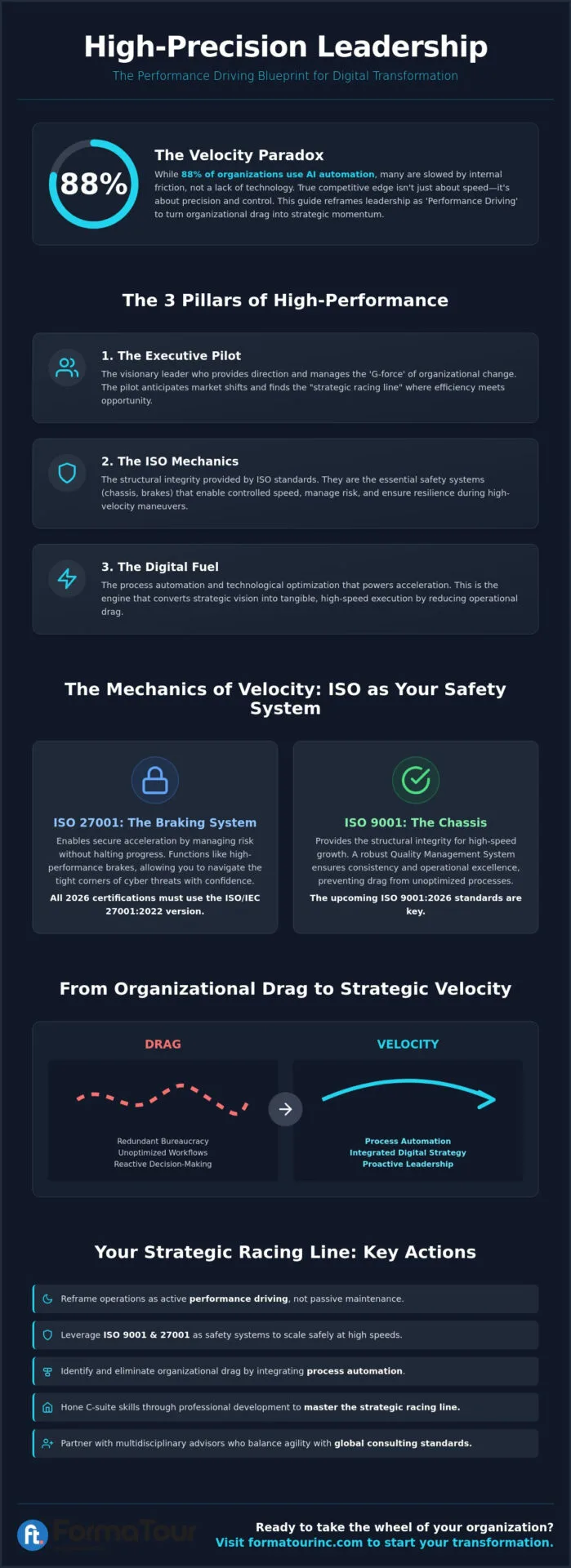
Organizational velocity has become the primary differentiator for Canadian firms. With the global AI automation market reaching $169.46 billion this year, the speed of digital evolution is no longer optional. But speed without control leads to failure. True leadership requires a balance of three critical pillars:
- The Executive Pilot: The visionary leader who provides direction and manages momentum.
- ISO Mechanics: The structural integrity provided by standards like ISO 9001 and ISO 27001.
- Digital Fuel: The process automation and technological optimization that powers acceleration.
The Executive as the High-Performance Pilot
An elite pilot doesn’t just look at the dashboard; they look three turns ahead. In the boardroom, this translates to anticipating market shifts before they appear on a quarterly report. Managing the ‘G-force’ of rapid organizational change requires a steady hand and a refined Business performance management framework to ensure the team remains aligned during high-speed maneuvers. This isn’t about reckless risk. It’s about finding the strategic racing line where efficiency meets opportunity and precision drives results.
Why ‘Operating’ Is No Longer Enough
Inertia is the silent killer of the modern enterprise. When a firm remains in ‘maintenance mode’, it accumulates operational friction that slows down every decision. Performance driving principles focus on reducing this ‘drag’ by optimizing core workflows and eliminating redundant layers of bureaucracy. Moving from a reactive stance to one of competitive acceleration means your leadership team isn’t just responding to the market; they’re dictating its pace. At Formatour Incorporated, we see this transformation as a necessary evolution for any organization seeking to thrive amidst the complexities of 2026. The goal is to move beyond mere survival and enter a state of sustainable, high-speed performance.
The Mechanics of Velocity: ISO Standards as Your Safety System
High-velocity growth requires more than just a powerful engine; it demands a structural integrity that can withstand the pressures of rapid scaling. In the world of performance driving, a driver’s confidence is directly proportional to the reliability of their safety systems. For an organization, ISO standards provide this essential framework. They transform a chaotic sprint into a controlled, high-speed maneuver. Without these systems, acceleration often leads to structural failure or a loss of control that can jeopardize the entire enterprise.
ISO 27001: Secure Acceleration
Information security is frequently viewed as a friction point, yet in a digital-first economy, it’s the essential braking system that enables speed. Just as a racing pilot relies on high-performance brakes to navigate tight corners, an executive uses ISO 27001 implementation services to manage risk without halting progress. Security must be integrated into the core engine of the business. By adopting strategic leadership principles, executives can view compliance as a roll cage for their data. This perspective ensures that even as the organization accelerates into new markets, its intellectual property and client trust remain protected against the turbulence of cyber threats. All new certifications in 2026 must adhere to the ISO/IEC 27001:2022 version, reflecting a global commitment to modern security standards.
Quality and Resilience: ISO 9001 and 22301
Operational excellence is built on the consistency of every lap. When processes are unoptimized, the organization suffers from drag that wastes resources and slows execution. Implementing ISO 9001 quality management implementation provides the chassis for your firm, ensuring that every workflow is lean and repeatable. With the transition to ISO 9001:2026 approaching in September, now is the time to refine these mechanics. This standard ensures that quality is a constant, even when the pace of the market increases.
Resilience is equally vital for long-term success. ISO 22301 focuses on business continuity, giving your team the tools to recover from a market skid without losing total momentum. It builds the organizational muscle memory required to handle disruptions, whether they’re regulatory shifts or economic downturns. These certifications act as a global license to operate, signaling to partners and stakeholders that your firm is engineered for high-stakes competition. If you’re ready to stabilize your organization’s growth trajectory, you might consider how a tailored gap analysis can identify where your current systems need reinforcement.
Executive Leadership: Mastering the Strategic Racing Line
In high-stakes competition, the racing line represents the most efficient path through a circuit, allowing for maximum speed while maintaining total control. For the modern executive, mastering this line means developing a “C-suite eye” for identifying strategic apexes; those critical moments where market shifts and internal capabilities intersect. Performance driving at this level isn’t just about individual skill. It’s about the ability to maintain clarity and precision while the organization scales at pace. It requires a transition from simply managing departments to orchestrating a high-performance ecosystem where every team member is empowered to ‘drive’ their specific sector with autonomy and alignment.
The synergy between leadership development and organizational evolution is the engine of sustainable growth. When leaders invest in their own professional development, they don’t just gain new tools; they sharpen their ability to anticipate the road ahead. This foresight is what separates reactive management from visionary leadership. It’s about building a culture that values intelligence, agility, and the seamless integration of high-level concepts into daily operations. By cultivating this mindset, executives ensure the organization doesn’t just react to the current market lap but prepares for the next series of turns.
Empowering the Next Generation of Pilots
The transition from technical expertise to strategic mastery is a defining challenge for leaders in 2026. As full-scale enterprise adoption of AI reached 24% this year, the bottleneck for most firms has shifted from technology to vision. Leaders must move beyond understanding the ‘how’ of digital tools and focus on the ‘why’ of strategic transformation. This is why leadership training for digital transformation is no longer an optional luxury but a core requirement for organizational health. Engaging in international seminars allows executives to benchmark their performance against global standards, ensuring they remain knowledgeable about international trends while staying grounded in practical application.
The Strategic Project Management Pit Crew
Even the most talented pilot cannot win a race without an elite pit crew. In a corporate environment, this crew is your agile advisory team. Success is rarely a solo endeavor; it’s a co-development of solutions between visionary leaders and seasoned mentors. By utilizing project management studies and specialized advisory services, organizations can optimize every ‘pit stop’; those vital moments of strategic recalibration or digital implementation. This methodical approach ensures that the transformation journey remains efficient and that the organization doesn’t lose momentum during complex pivots. At Formatour Incorporated, we act as that expert partner, providing the steady hand and strategic foresight needed to navigate the most complex organizational landscapes with confidence.
Overcoming Organizational Friction: Process Automation and Digital Strategy
Organizational drag is the invisible force that prevents even the most sophisticated strategy from reaching its top speed. In performance driving, aerodynamic drag is managed through precision engineering; in business, this drag manifests as legacy processes, manual data entry, and siloed communication. By 2026, the global RPA market is expected to exceed $1.70 billion, reflecting a widespread recognition that manual tasks are the friction points of the modern enterprise. Research indicates that companies implementing robotic process automation can achieve an average return on investment of 200% to 300% within the first twelve months. This isn’t just about saving time. It’s about reallocating human capital toward high-level strategic maneuvers that drive value.
Digital transformation isn’t a single race with a static finish line. It’s a continuous lap that requires constant adjustment and optimization. When every department operates with the same technical precision, the entire organization moves as a single, cohesive unit. Aligning IT certifications and process optimizations with your broader strategic goals creates a future-proof team that can handle the complexities of a blended human-AI ecosystem. This alignment ensures that your technological investments serve the strategy, rather than the strategy being limited by the tools.
The Digital Transformation Strategy
Navigating the current era of hyperautomation requires a focus on agility. Partnering with a specialized digital transformation strategy firm allows your organization to move beyond experimental AI and into scalable implementation. Automation serves as a tool for precision rather than just raw speed. It ensures that data flows seamlessly across departments, providing the executive pilot with real-time telemetry to make informed decisions under pressure. Integrating these optimizations into the daily rhythm of the organization ensures that excellence becomes a standard operational procedure.
Sustainable Excellence and ISO 14001
Sustainable excellence has evolved into a core component of organizational resilience. Environmental management is no longer a secondary concern; it’s a competitive necessity that dictates long-term viability. Utilizing ISO 14001 certification services allows a firm to improve its “fuel efficiency” by optimizing resource use and reducing waste. This standard, which integrated climate change considerations in 2024, provides a framework for sustainable growth that aligns with international benchmarks. It ensures that your organization remains lean and efficient, capable of maintaining high performance without depleting the resources necessary for future laps. If you’re ready to audit your current workflows and eliminate the drag slowing your acceleration, you can schedule a strategic consultation with our advisory team today.
Implementation: Partnering for Sustainable Performance Driving
Implementing the principles discussed throughout this guide requires more than just a theoretical understanding; it necessitates a partner who can bridge the gap between vision and execution. Formatour Incorporated delivers this through a unique combination of boutique agility and big-firm consulting standards. Our multidisciplinary advisory approach ensures that your organization doesn’t just improve in silos. Instead, we co-develop a holistic high-performance environment where ISO mechanics, leadership mastery, and digital fuel work in harmony. This integrated strategy is why Canadian firms seeking sustainable growth trust our team to guide their transformation journeys. Our advisory services provide a comprehensive project management framework that aligns with your specific market objectives, ensuring that every strategic pivot is backed by data and international benchmarks.
The Audit: Checking Your Vehicle’s Readiness
Before accelerating, you must understand the current state of your organizational machinery. A comprehensive gap analysis serves as the diagnostic tool to identify where your firm is leaking ‘horsepower’ through inefficient workflows or security vulnerabilities. We view internal auditing as a proactive instrument for continuous improvement rather than a mere compliance exercise. By identifying these friction points, you can reduce your operational ‘lap times’ and move toward a culture where performance driving is embedded in every department. This process transforms ISO certification from a static badge into a dynamic engine for quality and resilience. It’s about moving beyond the minimum requirements to reach a state of peak operational health.
Your Journey to the Podium
The path to international certification and strategic excellence is methodical and deliberate. During the implementation of complex standards like ISO 9001:2026 or ISO 27001:2022, our consultants provide the steady hand needed to navigate regulatory nuances without sacrificing speed. This journey also involves a deep commitment to human capital. The long-term impact of executive coaching and leadership development programs ensures that your C-suite remains capable of high-precision maneuvers in a fast-paced market. You’ll gain the confidence to lead through complexity, knowing that your governance systems are as robust as your strategic vision.
As you look toward the strategic horizon of 2026, the choice of partner will define your velocity. Whether you’re seeking to optimize your environmental management systems or lead a digital-first transformation, a structured roadmap is essential for reaching the podium. You’re invited to Contact Formatour Incorporated to start your performance driving journey today and secure your firm’s position as a leader in the global marketplace.
Accelerating Your Strategic Transformation
Mastering the discipline of performance driving requires a seamless integration of visionary leadership, rigorous international standards, and optimized digital workflows. By viewing ISO certifications as essential safety systems and automation as a strategic turbocharger, your organization can navigate the complexities of the 2026 market with unprecedented precision. Success is no longer measured by raw speed alone; it’s defined by the ability to maintain control and resilience while scaling at pace.
Formatour Incorporated brings over a decade of expertise in ISO implementation and strategic transformation to your executive team. Our multidisciplinary approach combines boutique agility with big-firm consulting standards, providing the steady hand needed to guide your organization through its most critical pivots. We’re dedicated to co-developing solutions that foster long-term growth and operational excellence through a collaborative partnership. This tailored guidance ensures that your firm doesn’t just keep pace with the market but sets the standard for others to follow.
Drive your organization to the next level with Formatour’s expert advisory services.
Your journey toward the strategic podium begins with a single, decisive turn toward excellence. We look forward to facilitating your success.
Frequently Asked Questions
What is performance driving in a business context?
In a corporate environment, performance driving refers to the shift from passive business operations to active, strategic intent. It’s a disciplined approach where leaders act as pilots, using data and governance as their vehicle to navigate market shifts with precision. This mindset focuses on balancing organizational velocity with structural integrity to ensure sustainable growth without losing control during rapid scaling.
How do ISO standards improve organizational performance?
ISO standards provide a robust framework that reduces operational friction and ensures consistency across all workflows. They act as the chassis and braking system of a company, allowing for safe acceleration in competitive markets. By standardizing quality and security, firms eliminate waste and build a reliable foundation for high-speed strategic execution and international expansion.
Can digital transformation actually increase my company’s speed?
Digital transformation increases velocity by replacing manual, high-drag processes with automated, intelligent workflows. In 2026, research indicates that 88% of organizations use AI automation to improve efficiency in at least one business function. This shift allows teams to execute strategies faster while significantly reducing the risk of human error during complex maneuvers.
What is the difference between ISO 27001 and ISO 9001 for business growth?
ISO 9001 focuses on quality management and process consistency, while ISO 27001 centers on information security and risk mitigation. Think of ISO 9001 as ensuring your vehicle is built correctly for the race. ISO 27001 provides the essential protection needed to scale into high-stakes global markets without compromising sensitive intellectual property or client trust.
Why is executive leadership development critical for strategic transformation?
Leadership development equips the pilot with the vision and decision-making skills required to handle rapid organizational change. It facilitates the transition from technical expertise to strategic mastery. This training ensures leaders can identify market openings and manage the pressure of digital evolution without losing momentum or clarity during a transformation journey.
How does Formatour Incorporated help Canadian firms achieve international standards?
Formatour provides a multidisciplinary advisory approach that combines boutique agility with global consulting standards. We guide firms through gap analyses, internal audits, and the implementation of complex ISO frameworks tailored to their specific goals. Our team acts as a strategic mentor, ensuring that certification leads to a true culture of excellence rather than a mere compliance exercise.
Is process automation necessary for high-performance driving in business?
Automation is the turbocharger for modern performance driving, as it removes the manual drag slowing down organizational acceleration. With the global RPA market reaching over $1.70 billion in 2026, automation is a requirement for competitive firms. It provides the precision and data telemetry required for real-time executive decision-making and sustainable operational efficiency.
What are the benefits of ISO 22301 for organizational resilience?
ISO 22301 establishes a business continuity management system that helps organizations recover from disruptions without losing total momentum. It builds the organizational muscle memory needed to handle market skids or unexpected crises effectively. This resilience ensures that the company can maintain its performance driving trajectory even during turbulent economic cycles or regulatory shifts.
