

Environmental compliance is no longer a defensive cost center; in 2026, it’s the primary engine of organizational resilience. Many executives find the recent shift to the ISO 14001:2026 standard daunting, especially with its rigorous new focus on climate-related risks and lifecycle perspectives. It’s understandable to feel that aligning these complex environmental goals with daily operational performance is a significant hurdle. However, choosing the right ISO 14001 certification services can transform this perceived burden into a strategic asset that secures international market eligibility and strengthens your brand’s integrity.
You’ll discover how to navigate the 2026 updates without exhausting your internal resources or disrupting your core business objectives. We’ll outline a clear path toward building a robust Environmental Management System (EMS) that integrates seamlessly with your existing ISO 9001 or ISO 27001 frameworks. This guide provides the executive foresight needed to move beyond simple checklists and toward a model of sustainable excellence that drives long-term growth.
Key Takeaways
- Discover how to leverage the 2026 ESG reporting requirements as a catalyst for strategic growth rather than a mere compliance hurdle.
- Learn the core pillars of a high-performance environmental framework, including the critical role of leadership in the Plan-Do-Check-Act cycle.
- Identify the essential steps for a zero-non-conformance outcome by utilizing specialized ISO 14001 certification services for gap analysis and internal auditing.
- Explore the advantages of the High-Level Structure, which allows for the seamless integration of environmental goals with your existing ISO 9001 or 27001 systems.
- Understand why a multidisciplinary advisory approach is vital for transforming environmental governance into a measurable competitive advantage.
Beyond Compliance: The Strategic Value of ISO 14001 Certification Services in 2026
ISO 14001 isn’t a mere administrative hurdle or a collection of restrictive policies. It is a sophisticated blueprint designed to harmonize environmental stewardship with operational excellence. By adopting this standard, organizations transition from a reactive stance on regulation to a proactive strategy of resource optimization. Modern ISO 14001 certification services provide the necessary framework to turn ecological responsibility into a measurable driver of profitability. This evolution is particularly critical as we move through 2026, where the distinction between “green” initiatives and core business strategy has entirely dissolved.
The regulatory environment in Canada has reached a pivotal turning point. Mandatory ESG reporting requirements now apply to a broader range of Canadian enterprises, demanding verifiable data on carbon footprints and sustainability metrics. Implementing the ISO 14000 family of standards ensures that your organization possesses the structural integrity to meet these demands with precision. It simplifies the reporting process by embedding data collection into daily workflows, ensuring that compliance is a natural byproduct of your operations rather than a seasonal crisis.
Choosing a partner for this transition requires a careful balance of authority and flexibility. While large, rigid certification bodies often apply a one-size-fits-all methodology, boutique advisory firms offer a level of agility that respects your unique organizational culture. This “boutique agility” allows for a tailored implementation that moves at the speed of your business. It ensures that your ISO 14001 certification services are integrated into your specific procurement cycles and international expansion plans, providing a distinct competitive edge in global markets that prioritize sustainable supply chains.
The ROI of Environmental Management Systems (EMS)
A well-structured EMS delivers tangible financial returns by identifying systemic inefficiencies. Waste isn’t just an environmental issue; it’s a financial leak. By refining material usage and energy consumption, firms see a direct improvement in their operational margins. Beyond immediate savings, a certified EMS often leads to:
- Reduced Liability: Lowering the risk of environmental incidents directly decreases long-term legal exposure and potential fines.
- Insurance Optimization: Canadian insurers increasingly recognize ISO 14001 as a sign of superior risk management, often leading to reduced premiums.
- Stakeholder Trust: Verifiable certification builds brand equity with investors and consumers who demand transparency and ethical governance.
ISO 14001 as a Catalyst for Strategic Transformation
Environmental standards act as a powerful catalyst for broader digital transformation. To track environmental metrics effectively, organizations must often upgrade their legacy systems and adopt process automation. This modernization doesn’t just help the planet; it makes the entire business more responsive and data-driven. Executive leadership plays a vital role here by fostering a culture where every employee understands their contribution to the organization’s environmental footprint. An Environmental Management System is the intersection of governance and ecological responsibility.
The Architecture of a High-Performance ISO 14001:2026 Framework
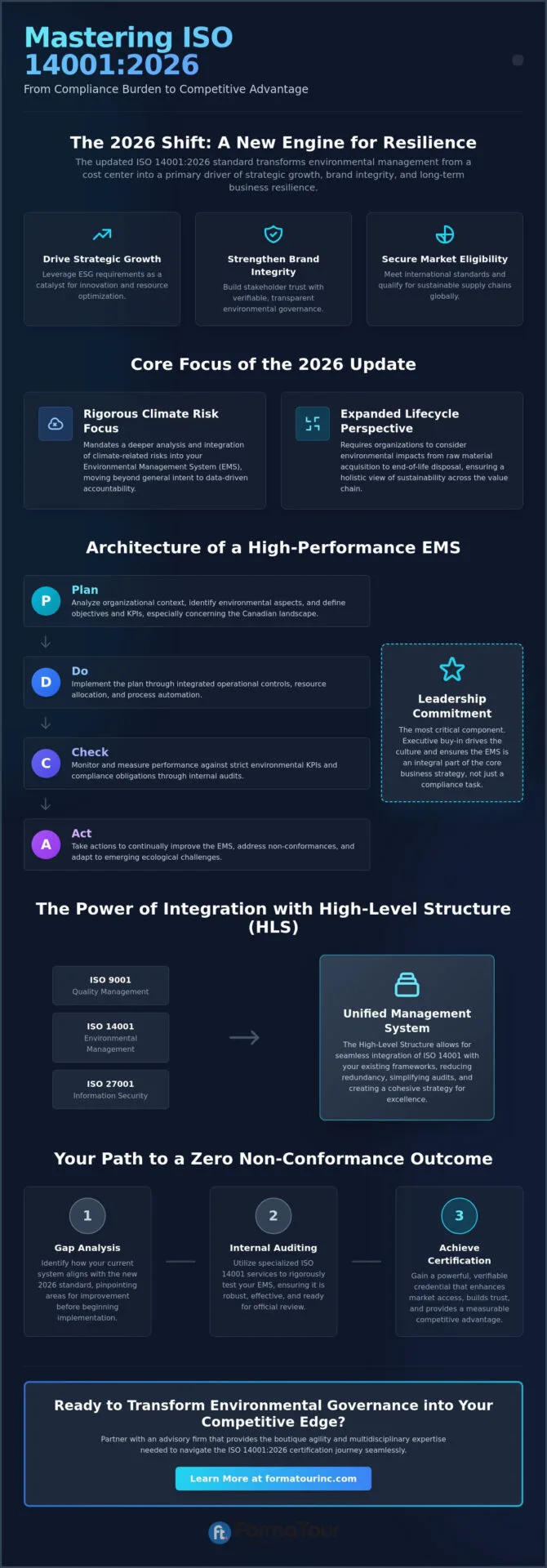
The publication of ISO 14001:2026 in April 2026 introduced a more rigorous architecture for environmental governance. This new version replaces the ISO 14001:2015 standard, moving beyond general intent to specific, data-driven accountability. At its core, the high-performance framework utilizes the Plan-Do-Check-Act (PDCA) cycle as a strategic project management tool. “Plan” now requires a deeper analysis of the organizational context, specifically identifying environmental aspects unique to the Canadian landscape, such as resource availability and regional biodiversity. “Do” focuses on the execution of these plans through integrated operational controls. “Check” involves monitoring performance against strict KPIs, while “Act” ensures the system evolves to meet emerging ecological challenges.
Leadership commitment is the most critical component of this architecture. The 2026 standard dictates that environmental policy must be a C-suite priority, not a delegated task. When executives own the environmental vision, it trickles down into every operational layer, fostering a culture of stewardship. This top-down approach is essential when integrating ISO 14001 certification services into existing business continuity or quality management systems. It ensures that resources, both human capital and technological, are properly allocated to support the Environmental Management System (EMS). This iterative approach ensures that your organization remains resilient against both regulatory shifts and environmental volatility.
Core Pillars of the 2026 Standard
The 2026 revision places a heavy emphasis on risk-based thinking. This involves identifying potential environmental disruptions, including climate-related risks, before they impact the bottom line. Supply chain transparency has also become a mandatory pillar. Organizations must now demonstrate a lifecycle perspective, ensuring that their environmental controls extend to suppliers and external partners. This level of oversight requires robust IT resources and process automation to track data across complex global networks.
Navigating the 2026 Transition Requirements
Organizations currently holding 2015 certifications have a three-year transition period to migrate to the 2026 version. The deadline for this transition is May 2029. Delaying this process increases the risk of certification gaps, which can disqualify firms from international procurement opportunities. Engaging professional ISO 14001 certification services during this window ensures that your internal teams are prepared for the more structured management review requirements. If you’re ready to begin this migration, it’s wise to speak with a strategic advisor to map out your timeline.
Navigating the Certification Journey: Gap Analysis and Internal Audits
Achieving a zero-non-conformance outcome during a final audit is a testament to an organization’s operational discipline. It isn’t a result of luck but of a systematic evaluation of current states against the rigorous 2026 standards. Professional ISO 14001 certification services provide the expertise needed to navigate this transition, ensuring that every operational pillar aligns with the latest requirements for climate risk and supply chain transparency. This journey begins with a clear-eyed assessment of your organization’s existing governance and its readiness for transformation.
An external advisory perspective is vital for identifying blind spots in environmental governance. Internal teams often develop a level of comfort with legacy processes that can obscure systemic risks. By engaging an objective partner, leadership can uncover these hidden vulnerabilities before they escalate into audit failures. This strategic foresight ensures that the Environmental Management System (EMS) is not just a document on a shelf but a living framework that drives stability and growth.
The Strategic ISO Gap Analysis
A gap analysis serves as a vital diagnostic tool for organizational health, pinpointing exactly where your current practices diverge from the 2026 mandate. By utilizing specialized ISO gap analysis services, leadership teams receive a prioritized roadmap for remediation. This process moves beyond surface-level compliance to evaluate how your EMS integrates with your broader business objectives. It identifies resource deficiencies and structural weaknesses, allowing the C-suite to allocate capital and human resources where they’ll have the greatest impact on long-term sustainability.
Internal Auditing as a Performance Tool
Internal audits shouldn’t be viewed merely as a dress rehearsal for the final certification. They’re a powerful mechanism for driving operational performance consulting initiatives across the enterprise. Engaging ISO internal audit services allows you to stress-test your systems in a controlled environment. These audits prepare your staff for the scrutiny of external bodies while fostering a culture of continuous improvement.
Objective, multidisciplinary auditors bring a fresh lens to your environmental governance. They ensure that every aspect of the 2026 lifecycle requirements is addressed with precision. This proactive approach to ISO 14001 certification services transforms the auditing process from a stressful obligation into a strategic exercise in organizational refinement and resilience.
The Power of Integration: ISO 14001, 9001, and 27001
Strategic growth in 2026 is defined by the seamless fusion of disparate management standards into a single, high-performance engine. The Annex SL High-Level Structure (HLS) serves as the architectural foundation for this integration, providing a common set of terms and definitions across all ISO standards. This harmonized approach allows organizations to manage quality, information security, and environmental impact without creating redundant silos. When organizations utilize multidisciplinary ISO 14001 certification services, they transition from managing individual compliance tasks to overseeing a unified strategy that enhances total organizational health.
Organizations that have already established a foundation in quality management find that environmental management system implementation is significantly more efficient. The existing ISO 9001 quality management implementation frameworks provide the necessary infrastructure for document control, management reviews, and corrective action processes. By leveraging these shared elements, the C-suite can accelerate the deployment of environmental controls while maintaining the structural integrity of their operations. This synergy ensures that sustainability goals are not just added onto the business but are woven into the very fabric of how quality is defined and delivered.
The intersection of ISO 27001 and ISO 14001 is increasingly critical for digital-first enterprises. As data centers and IT infrastructure expand, their environmental footprint becomes a significant component of the organization’s overall impact. Managing information security alongside environmental stewardship ensures that digital transformation initiatives are both secure and sustainable. This holistic view of risk management is a hallmark of modern ISO 14001 certification services, protecting the brand from both data breaches and ecological liabilities simultaneously.
Building an Integrated Management System (IMS)
An IMS streamlines policies by creating unified documentation for quality, security, and the environment. This reduction in administrative complexity empowers cross-functional teams to manage multiple compliance pillars through a single interface. Such a streamlined approach directly supports organizational resilience consulting goals by ensuring that the business remains agile and responsive to various external pressures. A unified system fosters a culture of comprehensive excellence where every employee understands their role in the broader corporate strategy.
Efficiency Gains in Multidisciplinary Auditing
Audit fatigue is a genuine threat to operational momentum, often caused by repetitive, overlapping assessments from different certification bodies. Combining audit schedules through a multidisciplinary advisory firm drastically reduces operational downtime. By leveraging shared resources for monitoring and measurement across standards, firms can orchestrate a multi-ISO rollout that is both cost-effective and strategically aligned. If you are seeking to consolidate your compliance efforts, you can contact our advisory team to discuss a customized integration roadmap.
The Formatour Advantage: Premium ISO 14001 Advisory in Canada
Formatour Incorporated positions itself as a visionary architect for organizations seeking more than a compliance checkbox. While accreditation bodies provide the necessary oversight, they lack the advisory depth required to weave environmental goals into a broader corporate strategy. Our ISO 14001 certification services deliver a unique blend of big-firm technical standards and boutique agility. This allows us to move at the speed of your business, providing a tailored implementation that respects your specific culture while meeting the highest international benchmarks. We act as a steady, expert hand, guiding your leadership through the complexities of global systems to ensure stability and growth.
Our multidisciplinary approach is built on three pillars: Strategy, Transformation, and Resilience. We don’t view environmental management in isolation. Instead, we see it as a critical component of a healthy, future-proof organization. By choosing a Canadian-based partner with a global perspective, you gain the advantage of local market intelligence combined with a deep understanding of international trade requirements. We co-develop solutions that don’t just meet the 2026 mandate but actively contribute to your long-term operational performance and brand equity.
Multidisciplinary Expertise for Global Resilience
Success in the modern landscape requires a partner whose expertise spans the entire organizational spectrum. Our advisory services range from specialized leadership training to the technical nuances of ISO implementation. We believe that an Environmental Management System is only as strong as the leaders who champion it. By integrating your EMS with a comprehensive digital transformation strategy, we help you automate complex reporting tasks and gain real-time insights into your environmental footprint. This synergy reduces the administrative burden on your staff and provides the data needed for informed executive decision-making. Our goal is to empower your team, fostering a feeling of security through strategic foresight and technical precision.
Your Strategic Partner for 2026 and Beyond
A certification should never be the end of the conversation. We ensure that your EMS remains a living system that evolves as your business scales and as global standards shift. Through our international seminars and ongoing leadership development programs, we provide your team with the tools to maintain excellence over the long term. This steady guidance fosters a sense of trust and predictable growth in an increasingly volatile world. We remain an active participant in our clients’ progress, ensuring that every structural change leads to a tangible, positive outcome for the organization and the environment alike. Contact Formatour Incorporated today for a strategic ISO 14001 consultation.
Building a Resilient Legacy Through Strategic Environmental Governance
The transition to the ISO 14001:2026 standard represents a definitive shift from administrative compliance to strategic business transformation. By integrating environmental stewardship with established quality and security frameworks, your organization secures a powerful competitive advantage in the global market. You’ve seen how a robust Environmental Management System fosters operational efficiency and satisfies the increasing demands for transparent ESG reporting. Leveraging professional ISO 14001 certification services ensures that this journey is methodical, resource-efficient, and aligned with your long-term growth objectives.
Formatour Incorporated brings over a decade of multidisciplinary advisory experience to your transition, offering specialized expertise across ISO 27001, 9001, and 14001. As a premium Canadian advisory firm, we focus on co-developing solutions that drive resilience and excellence. Our approach balances high-level authority with the boutique agility needed to address your unique organizational landscape. It’s time to transform your environmental commitments into a sustainable engine for success. Secure Your Organization’s Future with ISO 14001 Certification Services and take the first step toward a more resilient, data-driven future.
Frequently Asked Questions
What is the primary difference between ISO 14001:2015 and the 2026 update?
The primary difference is the explicit inclusion of climate change considerations and a stronger emphasis on biodiversity and lifecycle management. The 2026 update requires organizations to analyze climate-related risks as part of their environmental context. This shift ensures that the Environmental Management System (EMS) remains resilient against evolving global ecological challenges. It’s an evolution that moves beyond general intent toward data-driven accountability.
How long does the ISO 14001 certification process typically take for Canadian firms?
The certification timeline typically ranges from six to eighteen months depending on the organization’s size and current maturity. Small businesses may achieve readiness faster, while larger enterprises require more time for documentation and internal audits. Engaging professional ISO 14001 certification services often accelerates this timeline by providing a structured roadmap and avoiding common implementation errors that lead to delays.
Can ISO 14001 be implemented alongside ISO 9001 and ISO 27001?
Yes, these standards are designed to be integrated through the High-Level Structure (HLS). This unified architecture allows for shared documentation and management reviews, which significantly reduces administrative redundancy. Organizations that integrate quality, security, and environmental management often see higher efficiency gains and a more cohesive corporate culture. It’s a strategic way to manage multiple facets of organizational health through one framework.
What are the most common environmental risks identified during a gap analysis?
Common risks include regulatory non-compliance, resource scarcity, and supply chain vulnerabilities. A gap analysis often reveals blind spots in waste management protocols or energy consumption tracking that leadership might have overlooked. Identifying these risks early allows the C-suite to implement corrective actions before they impact operational continuity. This proactive approach ensures the brand’s integrity remains protected in a sustainability-focused market.
Is ISO 14001 certification mandatory for doing business in Canada?
ISO 14001 is not a legal requirement for all Canadian businesses, but it’s increasingly mandatory for government procurement and international trade. Many large corporations now require their suppliers to hold this certification to satisfy their own ESG reporting obligations. Achieving certification ensures your organization remains eligible for high-value contracts and maintains a competitive edge in both local and global landscapes.
How does an Environmental Management System (EMS) improve operational performance?
An EMS improves performance by identifying systemic waste and optimizing resource utilization throughout the organization. By refining energy consumption and material usage, firms see a direct reduction in operational costs and insurance premiums. It also fosters a culture of continuous improvement where data-driven decisions replace reactive measures. This leads to long-term stability and ensures that environmental goals align with financial objectives.
What is the role of executive leadership in ISO 14001 success?
Executive leadership must provide the strategic vision and resource allocation necessary for the management system to thrive. The 2026 standard places direct accountability on the C-suite for the effectiveness of the environmental policy. When leaders champion these initiatives, they ensure that environmental stewardship becomes a core component of the organizational identity. This top-down commitment is vital for fostering a culture of stewardship.
How does Formatour Incorporated support firms during the external audit phase?
Formatour Incorporated provides a steady, expert hand by conducting pre-certification audits and preparing staff for the rigor of external scrutiny. Our ISO 14001 certification services include a strategy focused on a zero-non-conformance outcome by identifying potential issues before the final assessment. We act as a supportive partner, ensuring your documentation and processes are robust enough to withstand the scrutiny of international certification bodies.
