

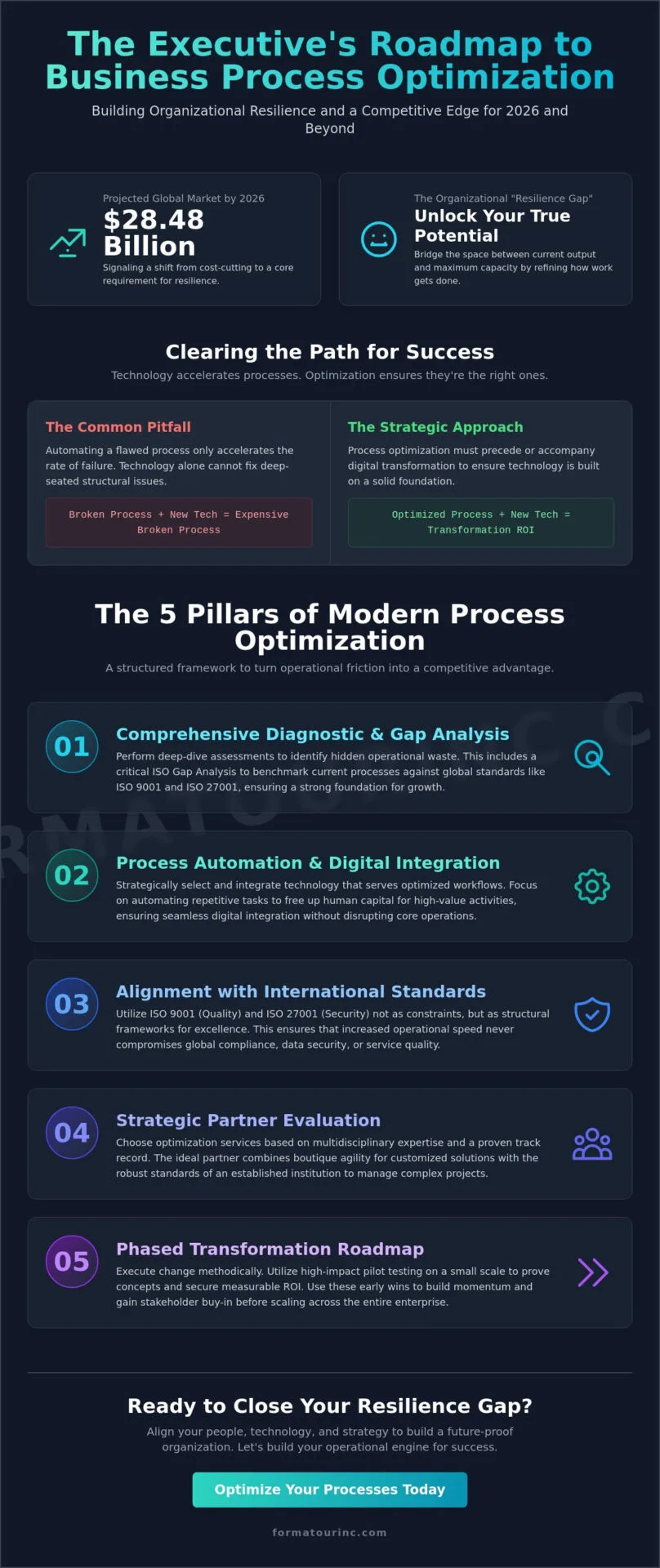
By the end of 2026, the global market for business process monitoring and optimization is projected to reach $28.48 billion; this growth signals a definitive shift from simple cost-cutting to a core requirement for organizational resilience. You’ve likely felt the friction of siloed departments or the persistent anxiety that rapid digital growth might compromise your hard-won ISO 9001 or ISO 27001 certifications. It’s a common challenge for leaders who refuse to sacrifice structural integrity for the sake of speed. Selecting the right business process optimization services is no longer just about efficiency, it’s about building a foundation that can withstand global regulatory shifts and technological acceleration.
We understand that your goal is to foster a culture of excellence without disrupting the delicate balance of your existing governance. This article provides a strategic roadmap to identify hidden inefficiencies and implement high-performance frameworks that align your operational pace with international standards. You’ll discover a comprehensive executive checklist for 2026, covering essential updates like the ISO 9001:2026 revision and the integration of AI-driven process intelligence to ensure your organization remains both compliant and competitive.
Key Takeaways
- Learn how to align human capital and digital technology to navigate 2026 market volatility with both boutique agility and institutional standards.
- Discover the five pillars of modern optimization, beginning with a comprehensive diagnostic phase that prioritizes long-term organizational health.
- Understand how to utilize ISO 9001 and ISO 27001 as structural frameworks to ensure operational speed never compromises global security or quality compliance.
- Identify the critical criteria for evaluating business process optimization services, focusing on multidisciplinary expertise and a proven track record in project execution.
- Implement a phased transformation roadmap that utilizes high-impact pilot testing to secure measurable results before scaling across the entire enterprise.
The Strategic Value of Business Process Optimization Services in 2026
Business process optimization represents the systematic alignment of an organization’s people, technology, and strategy. It’s a deliberate practice designed to refine workflows so they’re as efficient and effective as possible. This discipline is deeply rooted in the broader field of Business Process Management (BPM), which provides the necessary governance to oversee complex organizational workflows. In 2026, the global landscape has shifted significantly. Market volatility now demands a unique combination of boutique agility and big-firm standards. Executives can no longer afford to be reactive. They’re increasingly investing in business process optimization services to build proactive organizational resilience. This shift introduces the concept of Transformation ROI. Success in this new era is measured by structural integrity and market responsiveness, moving far beyond simple, short-term cost reductions.
Why Operational Performance is the New Competitive Moat
For leaders navigating the Canadian market, the ability to pivot faster than competitors has become a primary differentiator. Streamlined operations act as a shield against external economic shocks. In high-stakes industries, process clarity is also directly linked to employee retention. When teams understand their roles within a logical, frictionless framework, professional frustration decreases and productivity rises. Many organizations currently operate within what we call a Resilience Gap. This is the measurable space between their current output and their true potential capacity. Closing this gap requires a disciplined focus on how work actually gets done every day.
Digital Transformation vs. Process Optimization
It’s a common executive pitfall to assume that technology alone solves deep-seated structural issues. The reality is that organizational digital transformation services often fail to deliver results if the underlying processes are fundamentally broken. Automating a bad process doesn’t fix it; it only accelerates the rate of failure. High-performing firms recognize that business process optimization services must clear the path for successful technical integration. Strategic transformation defines the destination, while operational optimization builds the engine that ensures the organization actually gets there.
The Executive Checklist: 5 Pillars of Modern Process Optimization
The transition from high-level strategy to operational reality requires a structured framework that balances speed with structural integrity. Modern business process optimization services must address five specific pillars to ensure long-term viability. This checklist serves as a roadmap for executives who demand measurable ROI without sacrificing the governance that protects their organization. According to IBM’s guide to process optimization, the most successful initiatives are those that integrate data-driven insights with a deep understanding of human workflows. Each pillar builds upon the last, creating a cohesive system that transforms operational friction into a distinct competitive advantage.
Pillar 1: Comprehensive Diagnostic & Gap Analysis
A multidisciplinary approach is essential for identifying hidden operational waste that often escapes traditional audits. Formatour leverages boutique agility to perform deep-dive assessments that look beyond the surface of daily tasks. We focus on the health of the entire organizational ecosystem. A critical component of this phase is the ISO Gap Analysis. This process ensures that any proposed changes align with international standards like ISO 9001 and ISO 27001. By identifying the space between current performance and global benchmarks, leaders can make informed decisions that strengthen their foundation while preparing for future growth.
Pillar 2: Process Automation & Digital Integration
Technology selection is a frequent point of failure for many organizations. Leading digital transformation strategy firms prioritize tools that solve specific, documented pain points rather than following industry trends. When identifying where process automation consulting can provide the most value, we look for processes that meet three specific criteria: high volume, low complexity, and a high degree of standardization. Automation is the engine of optimization, but strategy is the steering wheel. Without a clear strategic vision, automation only accelerates existing inefficiencies.
Pillar 3: Strategic Alignment and Compliance
Every refined workflow must support a core business objective. We validate that optimizations meet the rigorous requirements of ISO 9001 for quality and ISO 27001 for security. This “Compliance-First” mindset ensures that as you scale, your risk profile remains manageable. Finally, we establish KPIs that drive continuous improvement. These metrics allow for real-time adjustments, ensuring your business process optimization services deliver value well into the future. If you’re ready to evaluate your current operational health, our experts can guide your initial diagnostic assessment.
Synthesizing Optimization with International Standards: The ISO Advantage
A common misconception suggests that ISO standards introduce unnecessary bureaucracy or slow down decision-making. On the contrary, clear standards eliminate the ambiguity that causes most operational delays. When every team member understands the established quality and security parameters, they can move with greater autonomy and confidence. This structural clarity is exactly what allows for the agility required in today’s volatile markets. It provides a stable platform where innovation can occur without risking the organization’s foundational integrity.
ISO 9001 as a Framework for Continuous Improvement
The Plan-Do-Check-Act (PDCA) cycle within ISO 9001 mirrors the most effective modern optimization methodologies. It creates a closed-loop system where every process win is institutionalized rather than left to chance. Using a quality management system as your foundation ensures that improvements are documented, measured, and consistently applied across the organization. Internal auditing then shifts from a punitive exercise to a strategic tool for maintaining your newly optimized state. This disciplined approach allows leaders to identify minor drifts in performance before they become major operational failures.
Securing the Stream: ISO 27001 and Process Security
In 2026, process optimization must include rigorous data governance to be considered successful. As workflows become more integrated and automated, the surface area for potential security risks increases. Protecting your intellectual property during digital transformation initiatives is non-negotiable. Our ISO 27001 implementation services bridge the gap between high-level information security management and daily operational performance. This integration ensures that your data remains a protected asset rather than a liability. When security is woven into the process design itself, it becomes a seamless part of the user experience rather than a friction-filled hurdle. This synergy between protection and performance is what defines a truly resilient organization.
Evaluating Advisory Partners: How to Choose Optimization Services
Selecting a partner to refine your operational core requires more than a simple review of technical capabilities. It demands a rigorous evaluation of how an advisory firm integrates strategic vision with international compliance standards. Effective business process optimization services provide a necessary bridge between your current state and a future of sustainable growth. When vetting potential partners, executives should prioritize firms that demonstrate a multidisciplinary approach. This means the consultant must understand both the nuances of your industry strategy and the technical requirements of global governance frameworks.
Beyond expertise, the implementation track record is a decisive factor. Many firms deliver impressive reports but vanish when the difficult work of execution begins. You need a partner who remains active throughout the transformation lifecycle. Cultural alignment is equally vital. The right firm doesn’t just change processes; they coach your executive leadership to lead through the transition. Finally, ensure they understand the local context. High-quality business process optimization services in the Canadian market require specific knowledge of regional regulatory landscapes that global generalists often overlook.
Boutique Agility vs. Big-Firm Inertia
Large consulting entities often suffer from institutional inertia, relying on templated solutions that fail to account for unique organizational health. Boutique firms offer a distinct advantage through personalized studies and project management. This high-touch approach ensures that every optimization effort is tailored to your specific objectives. Formatour acts as a seasoned strategic mentor, offering the sophisticated standards of a global firm with the agility of a dedicated partner. We focus on the co-development of solutions that feel both modern and deeply established.
The Role of Professional Development in Process Success
Optimization efforts often fail because the human element is ignored. Process refinement is only sustainable if your team has the skills to manage it. This is why leadership training for digital transformation is a non-negotiable pillar of our methodology. We also emphasize the value of IT certification training to future-proof your technical staff. Participating in international seminars can further broaden an executive’s perspective, providing access to global benchmarks that drive internal excellence.
To ensure your next operational shift is guided by expert hands, contact our multidisciplinary advisory team for a strategic review of your goals.
From Strategy to Sustainability: Executing Your Transformation Roadmap
Executing a transformation requires a methodical approach that moves from high-level vision to ground-level sustainability. Successful business process optimization services aren’t just about the initial design; they’re about the disciplined execution of a multi-phased roadmap. By selecting comprehensive business process optimization services that prioritize both strategy and execution, you ensure your roadmap leads to measurable growth rather than just a collection of reports.
The first phase begins with the establishment of a Strategic Vision and “North Star” metrics. These indicators serve as your primary compass, ensuring every operational adjustment remains anchored to your long-term growth objectives. In Phase 2, we recommend Pilot Testing. By optimizing a single high-impact department first, you can validate your framework in a controlled environment. This approach allows for the identification of unforeseen variables before they impact the entire enterprise. Phase 3 involves scaling this refined framework across the organization with ISO-aligned governance. This step ensures that your new workflows are consistent, secure, and compliant with international standards. Finally, Phase 4 focuses on Monitoring and Iteration. Utilizing project management advisory services is essential to maintain momentum. It prevents the organization from regressing into old habits and ensures that your processes evolve alongside market demands.
Overcoming Resistance to Process Change
The most significant barrier to optimization is rarely technical; it’s the human element. Executive leadership programs play a vital role here by facilitating buy-in at the highest levels. When leaders are equipped to communicate the “Why” behind optimization to front-line staff, they reduce anxiety and foster a sense of shared purpose. We emphasize the use of “Quick Wins” during the early stages of implementation. These small, visible successes build organizational confidence and provide the proof of concept needed to sustain long-term commitment.
Ensuring Long-Term Operational Excellence
To begin your journey toward a more resilient and efficient organization, Connect with Formatour Incorporated to begin your multidisciplinary diagnostic.
Securing Your Path Toward Operational Resilience
The landscape of 2026 demands that organizations move beyond reactive adjustments toward a proactive model of structural integrity. We’ve explored how the integration of international standards like ISO 9001 and ISO 27001 creates a secure environment where operational speed and compliance coexist seamlessly. True success lies in bridging the gap between high-level strategy and daily execution through a phased, sustainable roadmap that prioritizes both technology and human capital. Engaging professional business process optimization services provides the expert guidance necessary to navigate these complex global systems with quiet confidence.
With over a decade of multidisciplinary advisory experience, Formatour Incorporated specializes in implementing ISO 27001, 9001, and 22301 standards. As a Canadian-based firm with global strategic standards, we’re dedicated to helping you close the resilience gap and achieve long-term growth. You’re invited to Request a Strategic Transformation Consultation with Formatour Incorporated to begin refining your operational foundation. Your commitment to excellence today ensures a resilient and prosperous future for your entire organization.
Frequently Asked Questions
What exactly are business process optimization services?
Business process optimization services are professional advisory offerings that systematically align an organization’s people, technology, and strategy to improve workflow efficiency. These services focus on identifying bottlenecks and eliminating redundant tasks to enhance overall performance. By refining how work is conducted, these services ensure that organizational outputs meet high standards of quality and security consistently.
How do optimization services differ from standard business consulting?
Optimization services differ from standard business consulting by focusing specifically on the structural and tactical refinement of internal workflows. While standard consulting often provides broad strategic advice or market entry analysis, optimization is deeply operational. It involves re-engineering existing processes to ensure they’re scalable and compliant with global benchmarks like ISO 9001 or ISO 27001.
How long does a typical process optimization project take for a mid-sized firm?
A typical optimization project for a mid-sized firm generally spans three to six months from the initial diagnostic to the final implementation phase. This timeline allows for a thorough assessment of current gaps and the subsequent pilot testing of new frameworks. Complex organizations with multiple siloed departments may require a more extended period to ensure seamless integration across the entire enterprise.
Will process optimization affect our ISO 9001 or ISO 27001 certification status?
Process optimization will directly strengthen your ISO 9001 and ISO 27001 status when executed with a compliance-first mindset. Rather than compromising your certification, these services institutionalize the Plan-Do-Check-Act cycle. This ensures that your operational speed is built on a foundation of quality management and data security, significantly reducing the risk of non-conformities during external audits.
Can process optimization be done remotely, or is on-site advisory necessary?
Many components of business process optimization services can be delivered remotely through digital collaboration tools and remote data analysis. However, a hybrid model often yields the best results. Initial diagnostic phases and leadership coaching benefit from a periodic on-site presence to capture the cultural nuances of the organization. This ensures the proposed solutions are practical for your specific environment.
What is the expected ROI of business process optimization services in 2026?
In 2026, the ROI of optimization is measured through increased organizational resilience and the ability to pivot faster during market volatility. With the global market for process optimization projected to reach $28.48 billion by the end of the year, firms are seeing returns in reduced cycle times and enhanced data governance. Success is found in closing the gap between current output and potential capacity.
How do you measure the success of a process optimization initiative?
Success is measured using a combination of “North Star” metrics and specific operational KPIs such as error rates, cycle times, and compliance scores. We track how effectively a new process supports core business objectives and its impact on employee productivity. Long-term success is also reflected in the organization’s ability to maintain these optimized states without regressing into inefficient legacy habits.
Does Formatour provide both the strategy and the technical implementation support?
Formatour provides a comprehensive suite of services that covers both high-level strategy and technical implementation support. Our multidisciplinary team assists with digital transformation consulting, process automation, and project management. This end-to-end approach ensures that the strategic vision we develop together is successfully translated into daily operational reality through a steady, expert hand.
