

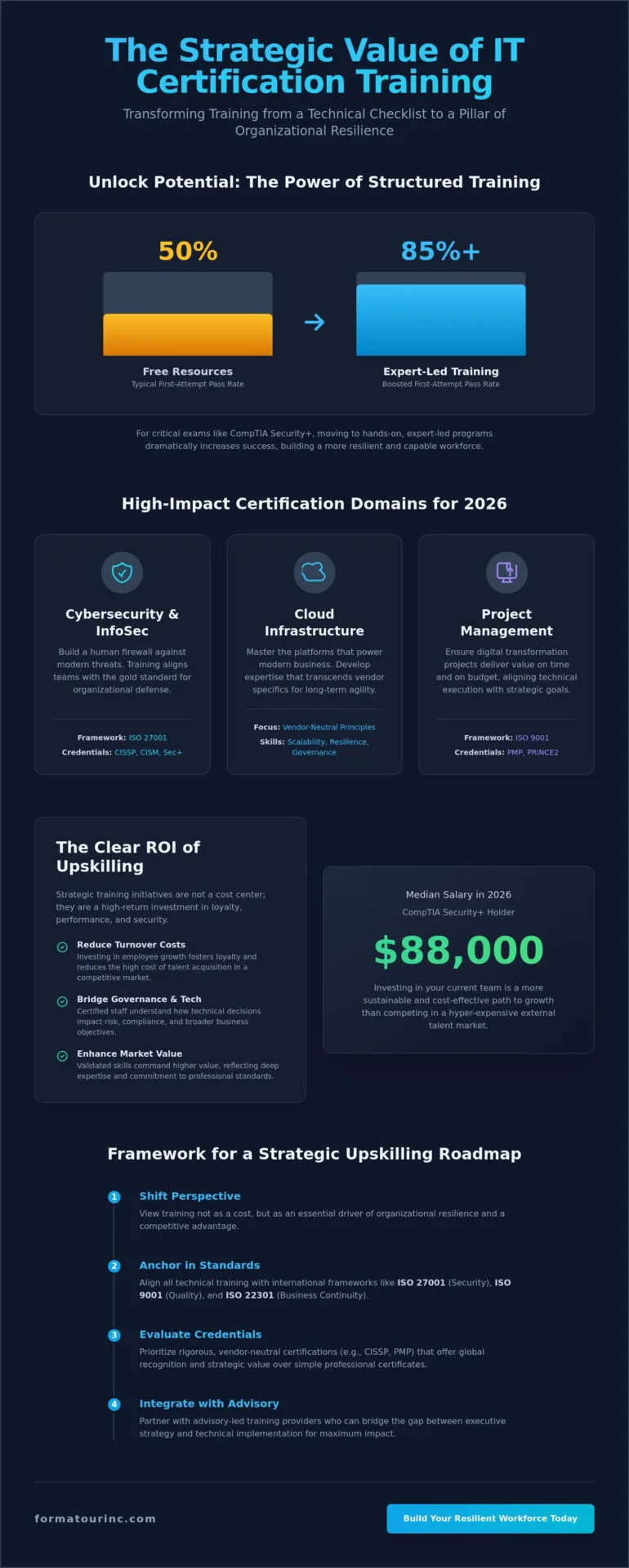
First-attempt pass rates for critical IT exams like the CompTIA Security+ can jump from 50% to over 85% when organizations move beyond free resources to hands-on, expert-led training. For executive leaders, this statistic represents more than just a test score; it’s the difference between a vulnerable infrastructure and a resilient one. High turnover costs and widening gaps in AI expertise have turned IT certification training programs from a routine line item into a critical strategic pillar. When training aligns with international standards like ISO 27001, it does more than upskill; it creates a culture of security and quality that protects the bottom line.
You likely agree that traditional, one-size-fits-all training models can’t keep pace with the current rate of technological change. You’re looking for a way to ensure every dollar spent on professional development translates into measurable operational maturity. This article will show you how to align IT certification training with organizational resilience and strategic digital transformation to future-proof your workforce. We’ll explore a curated list of high-impact certification domains and provide a framework for choosing programs that support ISO 27001 and ISO 9001 goals.
Key Takeaways
- Shift your perspective from viewing IT certification training programs as technical checklists to recognizing them as essential drivers of organizational resilience.
- Explore the most critical domains for 2026, including cybersecurity and cloud infrastructure, while anchoring technical growth in ISO 27001 and ISO 9001 frameworks.
- Evaluate the hierarchy of credentials to ensure your investment targets rigorous certifications that offer the highest level of global recognition and strategic value.
- Build a structured upskilling roadmap that aligns individual learning paths with broader strategic goals such as ISO 22301 business continuity and process optimization.
- Learn how a boutique, advisory-led approach can bridge the gap between executive leadership development and complex international compliance requirements.
The Strategic Importance of IT Certification Training Programs in 2026
IT certification training programs represent a systematic approach to validating both technical and managerial expertise across an entire enterprise. In 2026, the digital landscape has moved beyond the era of simple technical proficiency. Organizations now face a reality where skill gaps in AI and cybersecurity can paralyze growth overnight. This environment demands organizational resilience, a quality that goes deeper than having staff who can operate specific software. It requires a workforce that understands the intersection of technology and business survival. Modern training has shifted away from vendor-specific rote learning. Instead, it focuses on holistic, standards-based professional development that encourages the co-development of organizational solutions.
Bridging the Gap Between Technology and Governance
Certifications now serve as a vital bridge between technical IT departments and C-suite governance. Understanding the global IT qualification landscape is essential for leaders who want to align their human capital with long-term business objectives. Through the lens of strategic transformation, executives can identify which specific credentials drive actual value. Premium advisory firms prioritize certifications that align with international benchmarks, ensuring that technical skills support broader governance goals. This alignment transforms a standard training session into a strategic workshop where technical staff learn to speak the language of risk and compliance.
The ROI of Executive-Led Training Initiatives
Organizational resilience is the capacity of a certified workforce to anticipate, prepare for, and adapt to incremental change and sudden disruptions to ensure long-term stability and growth.
By integrating IT certification training programs into the corporate DNA, leadership teams can ensure their technical staff is prepared for the rigorous requirements of ISO 27001 and ISO 9001. This proactive stance turns training from a cost center into a competitive advantage. It builds a foundation where every team member is an active participant in the organization’s digital evolution and security posture.
A Roundup of Essential IT Certification Domains for Global Organizations
Selecting the right IT certification training programs requires a discerning eye for long-term utility rather than short-term technical fixes. In 2026, global organizations prioritize high-impact domains like Cybersecurity, Cloud Infrastructure, and Project Management to maintain their competitive edge. While vendor-specific training has its place for niche tasks, strategic leaders often favor vendor-neutral credentials such as the CISSP or PMP. These certifications provide a universal language that transcends specific software tools. This enables better alignment with international standards and executive governance across diverse global regions, ensuring your workforce remains agile as technologies evolve.
Cybersecurity and Information Security Management
The 2026 threat landscape makes ISO 27001 Information Security Management the gold standard framework for organizational defense. Certifications like the Certified Information Systems Security Professional (CISSP) and Certified Information Security Manager (CISM) are no longer just technical badges. They’re essential components of an organization’s human capital strategy. Training teams to be the first line of defense is critical to mitigating risk before it reaches the network core. However, staff training alone isn’t enough. It’s most effective when paired with professional ISO 27001 implementation services to ensure that certified knowledge translates into structural integrity. Industry leaders recognize the value of certified IT professionals as a primary driver for competitive advantage and closing the persistent skills gap. Digital transformation consulting often informs the selection of these paths, ensuring that security doesn’t become a bottleneck for automation.
Agile Project Management and Process Optimization
Standardizing project delivery is a cornerstone of operational performance in a fast-moving economy. Credentials such as the Project Management Professional (PMP) and Scaled Agile Framework (SAFe) are instrumental in driving process automation and optimization. These programs provide the methodologies needed to manage complex strategic transformation initiatives without the chaos often associated with rapid scaling. When project managers are certified in these global standards, they bring a level of predictability to digital deployments that directly impacts the bottom line. This structured approach ensures that resources are allocated efficiently and that project outcomes align with the organization’s broader quality management goals. If you’re ready to align your team’s development with these global benchmarks, you can consult with a strategic advisor to build a tailored training roadmap that addresses your specific operational challenges.
Evaluating Quality: Certifications vs. Professional Certificates
Understanding the hierarchy of credentials is vital for any executive making high-stakes talent investments. Not all markers of achievement carry the same weight in a global market. Professional certificates often focus on specific, immediate skills or participation in a course. In contrast, true certifications require rigorous, proctored examinations that validate a deep level of knowledge against an industry standard. This distinction is crucial when evaluating IT certification and degree integration, as academic institutions often use these benchmarks to measure mastery. Choosing the right path ensures that your team’s development is recognized by partners and regulators alike.
The Role of Accreditation and International Standards
Certifications aligned with ISO standards carry significantly more weight in the global marketplace. They provide a universal benchmark for excellence that stakeholders and clients recognize immediately. Executives should look for training providers who hold an ISO 9001 Quality Management certification themselves. This commitment to internal quality indicates that the provider’s own processes are optimized for excellence. Verifying the operational excellence of a partner ensures that the IT certification training programs you invest in will deliver a consistent, high-impact learning experience that supports your governance goals.
Vendor-Neutral vs. Vendor-Specific Paths
Choosing between platform-specific training and vendor-neutral paths is a strategic decision. Platform training for Azure or AWS is necessary for tactical cloud operations and technical proficiency. However, vendor-neutral paths like the CISSP or CISM foster long-term organizational resilience by preventing vendor lock-in. These broader programs teach principles that apply regardless of the specific technology stack your company uses today. This strategic layer is best explored through Leadership Training for Digital Transformation, which provides the overarching framework for navigating these choices. By balancing specialized technical skills with strategic, vendor-agnostic wisdom, organizations can maintain agility in an ever-shifting digital environment.
Building a Strategic Upskilling Roadmap for Your Leadership Team
A successful roadmap begins with a Strategic Transformation audit. This process identifies the technical and leadership gaps that might hinder your organization’s growth. Leaders must look beyond the immediate cost of exam vouchers and focus on the long-term ROI of a skilled workforce. By aligning IT certification training programs with specific corporate milestones, organizations ensure that every learning hour serves a larger objective. This structured approach moves beyond the transaction of buying training seats and focuses on the strategic design of human capital.
Integrating international seminars provides a global perspective that technical manuals cannot replicate. These sessions expose teams to emerging trends like AI literacy and multi-cloud expertise, which have become mandatory requirements in 2026. Finally, measuring the impact on operational performance and process efficiency validates the investment. When organizations track metrics like reduced downtime or faster incident response, the value of IT certification training programs becomes undeniable and transparent to stakeholders.
Aligning Training with ISO 22301 and Resilience
Disaster recovery certifications are critical for supporting ISO 22301 Business Continuity. These programs do more than teach backups; they prepare your team to maintain operations during a crisis. Training acts as a primary risk mitigation strategy, providing a sense of security for stakeholders and investors alike. The co-development of resilience occurs when staff education is paired with expert advisory to create a proactive defense against disruption.
From Technical Training to Executive Leadership
The transition from being a technical expert to a strategic mentor requires a significant shift in mindset. Leadership programs bridge this gap, allowing IT professionals to contribute to high-level decision-making and governance. You can explore this evolution further through Strategic Leadership Development Consulting. This approach fosters the co-development of solutions between IT leaders and executive management, ensuring that technology remains a driver of innovation rather than a siloed department. When your experts become mentors, they don’t just solve problems; they empower the entire organization to excel.
If you’re ready to define a clear path for your team’s growth, request a customized upskilling audit for your leadership team today.
The Formatour Advantage: Integrating Training with Strategic Advisory
Formatour stands as a premium partner for organizations that recognize the intrinsic link between executive education and the technical requirements of ISO implementation. We don’t treat IT certification training programs as mere tactical boxes to be checked by human resources. Instead, we view them as strategic investments in the structural integrity of the enterprise. Our boutique agility enables us to move beyond the rigid, transactional models of larger training firms. We tailor certification paths to the specific nuances of your organizational culture and technical stack, ensuring that every credential earned contributes to a larger vision of operational excellence and sustained growth.
By integrating international seminars into our curriculum, we help IT professionals develop a global citizen mindset. This perspective is essential for navigating the complex international benchmarks of 2026. This holistic development leads directly to a more capable workforce, fostering resilience through individuals who are both technically proficient and strategically aligned. When professional development is treated as a component of governance, it transforms from a cost center into a primary driver of efficiency.
A Multidisciplinary Approach to Professional Development
Formatour employs a multidisciplinary approach that seamlessly combines digital transformation consulting with technical certification training. This synergy ensures that upskilling is never a standalone event but a component of a larger organizational evolution. Having strategic mentors guide this process allows for the co-development of solutions that address both current technical gaps and future leadership needs. Our mentors don’t just teach the syllabus; they contextualize the material within your specific ISO 27001 or ISO 9001 goals. Leaders looking to broaden their perspective should explore our International Business Seminars, which provide the executive-level insights necessary for global competition.
Partnering for Long-Term Organizational Resilience
Our commitment to unwavering reliability and sustainable development defines every partnership we undertake. Formatour supports the full lifecycle of professional growth, beginning with meticulous auditing and extending through to executive certification and ISO compliance milestones. We act as a steady, expert hand, guiding your leadership through complex transitions to ensure that technical skills translate into measurable structural integrity. By choosing IT certification training programs that are integrated with strategic advisory, you secure a foundation for long-term stability. This proactive stance ensures that your organization remains a leader in its field, capable of adapting to any technological shift. To design your strategic IT training roadmap and future-proof your organization, contact Formatour Incorporated today.
Securing Your Organizational Future Through Strategic Upskilling
The transition toward true organizational resilience requires a fundamental change in how leadership perceives technical development. By viewing IT certification training programs as a core component of governance rather than an isolated expense, executives can bridge the gap between technical capability and strategic foresight. Success in 2026 is defined by the ability to align workforce skills with rigorous international standards. This alignment provides a foundation of security and quality that protects the enterprise from the volatility of the digital landscape.
Formatour Incorporated brings a decade of strategic transformation experience to every partnership. As a premium Canadian multidisciplinary advisory, we specialize in the co-development of solutions that integrate high-level training with ISO 27001 and 9001 expert implementation. Empower your team with Formatour’s Executive Education and IT Certification programs to ensure your workforce is prepared for the challenges of tomorrow. Your commitment to structured professional development today creates the resilient, expert-led organization of the future.
Frequently Asked Questions
What are the most valuable IT certifications for executive leadership in 2026?
The CISSP and CISM remain the gold standard for security governance, while the PMP is essential for standardized project delivery. In 2026, AI literacy and Cloud Architect credentials from AWS or Google provide the technical foundation necessary for digital maturity. These programs ensure leaders can oversee complex technical environments with confidence and strategic foresight.
How do IT certification training programs support ISO 27001 compliance?
These programs validate the technical and managerial competencies required to implement and maintain a robust Information Security Management System. By ensuring staff are certified in domains like risk management and incident response, organizations meet the human capital requirements of ISO 27001. This alignment turns technical education into a verifiable asset during compliance audits.
What is the difference between a professional certificate and an IT certification?
A certification requires a proctored, standardized exam that validates knowledge against a global industry benchmark. Professional certificates typically signify the completion of a specific course or the acquisition of a focused skill set. For executive-level governance, proctored certifications carry more weight due to their rigor and international recognition.
How can my organization measure the ROI of IT certification training?
ROI is measured through improved operational performance, such as a reduction in security incidents or increased efficiency in process automation. You can also track the high cost of employee turnover; certified professionals often report higher job satisfaction and longer tenures. Proactively closing skill gaps is significantly more cost-effective than reactive crisis management.
Should we prioritize vendor-neutral or vendor-specific IT certifications?
Leadership teams should prioritize vendor-neutral certifications to build long-term organizational resilience and avoid vendor lock-in. While vendor-specific training is necessary for day-to-day operations on platforms like Azure or AWS, neutral credentials provide a universal strategic framework. This balance allows your organization to remain agile regardless of changes in your technical stack.
How do international business seminars complement technical IT training?
Seminars provide the strategic context that technical manuals often lack, fostering a global citizen mindset among IT leaders. These sessions bridge the gap between technical proficiency and executive governance by focusing on international standards and forward-thinking trends. They empower professionals to apply their technical skills within the broader scope of organizational health.
Can IT certification training help with digital transformation strategy?
Yes, IT certification training programs provide the skilled human capital necessary to execute complex automation and optimization projects. Without a certified workforce, digital transformation initiatives often fail due to a lack of fundamental technical understanding or poor project management. Training ensures that your team can co-develop solutions that drive efficiency across the enterprise.
What role does ISO 9001 play in selecting a training provider?
An ISO 9001 certification indicates that a training provider adheres to strict quality management principles in their own operations. This ensures a consistent, high-impact learning experience and predictable results for your staff. Selecting a provider committed to these standards reflects your own organization’s dedication to excellence and structural integrity.
