

Global market dynamics have shifted toward a landscape where trust is the primary currency of enterprise partnerships. With 81% of organizations reporting they either hold or are actively planning for certification as of 2025, verified information security is no longer optional. When a high-value client requires ISO 27001 certification, the situation demands a response that is both urgent and strategically sound. You likely recognize the tension between securing a vital contract and the perceived complexity of the ISO/IEC 27001:2022 standard. It’s common to worry about resource constraints or the potential for operational friction during such a rigorous implementation process.
This guide serves as an executive roadmap to help you navigate these requirements with confidence and precision. You’ll discover how to transform a compliance mandate into a distinct competitive advantage while securing your client’s trust. We’ll outline the essential steps to achieve a robust security posture, covering everything from the 93 restructured controls to the integration of mandatory climate action considerations. By aligning your security framework with your broader business objectives, you can protect your organization and accelerate your growth in a demanding global market.
Key Takeaways
- Position information security as a strategic asset that facilitates market expansion and strengthens high-level enterprise partnerships.
- Evaluate the critical trade-offs between internal implementation and expert advisory when a client requires ISO 27001 certification to avoid hidden operational costs.
- Execute a structured five-phase roadmap designed to bridge the gap between your current security state and international excellence.
- Address executive concerns regarding time and investment by focusing on the tangible ROI gained from securing security-conscious, high-value contracts.
- Transform compliance into a sustainable advantage by integrating ISO 27001 standards into the core of your organizational development and digital transformation.
Navigating the Strategic Demand: When a Client Requires ISO 27001 Certification
Procurement has evolved into a rigorous vetting process where technical capability is secondary to organizational maturity. The global B2B landscape has undergone a fundamental transformation. Security is no longer a peripheral concern. It’s a core requirement for entry into high-value markets. When a client requires ISO 27001 certification, they’re seeking a partner who understands that risk management is a continuous discipline rather than a one-time project. It’s a signal that your organization has reached a level of professional stability that justifies a long-term investment.
The ISO/IEC 27001 standard serves as the definitive framework for an Information Security Management System (ISMS). It provides a structured approach to managing sensitive company information so that it remains secure. While frameworks like SOC 2 are common in the United States, ISO 27001 remains the preferred choice for international operations due to its rigorous, process-oriented methodology. Choosing to ignore these mandates invites significant peril. You risk the immediate loss of lucrative contracts and the potential for long-term reputational damage that can take years to repair. When a client requires ISO 27001 certification, they aren’t just asking for a certificate; they’re asking for proof of your strategic foresight.
Why Your Client is Demanding This Standard Now
Supply chain pressure drives much of this demand. Modern enterprises are only as secure as their weakest vendor. Consequently, security requirements trickle down from global leaders to every partner in their ecosystem. Regulatory environments like GDPR and CCPA have also intensified the focus on third-party risk management. Beyond mere compliance, this standard acts as a strategic accelerator. It shortens your sales cycle by providing a pre-validated answer to the complex security questionnaires that often stall procurement. It transforms you from a vendor into a trusted, low-risk partner.
The CIA Triad: The Foundation of Your Response
Your strategic response rests on three fundamental pillars: Confidentiality, Integrity, and Availability. Confidentiality ensures your data stays in the right hands through robust access controls. Integrity focuses on safeguarding the accuracy of your information, ensuring it hasn’t been tampered with or corrupted. Availability guarantees that your services remain operational and accessible when your clients need them most. Together, these elements form a resilient security posture that protects both your organization and your clients’ interests. This foundation allows you to transform a client requirement into a lasting competitive edge.
Assessing the Path: Internal Implementation vs. Strategic Advisory
Deciding how to respond when a client requires ISO 27001 certification requires a realistic appraisal of your internal capabilities. Many organizations initially view this as a purely technical project. They often overlook the deep cultural and operational shifts required for success. A meaningful implementation demands more than just checking boxes; it requires a sophisticated alignment with your existing digital transformation strategy to ensure that security enhances rather than hinders your organizational agility. This moment is a fork in the road for leadership. One path leads to a robust, scalable system. The other often leads to wasted resources and missed deadlines.
Understanding the Benefits of ISO 27001 Certification extends far beyond contract retention. It’s about building a resilient foundation for sustainable growth. However, the path to achieving these benefits is fraught with hidden costs. A “Do-It-Yourself” approach frequently results in extended timelines and significant errors. Audit failure is a real risk when internal teams lack the specialized expertise to interpret the 93 controls of the 2022 standard. While “Big Four” firms offer global prestige, they often lack the boutique agility and personalized attention needed to provide tailored, hands-on support for growing organizations. Expert advisory fills this gap by providing a steady hand through complex transitions.
The Internal Implementation Challenge
Internal teams often struggle with inherent biases and a lack of specialized audit experience. The strain on IT and HR departments during the documentation phase can be immense, pulling key talent away from core business objectives. This frequently results in the creation of a “paper ISMS.” This is a system that looks compliant on paper but fails to protect the organization in real-world scenarios. Without a neutral outside perspective, critical vulnerabilities remain hidden until a formal auditor discovers them. This oversight can lead to costly delays and the potential loss of the very contract you’re trying to secure.
The Value of a Strategic Partner
When a client requires ISO 27001 certification, the pressure to deliver can lead to hasty decisions. A strategic partner accelerates the timeline from gap analysis to final certification by providing proven templates and methodologies. They offer expert guidance on selecting the right Statement of Applicability (SoA), ensuring your controls are relevant and efficient. True security isn’t just about technology; it’s a leadership discipline. By integrating executive leadership development into the process, you build a culture where security is championed from the top down. This holistic approach ensures that your compliance efforts translate into genuine operational excellence. To explore how a tailored roadmap can benefit your specific goals, you may wish to consult with a strategic advisor who understands your unique landscape.
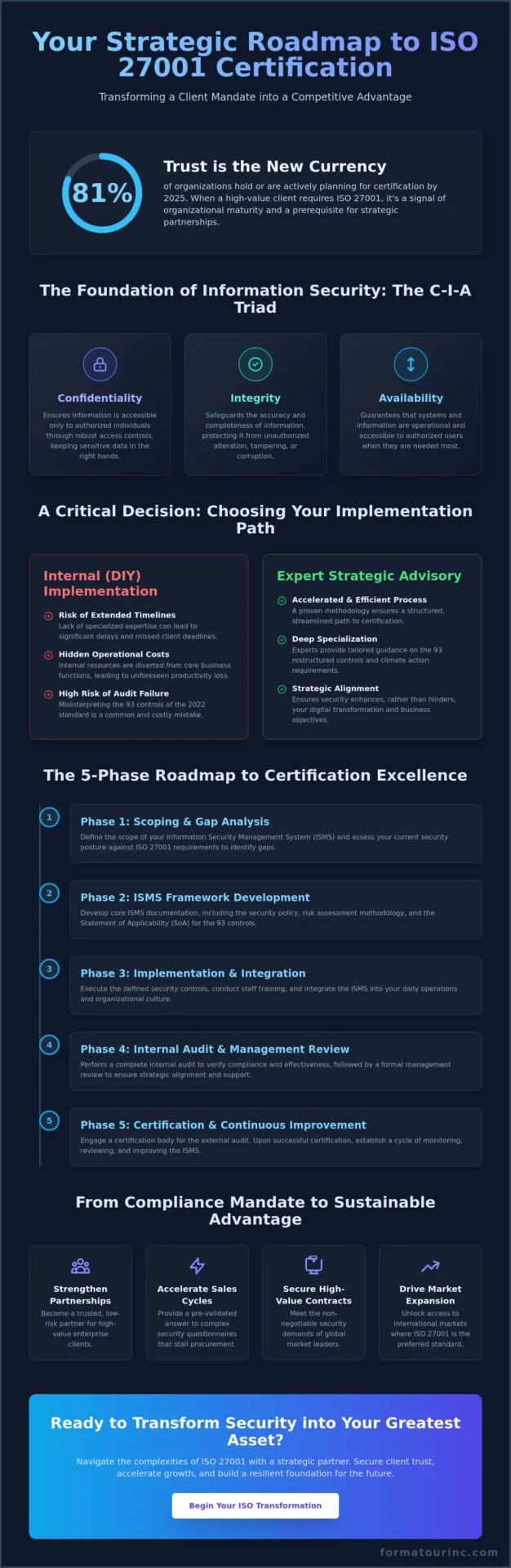
How to Achieve ISO 27001 Certification: A 5-Phase Roadmap
Achieving organizational resilience is a methodical journey rather than a sudden transformation. When a client requires ISO 27001 certification, your immediate priority should be the establishment of a clear, actionable roadmap. This structured path ensures that compliance becomes an integrated part of your business model rather than a disruptive external force. Understanding How to Obtain ISO Certification involves moving through five distinct phases of maturity.
- Phase 1: Gap Analysis. Identify the specific distance between your existing security posture and the mandatory requirements of the ISO/IEC 27001:2022 standard.
- Phase 2: ISMS Design. Craft policies and procedures that align with your unique operational performance goals while meeting international benchmarks.
- Phase 3: Implementation. Roll out the necessary Annex A controls and conduct comprehensive staff training to ensure widespread cultural adoption.
- Phase 4: Internal Audit. Execute a mandatory dry run to verify the effectiveness of your system and identify any remaining weaknesses before the external assessment.
- Phase 5: Certification Audit. Navigate the formal Stage 1 documentation review and the Stage 2 implementation verification with the confidence of a fully prepared organization.
Defining the Scope and Statement of Applicability
Scoping is the most critical decision in your entire journey. It defines the boundaries of your ISMS and determines which departments or locations are covered by the certification. A precise scope allows you to exclude non-relevant controls without compromising the integrity of your system. This focus prevents resource drain on areas that don’t impact your security posture or client requirements. Executive buy-in is essential here to ensure the scope aligns with long-term business objectives and strategic growth.
Conducting a Robust Risk Assessment
A robust risk assessment is the engine that drives your entire security strategy. You must utilize methodologies that identify, analyze, and evaluate risks based on their potential impact on your organizational stability. This process culminates in a Risk Treatment Plan (RTP) that provides auditors with a clear, logical rationale for your security choices. For organizations seeking deep-dive support throughout this process, our ISO 27001 Implementation Services provide the expert advisory needed to master these complex requirements. By treating risk assessment as a strategic exercise, you build a system that is both compliant and genuinely resilient.
Overcoming Executive Objections: Time, Cost, and Disruption
Executive leadership often views compliance as a cost center rather than a value driver. When a client requires ISO 27001 certification, the immediate reaction usually centers on the perceived drain on time and capital. It’s easy to see these requirements as roadblocks to innovation or speed. However, viewing this through the lens of strategic optimization reveals a different picture. A phased rollout allows your organization to maintain momentum without overwhelming your core operations. By integrating these standards into your existing workflows, you avoid the trap of adding “more work” and instead create a more disciplined, efficient environment that supports long-term growth.
This transition often serves as a powerful catalyst for process automation and optimization. Instead of manually managing disparate security tasks, you can implement structured systems that reduce human error and increase output. This shift doesn’t just satisfy a single client; it elevates your entire operational baseline. It’s an opportunity to audit your own inefficiencies and replace them with scalable, automated solutions that serve the business long after the certification is granted. You’re not just buying a certificate; you’re investing in a more mature version of your company.
The ROI of Organizational Resilience
The financial argument for certification is compelling when you consider the long-term impact on your bottom line. Securing a high-value, security-conscious client often pays for the implementation costs many times over during the contract’s lifecycle. Beyond immediate revenue, you gain several strategic advantages:
- Mitigating Risk: Reducing the likelihood and cost of data breaches significantly lowers potential liabilities and can lead to more favorable insurance premiums.
- Efficiency in Sales: You’ll streamline vendor security questionnaires and RFP responses, allowing your sales team to close high-value deals faster.
- Talent Acquisition: A secure, structured environment attracts premium talent who value organizational maturity and clear governance.
Minimizing Operational Friction
Securing a major contract shouldn’t come at the cost of your internal culture. If you’re ready to build a resilient, high-performance organization that satisfies your most demanding partners, reach out to our strategic consultants today.
Formatour: Your Premium Partner for ISO 27001 Transformation
Formatour positions itself at the intersection of international excellence and operational reality. When a client requires ISO 27001 certification, you need a partner that provides more than a simple checklist. Our multidisciplinary approach ensures that your Information Security Management System (ISMS) is woven into the very fabric of your organization. We combine the rigorous benchmarks of global standards with the boutique agility required to address your specific operational nuances. This methodology has proven successful for both complex global firms and high-growth Canadian enterprises seeking to solidify their market position through verified security maturity.
Our role is that of a seasoned strategic mentor and a visionary architect. We guide you through the complexities of the ISO/IEC 27001:2022 standard with quiet confidence. By focusing on the seamless integration of high-level concepts into your daily operations, we help you achieve a robust security posture that satisfies the most demanding auditors. You aren’t just pursuing a certificate. You’re building a foundation for stability and growth in an increasingly volatile global market. We act as an active participant in your progress, ensuring every control implemented serves your broader business objectives.
Beyond Compliance: Strategic Growth
True success lies in using compliance as a lever for broader organizational development. We leverage the ISO 27001 framework to drive meaningful digital transformation across your entire enterprise. Our solutions are never generic. We tailor our advisory to fit complex, multidisciplinary landscapes where security must coexist with innovation. Beyond the initial certification, we provide the steady guidance needed for annual surveillance audits and continuous improvement. This long-term commitment ensures your security posture remains a durable asset rather than a fleeting achievement.
Start Your Certification Journey Today
The path toward securing your high-value contract begins with a decisive first step. Our immediate gap analysis services provide the clarity you need to satisfy urgent client demands with precision. To ensure sustainable success, we provide access to our executive leadership programs. These programs are designed to foster the deep management buy-in necessary for a successful ISMS rollout. You can connect directly with our senior advisory team to develop a customized roadmap that addresses your unique challenges and timelines. Let’s transform your compliance mandate into a definitive security posture that wins business and protects your future.
Securing Your Competitive Edge Through Verified Security
The transition toward global security excellence is a defining moment for your organization’s maturity. By shifting your perspective from simple compliance to strategic transformation, you unlock new pathways for sustainable growth and client trust. We’ve explored how a structured, five-phase roadmap and a commitment to leadership development can turn a rigorous mandate into a streamlined operational advantage. When a client requires ISO 27001 certification, they’re inviting you to demonstrate that your business is built on a foundation of reliability and foresight.
Formatour brings over a decade of ISO implementation expertise to your unique organizational landscape. Our multidisciplinary approach to organizational resilience ensures that your security posture enhances every facet of your business. We provide premium advisory designed for high-stakes strategic transformation, helping you navigate complex requirements with quiet confidence. If you’re ready to secure your high-value contracts and elevate your operational baseline, we invite you to Schedule a Strategic ISO 27001 Consultation with Formatour. Your journey toward a more secure and resilient future starts with a single, expert-led conversation.
Frequently Asked Questions
How long does it take to get certified when a client requires it immediately?
Achieving full certification typically requires six to twelve months of dedicated effort. When a client requires ISO 27001 certification on an accelerated timeline, you can often satisfy initial procurement demands by providing a formal Gap Analysis report or a signed Letter of Intent from your certification body. These documents demonstrate a professional commitment to the standard while the full implementation of the Information Security Management System (ISMS) is underway.
Can a client legally require ISO 27001 certification in a contract?
Private organizations have the right to set specific security benchmarks as a prerequisite for partnership. This is a common practice in global B2B procurement to mitigate third-party risk and ensure supply chain integrity. Including these requirements in a service level agreement is a standard method for ensuring that all vendors meet a verified level of organizational maturity and data protection.
What is the difference between ISO 27001 and SOC 2 for my client’s requirements?
ISO 27001 is an internationally recognized framework focused on the continuous improvement of a management system. SOC 2 is a reporting framework primarily utilized in North America that focuses on specific trust service criteria at a single point in time. Many global enterprises prefer the ISO standard because it demonstrates a process-oriented approach to security that is recognized in every major market worldwide.
How much does ISO 27001 certification cost for a mid-sized firm?
Total investment varies based on the complexity of your operations and the scope of your ISMS. Industry data from 2026 suggests that audit fees for mid-sized companies with up to 125 employees often hover around £15,000, which is approximately $18,700 USD. This does not include internal resource allocation or the strategic advisory needed to ensure a successful first-time audit. You should view these costs as a strategic investment in securing high-value contracts.
What happens if we fail our initial ISO 27001 audit?
Audit “failure” usually results in the identification of Non-Conformities (NCs) rather than a permanent rejection. You’ll receive a formal report detailing where your system lacks alignment with the standard. Your organization is then given a specific timeframe to implement corrective actions and provide evidence of resolution. This process ensures that your final certification is based on a truly effective and resilient security posture.
Do we need to certify the whole company or just the service the client uses?
Certification is based on a defined scope that you determine during the design phase. You can choose to certify a specific department, a single location, or a particular service line that your client requires ISO 27001 certification for. While a narrower scope can accelerate the initial certification, many organizations eventually expand it to cover the entire enterprise to maximize their competitive advantage and internal security.
Is ISO 27001:2022 the version we need to implement for current mandates?
The 2022 revision is the only applicable version of the standard as of May 2026. The transition period for the previous 2013 version ended on October 31, 2025. All new certifications must align with the 2022 structure, which includes the 93 restructured controls and the mandatory climate action amendment published in February 2024. Implementing the current version ensures your security framework remains relevant and compliant with modern global expectations.
