

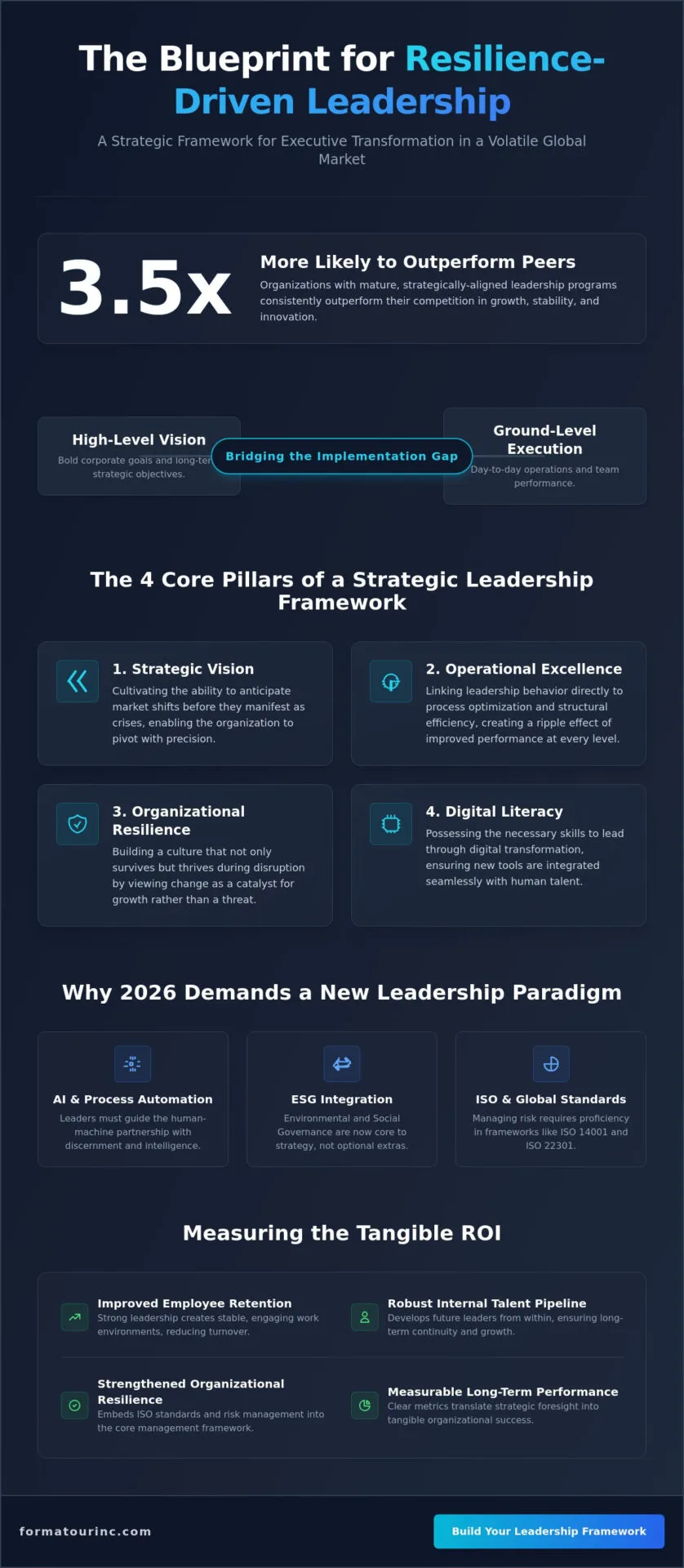
Organizations with mature leadership programs are 3.5 times more likely to outperform their peers. You’ve likely felt the disconnect when a bold corporate vision fails to take root in ground-level execution, or perhaps you’ve seen leadership fatigue stall a critical digital transformation. This misalignment often stems from inconsistent management standards across global offices. Investing in strategic leadership development consulting isn’t just about individual coaching; it’s about building a structural competency that ensures your executive team leads through complexity while maintaining operational integrity.
This article explores how a structured approach to leadership bridges the gap between visionary goals and the resilience required in a volatile global market. You’ll learn how to cultivate a team capable of navigating complex ISO and regulatory landscapes while improving decision-making across the board. We’ll provide a roadmap for executive transformation that turns strategic foresight into measurable, long-term organizational performance.
Key Takeaways
- Align executive capabilities with long-term organizational objectives to ensure stability and growth in a volatile global market.
- Bridge the implementation gap by integrating strategic leadership development consulting with operational excellence to turn visionary goals into ground-level results.
- Leverage digital transformation and process automation to streamline management tasks and empower leaders to focus on high-level strategic foresight.
- Establish clear performance metrics to measure the tangible ROI of leadership programs, including improved employee retention and a robust internal talent pipeline.
- Strengthen organizational resilience by embedding international ISO standards into executive education and management frameworks.
What is Strategic Leadership Development Consulting?
Strategic leadership development consulting is a specialized advisory service designed to align individual executive capabilities with the long-term governance and operational goals of an enterprise. It moves beyond traditional training by focusing on the structural integration of leadership behaviors into the corporate strategy. A consultant in this field acts as both a seasoned strategic mentor and a visionary architect. They help firms build a framework where leadership isn’t just a title, but a measurable driver of organizational resilience. For a foundational understanding of these processes, a Strategic Leadership Overview provides essential context on how leaders influence the long-term viability of their organizations.
The business climate in 2026 requires a fundamental shift from reactive management to proactive strategic foresight. Organizations no longer seek consultants simply to fix broken processes; they engage them to navigate extreme market volatility and complex digital shifts. This consulting approach ensures that every executive decision contributes to a cohesive path forward, bridging the gap between high-level ambition and ground-level execution. It’s about creating a leadership team that can anticipate market disruptions before they occur.
The Evolution of Executive Mentorship
Modern mentorship has evolved from isolated coaching sessions into holistic organizational development. In the past, firms focused on individual performance. Today, strategic leadership development consulting identifies hidden talent gaps across the entire C-suite to ensure the team functions as a unified force. This is particularly vital for “global citizen” leadership. Leaders in multinational operations must understand international benchmarks and maintain consistent management standards across diverse offices. By utilizing Executive Leadership Development Programs, firms can establish a steady, expert hand that guides the organization through complex international landscapes with quiet confidence.
Why 2026 Demands a New Leadership Paradigm
The rapid adoption of AI and process automation has fundamentally changed how executives make decisions. Leaders don’t just need to understand the technology; they must lead the human-machine partnership with discernment and intelligence. Additionally, integrating environmental and social governance (ESG) into core strategy is no longer optional. Modern leadership must be proficient in managing risk through established frameworks, such as ISO 14001 for environmental management and ISO 22301 for business continuity. This paradigm shift ensures that leadership is rooted in structural integrity and compliance, providing a sense of security for stakeholders while fostering sustainable growth. Success in this era depends on leaders who view operational resilience as a strategic advantage rather than a regulatory burden. Executives seeking to build these competencies will find that investing in leadership training for digital transformation has become a foundational requirement for navigating the complex technological and cultural shifts defining the 2026 business landscape.
The Core Pillars of a Strategic Leadership Framework
A robust framework serves as the structural foundation for any successful executive transformation. It’s the difference between a temporary surge in productivity and a permanent shift in organizational capability. Within the context of strategic leadership development consulting, this framework is built upon four essential pillars that ensure a firm remains both agile and stable.
- Strategic Vision: This involves cultivating the ability to anticipate market shifts before they manifest as industry-wide crises. It’s a proactive approach that allows a firm to pivot with precision.
- Operational Excellence: Leadership behavior must be linked directly to process optimization. When executives prioritize structural efficiency, it creates a ripple effect that improves performance at every level.
- Organizational Resilience: Building a culture that survives and thrives during disruption requires a leadership team that views change as a catalyst for growth rather than a threat.
- Digital Literacy: Technology is the engine of modern business. Executives must possess the literacy to lead through digital transformation, ensuring that new tools are integrated seamlessly with existing human talent.
These pillars aren’t isolated concepts; they’re interconnected disciplines that require constant refinement. Organizations that master these areas find themselves better equipped to handle the complexities of a globalized economy. They move beyond mere survival and begin to define the standards for their respective industries. Success in these arenas requires a methodical approach to human capital and technical governance.
Linking Leadership to International Standards
Integrating international standards provides a clear roadmap for executive accountability and precision. Adopting an ISO 9001 mindset encourages a focus on quality management that permeates every decision made at the board level. Governance shouldn’t be viewed as a set of restrictive rules but as a framework for security and excellence. For example; aligning executive oversight with ISO 27001 ensures that information security is managed as a strategic asset rather than a technical checkbox. This level of structured development is reflected in the rigorous standards seen in OPM’s Executive Development Programs, which highlight the importance of formal frameworks in large-scale leadership implementation.
Human Capital and Cultural Alignment
Strategy vs. Execution: Bridging the Implementation Gap
Great strategies often fail because they lack a clear path to execution. While the C-suite may envision a bold future, that vision frequently stalls at the middle-management level. This implementation gap occurs when high-level concepts aren’t translated into daily operational tasks. Strategic leadership development consulting addresses this disconnect by providing leaders with the tools to bridge the divide between theory and practice. It moves beyond theoretical slide decks, focusing instead on tangible results that improve the organization’s structural integrity.
Effective consultants utilize process automation to free executives from repetitive administrative burdens. This shift allows leaders to focus on their primary roles: transforming organizational culture, optimizing resource allocation, and co-developing solutions with their teams. By automating routine governance tasks, leadership becomes an active participant in the firm’s progress rather than a passive overseer. This transformation ensures that every executive hour is spent on high-impact strategic work that drives the company forward.
Operational Performance as a Leadership Outcome
Efficiency is a direct outcome of effective leadership. When managers are trained to view their roles through the lens of operational performance, friction during transitions is significantly reduced. Strategic change management consulting provides the expert hand needed to guide staff through digital shifts without sacrificing productivity. This structured advisory ensures that every leadership action has a measurable impact on the firm’s efficiency. By linking leadership training to specific process outcomes, organizations can see a clear return on their investment through improved decision-making and reduced waste.
Empowering Middle Management for Strategic Alignment
Strategy shouldn’t be confined to the boardroom. It must flow from the C-suite to the floor through a cascading effect that empowers middle management. These managers act as internal champions, ensuring that new initiatives are adopted and maintained across the organization. They’re the vital link that turns a visionary goal into an operational reality. Practical governance frameworks, such as those found in ISO 27001 implementation services, provide the necessary structure for this alignment. This approach ensures that everyone, from the executive office to the operational front lines, understands their role in the broader strategic objective. When middle management is aligned with the core mission, the entire organization moves with a sense of predictable excellence.
How to Measure the ROI of Leadership Consulting
Sophisticated organizations recognize that leadership is a measurable asset. To determine the true value of strategic leadership development consulting, firms must move beyond anecdotal feedback and implement a rigorous framework of data-driven evaluation. This begins with establishing baseline performance metrics before any advisory work commences. By documenting the current state of organizational health, leaders can track exactly how new behaviors and strategies influence the bottom line.
The return on investment for these programs is often substantial. Verified industry data suggests that for every $1 invested in leadership development, companies see an average return of $7. These gains manifest in both soft and hard metrics. Soft metrics include improvements in employee retention and the strength of the internal leadership pipeline. For example; a study of a healthcare technology client demonstrated a 7.8x ROI primarily through the reduction of manager-driven attrition. Hard metrics are equally vital, focusing on project completion rates, revenue growth, and compliance scores. A professional services firm recently documented a 9.6x ROI attributed to improved win rates following a comprehensive manager development program.
Quantifying Strategic Transformation
A structured approach to strategic leadership development consulting ensures that transformation is both visible and sustainable. The process follows three distinct steps:
- Define KPIs: Establish specific Key Performance Indicators for the leadership team that align with broader corporate goals.
- Internal Audits: Conduct regular audits to verify progress against these benchmarks, ensuring that quality standards are maintained.
- Analyze Correlation: Evaluate the link between leadership interventions and tangible operational savings, such as reduced waste or optimized resource allocation.
The Cost of Inaction: Avoiding Leadership Stagnation
The financial impact of poor strategic decision-making is often far greater than the cost of a consulting engagement. Leadership gaps frequently lead to critical compliance failures, particularly in areas like ISO 22301 Business Continuity. When an organization lacks a resilient leadership structure, it remains vulnerable to market disruptions that can stall growth for years. Future-proofing through executive education isn’t just about growth; it’s a risk mitigation strategy that protects the firm’s structural integrity. To begin evaluating your team’s potential for growth, schedule a strategic assessment with our expert advisors today.
The Formatour Approach: Resilience-Driven Leadership
Formatour offers a sophisticated advisory experience that blends boutique agility with the high-level standards typical of a global firm. We believe that strategic leadership development consulting should never be a one-size-fits-all exercise. Instead, we commit to co-developing solutions that respect the unique operational context of each client. Our objective is clear. We seek to build organizational resilience, ensuring that leadership teams aren’t just managing day-to-day tasks but are actively securing the firm’s future in an unpredictable market. This commitment to structural integrity allows us to position our clients as leaders in their respective fields.
Our methodology is rooted in a deep understanding of international benchmarks. Because we are seasoned ISO auditors, we bring a level of precision to leadership programs that few others can match. We see the synergy between digital transformation and executive development as a critical path for modern growth. By integrating standards like ISO 9001 for quality and ISO 27001 for security into our mentorship, we provide a holistic solution that strengthens both human capital and technical governance. Our Canadian perspective allows us to act as a “global citizen,” offering a balanced approach that respects international standards while remaining grounded in practical, local application.
Multidisciplinary Expertise for Complex Problems
Solving the challenges of the 2026 business landscape requires more than just management theory. It demands a multidisciplinary approach that combines process automation and optimization with high-level executive education. We leverage our extensive experience in studies and project management to help leaders navigate the complexities of digital shifts. This ensures that when a firm undergoes transformation, the leadership team is equipped to handle the technical and human elements of the transition simultaneously. This integrated strategy reduces friction and accelerates the time to value for new initiatives. Organizations looking to deepen their executives’ capabilities in this area can explore our comprehensive leadership training for digital transformation, which provides a strategic roadmap for aligning digital initiatives with ISO standards and building lasting organizational resilience.
Your Partner in Strategic Growth
We view our role as more than a service provider. We’re strategic mentors dedicated to your long-term success. Our approach to strategic leadership development consulting focuses on moving from a consultant-client relationship to a long-term strategic mentorship. This partnership extends beyond the boardroom through access to international business seminars and professional development resources that keep your team at the forefront of industry trends. We help you move from reactive management to a proactive stance where every decision is filtered through the lens of strategic foresight.
Beginning your transformation journey with Formatour starts with a commitment to excellence. Whether you’re looking to optimize your leadership pipeline or integrate complex process automation, our expert advisors provide the steady hand needed to guide your organization through its next phase of growth. We invite you to explore our Executive Leadership Development Programs to see how we can co-develop a roadmap for your sustainable success.
Building a Legacy of Resilient Leadership
Strategic leadership isn’t a static trait; it’s a dynamic capability that requires constant refinement. By aligning executive behaviors with international standards and operational goals, organizations create a foundation for sustainable growth. This process ensures that visionary strategies don’t just exist on paper but drive daily performance across every level of the firm. You’ve seen how bridging the implementation gap and measuring ROI turn leadership from a cost center into a powerful engine for organizational resilience.
Investing in strategic leadership development consulting allows your team to navigate global volatility with quiet confidence. Formatour brings over a decade of experience in premium multidisciplinary advisory, combining boutique agility with world-class consulting standards. Our global expertise in ISO implementation and executive education provides the structural integrity your organization needs to thrive in a complex market. We’re ready to partner with you to co-develop solutions that ensure long-term stability and success.
Elevate your organization with Formatour’s strategic advisory services and begin your executive transformation today. Your team’s potential for excellence is waiting to be unlocked.
Frequently Asked Questions
What is the difference between leadership coaching and strategic leadership consulting?
Leadership coaching typically targets the performance of a single executive, whereas strategic leadership development consulting aligns the entire C-suite with the firm’s long-term objectives. Consulting focuses on the structural integration of leadership behaviors into the corporate strategy. It ensures that every decision made at the executive level supports the organization’s governance and operational resilience goals.
How long does a typical strategic leadership development program take to show results?
While behavioral improvements are often visible within the first 90 days, tangible business results usually manifest over a six to twelve-month period. Organizations often track metrics like leadership pipeline strength or project completion rates to verify progress. Long-term ROI, such as the 7.8x return seen in documented healthcare technology cases, requires consistent application of the new framework over several quarters.
Can strategic leadership consulting help with ISO certification?
Strategic consulting directly supports ISO certification by embedding quality and security standards into the leadership mindset. We integrate frameworks like ISO 9001 for quality management and ISO 27001 for information security into executive education. This approach ensures that compliance is not a separate technical task but a core component of the organization’s strategic governance.
How do you tailor leadership programs for different industries?
Programs are tailored by aligning the leadership curriculum with specific industry benchmarks and regulatory requirements. A consultant analyzes the unique market volatility and operational pressures of your sector to co-develop relevant solutions. This ensures that the leadership team is equipped to navigate the specific ISO or environmental landscapes relevant to their global operations.
What are the most critical leadership skills for 2026?
The most critical skills for 2026 include strategic foresight, digital literacy, and the ability to manage human-machine partnerships. Leaders must move beyond reactive management to anticipate market shifts before they occur. Developing adaptive capability is essential for remaining effective in a business landscape defined by ambiguity and rapid technological change. Participating in international business seminars is one of the most effective ways executives can gain the global perspective and regulatory awareness needed to stay ahead of these shifts.
How does digital transformation impact leadership development?
Digital transformation requires leaders to become facilitators of process automation and technological optimization. It shifts the executive role from traditional oversight to the active management of digital assets and human talent. Effective strategic leadership development consulting helps executives build the confidence to experiment with new technologies while maintaining critical thinking and discernment.
Is strategic leadership development suitable for small-to-medium enterprises (SMEs)?
Strategic development is highly suitable for small-to-medium enterprises seeking to establish a foundation for sustainable growth. SMEs often face the same complexities as larger firms but with fewer resources; this makes structural integrity and efficient decision-making even more vital. A tailored advisory approach provides the boutique agility needed to build a resilient leadership team without the overhead of a large firm.
What is the role of organizational resilience in leadership consulting?
Organizational resilience is the primary goal of modern leadership consulting. It involves building a culture that can survive and thrive during periods of significant disruption. By focusing on resilience, leaders ensure that the organization remains stable and productive regardless of market volatility or digital shifts, protecting the firm’s long-term viability and success.
