

A carbon plan is only as credible as the data behind it. For Canadian organizations, reducing corporate carbon footprint Canada-wide starts with understanding emissions across facilities, vehicles, suppliers, and business travel, not with choosing a highly visible initiative.
Getting started can be difficult. Emissions data may sit across different teams and systems, while budget and reporting expectations make it hard to decide what to tackle first. A defensible baseline brings those pieces together and gives leaders a sound basis for setting priorities.
This 2026 guide lays out a practical sequence: map relevant emissions sources, assess reduction opportunities, assign clear ownership, and review progress consistently. It also explains how to make environmental claims carefully, so public statements reflect documented results rather than ambition alone.
Reducing emissions is an operational effort as well as an environmental one. An ISO 14001 environmental management system can help embed defined responsibilities, documented processes, and continual improvement into organizational management. With a measured approach, your organization can build a credible plan and strengthen it over time.
Key Takeaways
- Set clear organizational boundaries and a reporting purpose before building an emissions inventory, so you know which activities and value-chain sources to include.
- Use a repeatable measurement process: identify emissions sources, collect activity data, calculate results, and document methods and assumptions.
- For reducing corporate carbon footprint Canada, compare potential actions by impact, feasibility, operational fit, and confidence in the underlying data before setting priorities.
- Turn selected actions into an accountable roadmap with owners, milestones, resources, and measurable indicators across relevant business functions.
- Report progress transparently by explaining your baseline, scopes, methodology, exclusions, and factors that may affect year-over-year comparisons.
What reducing a corporate carbon footprint means for Canadian organizations
A corporate carbon footprint is the greenhouse gas emissions associated with an organization’s activities and relevant relationships across its value chain. It can include emissions from operating buildings, using vehicles, buying electricity, purchasing goods and services, and business travel. The Carbon footprint overview introduces the broader concept, including direct and indirect emissions.
The inventory boundary depends on the organization’s structure and the purpose of measurement. A company preparing an internal baseline might begin with its facilities and fleet. A broader assessment may also include emissions tied to suppliers, products, or other value-chain activities. A clear, consistent boundary helps decision-makers understand what the results represent and where data gaps remain.
Measurement, reduction, and compensation are separate steps. Measuring establishes an estimate of emissions; reducing means changing activities or operations to lower them. Compensation, such as purchasing carbon credits, addresses residual emissions separately. It should not be presented as a substitute for reducing emissions within the organization’s own operations or value chain.
Which emissions belong in a corporate footprint?
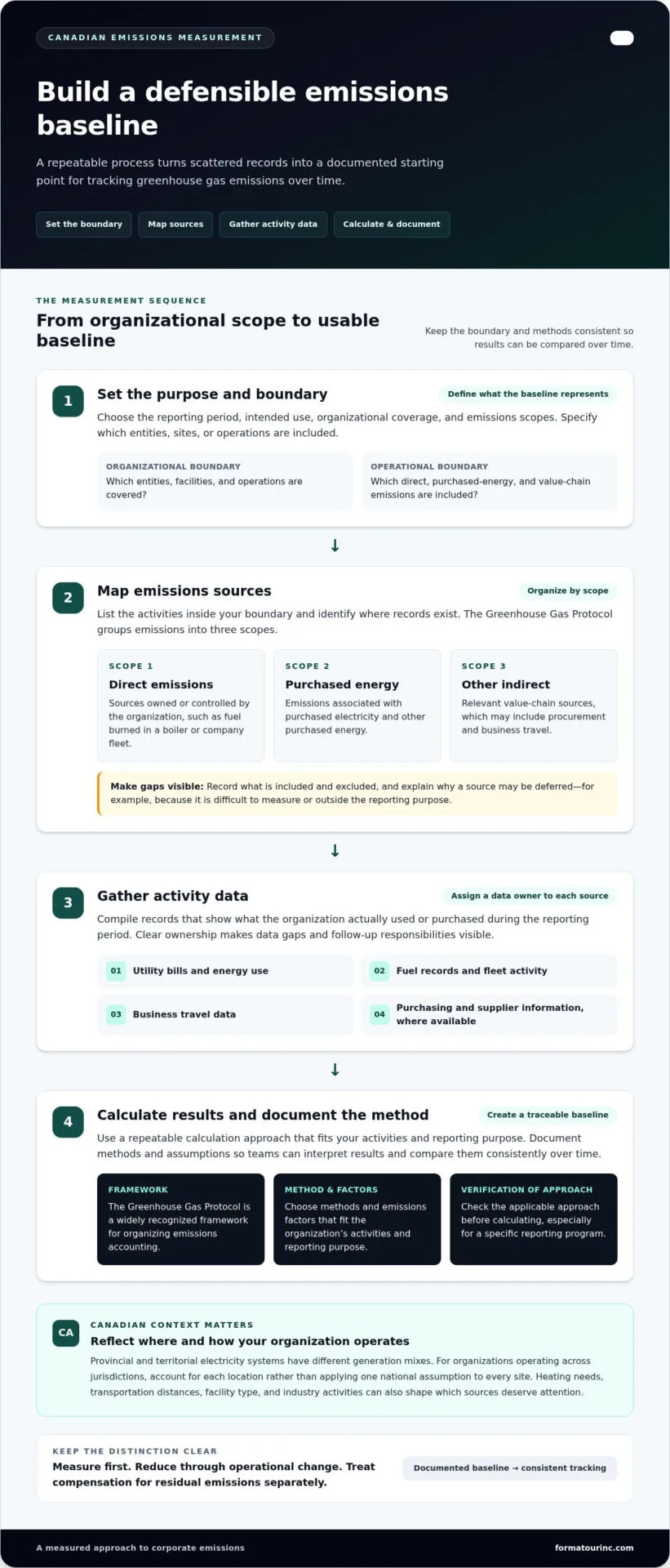
The Greenhouse Gas Protocol groups emissions into three scopes. Scope 1 covers direct emissions from sources an organization owns or controls, such as fuel burned in a boiler or company fleet. Scope 2 covers emissions associated with purchased electricity and other purchased energy. Scope 3 covers other relevant indirect emissions, which may include procurement and business travel.
Not every category will be equally material or easy to quantify at the outset. Start by identifying major activities and the records available for them. Document what’s included, what’s excluded, and why. As data improves, the inventory boundary can become more complete.
Why a Canadian organization’s location and operations matter
Canada doesn’t have one uniform emissions profile. Provincial and territorial electricity systems have different generation mixes, so electricity use can contribute differently to an organization’s footprint depending on where it operates. A company with facilities in several jurisdictions should account for each location rather than applying one national assumption to every site.
Reporting obligations depend on factors such as an organization’s activities, size, and jurisdiction. Confirm current federal, provincial, or territorial requirements before relying on an inventory for regulatory reporting. For ongoing management, documented responsibilities and review processes can help embed environmental objectives in day-to-day decisions and support continual improvement.
How to measure your organization’s carbon footprint in Canada
A reliable inventory follows a repeatable method, not a collection of disconnected estimates. The Greenhouse Gas Protocol is a widely recognized framework for organizing emissions accounting. The methods and emissions factors you use should fit your organization’s activities and reporting purpose. Verify the applicable approach before calculating results, especially when preparing information for a specific reporting program.
An emissions baseline is a documented starting point for tracking change in an organization’s greenhouse gas emissions over time. A clear baseline helps teams compare results consistently and understand whether reported changes reflect operational improvements or differences in data and methods.
Set boundaries and identify emissions sources
Define the organizational boundary by deciding which entities, sites, or operations the inventory covers. Then set the operational boundary by identifying the types of emissions to include, such as direct fuel use, purchased energy, and relevant value-chain activities. Map facilities, vehicles, electricity and other purchased energy, business travel, and material supplier categories. Record exclusions and explain whether each source is deferred because it is immaterial, difficult to measure, or outside the current reporting purpose.
Collect Canadian activity data and build a baseline
Gather records that show what your organization actually used or purchased during the reporting period. Assign a data owner to each source so gaps and follow-up responsibilities are visible.
- Set the purpose and boundary. Define the reporting period, organizational coverage, intended use, and emissions scopes.
- Identify sources. List the activities within that boundary, including sites, fleet, energy use, travel, and relevant suppliers.
- Gather activity data. Compile utility bills, fuel records, travel data, purchasing records, and supplier information where available.
- Calculate emissions. Apply suitable emissions factors to the activity data. Choose current, geographically appropriate factors, and record each factor’s source and reporting year.
- Document the inventory. Keep calculation methods, data owners, assumptions, estimates, exclusions, and limitations with the results.
Separate measured information from estimates. For example, distinguish recorded fuel purchases from an estimate used when a site’s records are incomplete. Note data quality and gaps rather than presenting every figure with equal certainty. This makes the inventory more transparent and gives the next reporting cycle a practical path for improvement.
For organizations pursuing reducing corporate carbon footprint Canada, measurement should connect to management rather than remain an isolated spreadsheet. Formatour’s ISO 14001 advisory work supports the processes and responsibilities that embed environmental priorities into organizational governance. Discuss environmental management priorities as part of that broader effort.
Which carbon-reduction actions should Canadian companies prioritize?
The strongest priorities address material emissions and can be implemented, measured, and sustained within your operations. For reducing corporate carbon footprint Canada, avoid choosing projects on visibility alone. Compare each opportunity by expected emissions impact, feasibility, available cost information, operational fit, and confidence in the data behind the estimate.
Base the comparison on your organization’s activities rather than generic savings claims. Estimate potential changes using your own energy use, fleet activity, procurement, or travel patterns, and label assumptions clearly. A project with a smaller estimated impact may still be a sensible first step if it is straightforward to implement, provides reliable data, or enables a larger operational change.
Compare efficiency, electrification, renewable electricity, and procurement
Start with the sources that matter in your inventory. Assess building controls, heating systems, lighting, and equipment against facility schedules, condition, and local climate. When comparing options across Canadian sites, account for differences in heating demand and provincial electricity mixes.
Separate emissions reductions from carbon offsets
Prioritize improvements to operations and value-chain activities before relying on offsets. Offsets support projects outside an organization’s operations and don’t erase emissions recorded in its inventory. If an organization uses them for residual emissions, report them separately from measured reductions and explain what they represent.
Assess offset claims carefully. Relevant considerations include transparent project information, credible accounting, how long the claimed carbon benefits are expected to last, and the risk that the same reduction could be counted more than once. Tree Canada’s tree planting and restoration work can illustrate the role of tree-related programs, but participation in such a program alone doesn’t establish that a company has reduced its corporate footprint.
A practical comparison can help teams move from a long list of ideas to a manageable set of priorities:
- Impact: Which material emissions source does the action address?
- Feasibility and fit: Can it work within facility, fleet, process, or procurement requirements?
- Cost information: What project-specific costs and operational implications are known, and what still needs assessment?
- Evidence: Are the activity data and assumptions strong enough to track results?
Record why an action ranks highly, who needs to assess it, and what information is missing. This makes prioritization a defensible decision process and gives the next planning stage a clear basis for assigning owners, resources, and progress measures.
How to turn carbon-reduction priorities into an accountable plan
A prioritized action becomes an organizational commitment when someone owns it, resources are assigned, and progress can be reviewed. Build a roadmap that connects each initiative to the emissions source it addresses, the people responsible, key milestones, required resources, dependencies, and a measurable indicator. This turns reducing corporate carbon footprint Canada from a broad ambition into coordinated operational work.
Assign governance, responsibilities, and milestones
Name an executive sponsor to provide direction and resolve cross-functional barriers. Assign operational owners for material emissions categories, such as facilities, fleet, procurement, or business travel. Set milestones that reflect the baseline, organizational capacity, and a credible target-setting approach. Define how investment decisions are approved and how material changes, delays, or new risks are escalated.
Build the plan into existing decision processes rather than relying on a separate sustainability document. Procurement teams can include environmental criteria in purchasing decisions; facilities teams can incorporate energy actions into maintenance planning; fleet managers can assess operational needs; and finance leaders can review resources and dependencies. Leadership should review progress alongside business performance.
- Owner: Who is accountable for delivery and reporting?
- Milestone: What progress should be visible, and by when?
- Indicator: What measure will show implementation or emissions change?
- Dependency: Which approvals, data, or operational changes must come first?
Review the roadmap at planned intervals. Compare current activity data with the baseline, record delays, and revise assumptions when operations, facilities, or data sources change. Keep a record of why each revision was made so future comparisons distinguish real performance shifts from changes in methods or business conditions.
Use an environmental management system to sustain improvement
An environmental management system helps make environmental objectives part of normal management. Defined responsibilities, procedures, records, internal audits, and management review provide a repeatable structure for checking whether actions are implemented and whether the process needs adjustment. Linking this work with operational performance and risk-management routines can strengthen ownership across departments.
ISO 14001 is a management-system framework, not a certification of carbon neutrality or a guarantee of emissions reductions. It can support the processes and continual improvement that help an organization manage its environmental priorities. Formatour’s ISO 14001 certification guide explains how this framework can support organizational management.
Formatour provides ISO 14001 environmental management support to help embed environmental priorities in governance and operating processes. Discuss ISO 14001 environmental management support.
How Canadian organizations can report progress and strengthen the next cycle
Credible reporting makes it possible to understand what changed, why it changed, and what the organization will improve next. For reducing corporate carbon footprint Canada, transparency matters as much as the headline result. Readers need enough context to interpret the inventory and assess progress without overstating what the data shows.
Choose indicators that make progress meaningful
Report the organizational boundary, baseline year, scopes covered, calculation methodology, progress, exclusions, and material limitations. Track absolute emissions to show the inventory’s overall direction. Where it adds useful context, pair this with intensity measures, such as emissions relative to output or floor area, so changes can be interpreted alongside organizational activity.
Include operational indicators that show whether planned actions are being implemented. These might include facility energy use, fleet fuel consumption, or the share of relevant supplier data collected. Keep boundaries and calculation methods consistent between reporting periods. If a methodology changes or an error requires a recalculation, explain the adjustment and its effect on comparisons.
Make credible claims and plan the next improvement cycle
Separate emissions changes from shifts in business conditions. Growth, acquisitions, unusually cold weather, or a revised calculation method can affect reported totals without reflecting the performance of a reduction initiative. Explain material factors and avoid presenting estimates as measured results. Recognized reporting approaches can help structure disclosures, but organizations should verify current requirements that apply to their activities and jurisdictions before claiming compliance.
Choose words that match the evidence. A goal is not a completed action; an installed measure is not, by itself, proof of a quantified emissions reduction. Identify what has been done, what has been measured, and what remains estimated. This discipline supports stakeholder confidence and helps prevent environmental claims from extending beyond the available data.
Use each reporting cycle to set the next one in motion. Leadership and operational owners can review results, assess whether actions delivered as intended, and update priorities, responsibilities, and data processes. If business activity or inventory methods have changed, document those changes before setting new comparisons.
Formatour’s environmental management advisory services help organizations embed environmental priorities into management processes and continual improvement. To discuss how this work could align with your organization’s objectives, start a discussion about your priorities.
Make your carbon plan part of how the organization works
A credible emissions strategy begins with a defensible baseline, then directs attention to practical operational reductions. A roadmap with clear owners, milestones, and indicators helps turn priorities into managed work. Consistent reporting shows what has changed and where the next improvement cycle should focus. A practical approach to reducing corporate carbon footprint Canada-wide also accounts for the organization’s operations and locations rather than relying on a one-size-fits-all plan.
Environmental objectives are more durable when integrated into governance and everyday decisions. Formatour is a Canadian advisory firm serving organizations nationally, with ISO 14001 environmental management system services and expertise in strategic transformation and operational performance. These capabilities can help embed defined responsibilities, documented processes, and continual improvement into organizational management.
Build a plan your organization can measure, manage, and strengthen over time. Discuss a practical environmental management approach for your organization with Formatour. With clear ownership and a repeatable process, your organization can move forward with confidence and make progress more accountable.
Frequently Asked Questions
How can a company reduce its carbon footprint in Canada?
A company can reduce its footprint by measuring emissions, identifying material sources, and prioritizing operational changes it can track. For reducing corporate carbon footprint Canada-wide, consider facility energy use, fleet operations, procurement, and business travel in light of the organization’s sites and activities. Assign owners, milestones, and indicators to selected actions, then review results regularly. Treat offsets separately from direct reductions, and support environmental objectives with consistent management processes.
What are the main sources of corporate carbon emissions?
Common sources include fuel burned in boilers and company vehicles, purchased electricity and other energy, and indirect emissions connected to business activities. These can include purchased goods and services, transportation, and business travel. The relative importance of each source varies by organization, facility, industry, and location. An emissions inventory helps identify which sources are material, where reliable data is available, and which gaps need attention in future reporting cycles.
How do Canadian companies calculate their carbon footprint?
Companies generally collect activity data, such as electricity use, fuel consumption, travel, and purchasing information, then apply suitable emissions factors to estimate greenhouse gas emissions. The Greenhouse Gas Protocol is a recognized framework for organizing inventories. Organizations should select methods and factors appropriate to their activities and locations, and document the source and reporting year. Keep estimates distinct from measured data, and record assumptions, exclusions, and limitations so results can be interpreted consistently.
Does every Canadian company have to report greenhouse gas emissions?
No single reporting requirement applies uniformly to every Canadian company. Obligations can depend on factors such as the organization’s activities, emissions, industry, and jurisdiction, and may arise under applicable federal or provincial programs. Voluntary disclosure expectations can also differ from legal requirements. Before making a compliance claim, verify current rules for the organization’s operations and locations. A documented emissions inventory can still support internal planning and stakeholder communication even when formal reporting doesn’t apply.
Are carbon offsets enough to reduce a company’s carbon footprint?
No. Offsets support projects outside a company’s own operations, but they don’t eliminate or reduce the emissions recorded in its inventory. Companies should prioritize feasible reductions in their operations and relevant value chains, then report any offsets separately, particularly when addressing residual emissions. If using credits, assess project transparency, accounting, permanence, and the risk of double counting. Describe what the credits represent and avoid presenting them as proof of operational emissions reductions.
What is the difference between Scope 1, Scope 2, and Scope 3 emissions?
Scope 1 covers direct emissions from sources an organization owns or controls, such as fuel burned in its boilers or fleet. Scope 2 covers emissions associated with purchased electricity, steam, heating, or cooling. Scope 3 includes other indirect emissions across relevant value-chain activities, such as procurement and business travel. These categories help organizations organize an inventory and clarify which activities it includes. The relevant Scope 3 categories depend on the organization’s operations and reporting boundary.
How does ISO 14001 support a corporate carbon-reduction plan?
ISO 14001 provides a framework for an environmental management system, helping an organization define responsibilities, establish processes, maintain records, and review performance for continual improvement. It can help integrate environmental objectives into existing operational and governance practices. ISO 14001 is not a certification of carbon neutrality and doesn’t guarantee emissions reductions. Organizations still need to measure their emissions, select appropriate actions, and substantiate any claims about results with supporting information.
