

What if the success of a major change depends less on the plan itself and more on how well it fits into everyday operations? Leaders comparing change management consulting firms Canada offers need to know which partner can help deliver transformation while keeping business performance in view. That means looking beyond presentations and project milestones to leadership alignment, employee adoption, and the operational capacity needed to sustain change.
It’s reasonable to expect a consulting partner to bring structure and momentum. Yet initiatives can stall when leaders, employees, and delivery teams aren’t aligned, or when internal teams lack capacity to coordinate communication and implementation. Progress also needs to be assessed through meaningful adoption and strategic outcomes, not activity counts alone.
This guide explains what change management consulting firms do, how to assess their approach, and how to align change activity with organizational priorities. It also covers the roles of leadership, employee engagement, and adoption measures, as well as ways consulting can complement internal teams. For Canadian organizations pursuing transformation, leadership development, or process optimization, the goal is practical change that connects strategy with day-to-day performance.
Key Takeaways
- Distinguish change management from strategy design, project delivery, communications, and technology implementation to define the support your initiative needs.
- Connect strategic outcomes to employee adoption through an adaptable sequence of impact assessment, leadership alignment, team engagement, and evidence review.
- Compare change management consulting firms Canada by how they tailor their approach, involve stakeholders, integrate with delivery teams, and measure meaningful outcomes.
- Plan engagement around your organization’s structure, provincial operations, team locations, and language needs instead of assuming one approach fits every Canadian workforce.
- See how project management, process optimization, and executive leadership development can complement organizational change and support day-to-day performance.
What change management consulting firms in Canada help organizations achieve
Change management consulting provides structured support for the people and operational dimensions of organizational change. It helps employees adopt new ways of working so the organization can advance its objectives. The work connects a planned change to the roles, decisions, routines, and capabilities needed to put it into practice. For a foundational overview of the concept and common approaches, see What is change management.
Change management complements other parts of a transformation, but it has a distinct focus. Strategy design sets the direction and desired outcomes. Project delivery manages scope, activities, and implementation. Communications share information, while technology implementation configures or introduces systems. Change management addresses how these efforts affect people and operations, and how the organization can support understanding, readiness, and adoption. It should be coordinated with the project, not treated as a substitute for its technical or strategic expertise.
Which organizational changes may need consulting support?
Support can be useful when a transformation changes how people work, not only which tools they use. Digital transformation, for example, may alter workflows, job responsibilities, systems, or decision rights. Process optimization can change handoffs and accountabilities, requiring teams to replace familiar routines. Restructuring and new operating models can also shift reporting relationships and collaboration across functions.
The coordination challenge increases when changes depend on one another. A redesigned process may affect several departments, while a digital initiative could involve teams in multiple locations. Leaders may need structured support to identify impacts, sequence engagement, and surface operational conflicts early, while keeping ongoing work in view.
What does a change management consultant contribute?
A consultant can help map affected stakeholders, clarify leadership responsibilities, plan communications, and organize support for adoption. This work is most useful when integrated with project planning. Executives set direction and make decisions, project teams share delivery information, managers guide teams through changed expectations, and employees offer practical insight into how new processes will work.
The consultant coordinates these perspectives rather than treating communication as the entire change effort. Scope should reflect the organization’s objectives, operating context, affected groups, and internal capacity. A tailored, collaborative approach can help teams address practical implementation needs without imposing a fixed template. For organizations comparing change management consulting firms Canada, the distinction matters: useful support connects the intended change to people’s day-to-day work and the outcomes leadership is seeking.
How change management consulting connects strategy to employee adoption
A strategy creates value only when people can translate it into decisions and daily work. Employee adoption connects change activities with intended business outcomes by turning new processes, roles, or systems into consistent practice. That is why change management involves more than announcing a change. It also helps people understand and use it. Harvard Business School Online explains how change management drives the successful adoption and usage of change.
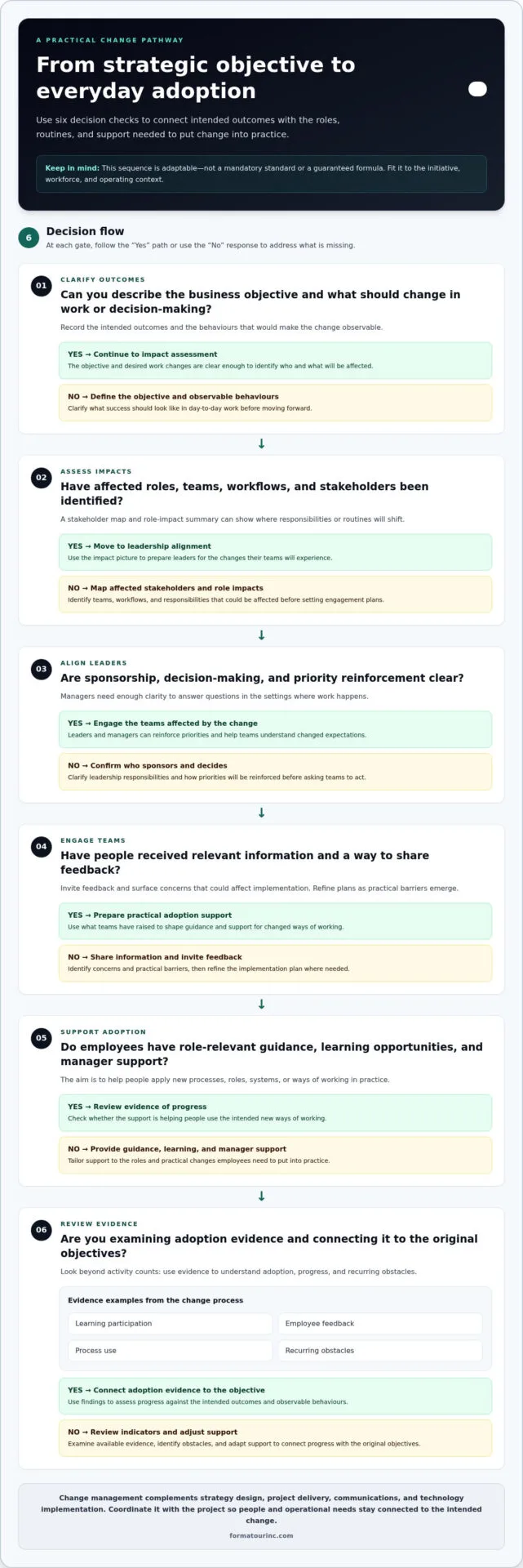
A practical sequence can help executives make that connection visible. It isn’t a mandatory standard or a guaranteed formula. Adapt its stages to the initiative, workforce, and operating context:
- Clarify outcomes: Define the business objective, then describe what should change in work or decision-making. Record intended outcomes and observable behaviours.
- Assess impacts: Identify affected roles, teams, workflows, and stakeholders. A stakeholder map and role-impact summary can show where responsibilities or routines will shift.
- Align leaders: Confirm who sponsors the change, makes decisions, and reinforces priorities. Managers need enough clarity to answer questions in the settings where work happens.
- Engage teams: Share relevant information, invite feedback, and identify concerns that could affect implementation. Use that feedback to refine plans as practical barriers emerge.
- Support adoption: Provide role-relevant guidance, learning opportunities, and manager support so employees can apply new ways of working.
- Review evidence: Examine indicators such as learning participation, employee feedback, process use, or recurring obstacles. Use the findings to adjust support and connect progress to the original objectives.
How should leaders connect a change initiative to strategic outcomes?
Start by translating the intended result into observable changes. If the objective is to improve coordination, identify which handoffs, decisions, or team practices need to change. Assign an accountable executive sponsor and managers who can reinforce those changes in day-to-day operations. Then connect project milestones and adoption indicators to the business objective. Choose measures that fit the initiative instead of relying on universal targets.
How can employee communication and engagement support adoption?
Communication works best when it explains what is changing, why it matters, and what it means for each affected group. Tailored updates should be paired with two-way feedback, manager conversations, and learning support. These channels can surface confusion or workflow barriers early, so implementation can respond to employee experience instead of relying on announcements alone.
For executives evaluating change management consulting firms Canada, look for an approach that links strategic objectives with practical adoption evidence and involves internal leaders and project teams. Organizations planning transformation can explore Formatour’s strategic advisory support.
How to assess change management consulting firms in Canada without buying a generic framework
A polished framework can provide structure, but it won’t tell you whether the proposed work fits your organization. Assess change management consulting firms Canada by how clearly they connect strategic objectives to affected roles, involve leaders and employees, integrate with project delivery, and evaluate adoption. A useful engagement clarifies who owns decisions, how feedback reaches the project team, and what evidence will indicate progress. The Change Management Institute Canada provides a professional community spanning government, corporate, and non-profit sectors, offering a relevant Canadian reference point for the discipline.
Consulting should add coordination and insight, not simply more meetings, templates, or a communications plan. Those tools can help, but their value depends on whether they address real operational impacts and inform action.
What distinguishes a tailored change engagement from a generic framework?
A tailored approach reflects the organization’s scale, culture, operating model, internal capacity, and the complexity of the change. A process redesign affecting one team has different coordination needs from a transformation involving several functions and locations. Established models can inform planning, but they should support rather than replace organizational judgment. The consultant works alongside internal leaders and project teams, adjusting the work as impacts and priorities become clearer.
| Assessment area | Generic framework-led support | Context-led, collaborative support |
|---|---|---|
| Strategic alignment | Applies standard activities with a loose link to objectives | Connects change actions to defined business priorities |
| Stakeholder involvement | Uses broad audience categories | Identifies affected roles and creates relevant feedback routes |
| Leadership participation | Assigns general sponsorship expectations | Clarifies sponsor, manager, and decision-making responsibilities |
| Delivery integration | Runs change activities alongside project work | Coordinates planning with project milestones and operating needs |
| Outcome measurement | Counts communications or completed activities | Reviews adoption indicators and operational evidence against objectives |
Which signs suggest a consulting approach is outcome-oriented?
Look for a clear connection between strategic objectives, impacted roles, and relevant adoption measures. Governance should identify owners and decision rights, and explain how employee feedback informs adjustments. Review the proposed approach, work products, and process for assessing progress. These are more useful indicators than unsupported promises of guaranteed results. Strong evaluation considers whether change activities support adoption and operational outcomes, not whether every template was completed.
How to plan change consulting across Canadian teams and operations
Canadian organizations may operate across provinces, locations, business units, and workforce groups, each with distinct workflows and communication needs. A change plan should account for those differences instead of assuming one language, regulatory, or workforce context applies everywhere. Before implementation begins, map who is affected, how work moves between teams, where decisions sit, and which communication and feedback channels can reach people effectively.
For executives considering change management consulting firms Canada, the planning question is whether a partner can help maintain consistent objectives while adapting engagement to real operating conditions. A shared direction does not require identical local execution.
How can leaders coordinate change across locations and teams?
Start with an impact map that identifies where roles, processes, systems, and dependencies vary. For example, a redesigned workflow may involve a central team and regional operations, with different handoffs or manager responsibilities. Preserve the intended outcome across the organization, then tailor implementation details to local realities. Assign clear owners for cross-functional decisions, employee questions, and escalation so issues reach someone empowered to address them.
Plan how updates will reach each affected group and how feedback will return to decision-makers. Consider language needs, team structure, available channels, and operational demands when designing engagement. This helps prevent a single communications plan from overlooking groups that experience the change differently.
How can organizations monitor adoption without relying on activity counts?
Set measures before implementation, linking them to the work practices and operational outcomes the change is intended to influence. Training completion or messages sent are useful delivery outputs, but they don’t establish that people can apply a new process or that work is operating as intended. Pair activity data with relevant feedback and operational indicators.
- Outputs: Learning participation, briefings delivered, or guidance distributed.
- Adoption signals: Employee feedback, observed use of a new process, or recurring questions about changed responsibilities.
- Operational indicators: Measures tied to the initiative, such as handoff quality or process consistency, where appropriate to its objectives.
Review these signals at agreed points with the teams responsible for delivery and operations. If feedback reveals confusion or an indicator points to friction, adjust guidance, manager support, or implementation details. This makes measurement a decision tool rather than just a progress report, while keeping the approach grounded in organizational objectives.
To plan change across teams and operations, explore organizational change priorities with Formatour.
How Formatour supports strategic change and organizational transformation
Organizational change is more sustainable when it advances a defined strategic priority and fits the realities of daily operations. Formatour is a Canadian advisory firm focused on strategic transformation, operational performance, and project management. Its services can help organizations connect intended changes with the projects, processes, and leadership alignment needed to put them into practice.
How can Formatour align change work with transformation priorities?
Strategic objectives can guide project planning, clarify which processes need attention, and help leaders align decisions and communication. Formatour provides strategic transformation and process optimization support, alongside project management and executive leadership development. These capabilities can help organizations coordinate work across teams, address changes to routines and responsibilities, and build leadership capacity to guide transformation.
For digital initiatives, this connection matters because introducing or changing technology can also affect workflows, roles, and decision-making. Explore Formatour’s strategic transformation and digital advisory to consider these priorities together.
Standards-related work may also involve organizational change. Formatour supports implementation, auditing, and certification processes for ISO 9001, ISO 27001, ISO 22301, and ISO 14001. These standards can be relevant to an organization’s objectives and scope, but they do not replace attention to employee adoption or operational impacts.
For executives comparing change management consulting firms Canada, the value of an advisory relationship lies in how well it complements internal expertise and day-to-day delivery. Collaborative planning can connect strategic priorities to project responsibilities, process changes, and leadership development without promising a predetermined result.
What is a practical next step for Canadian executives?
Prepare a concise initiative brief to focus an initial advisory discussion. Include:
- The change: What is changing, and what prompted the initiative?
- The intended outcome: Which strategic or operational objective should the change support?
- The affected groups: Which teams, roles, or locations may experience a difference in their work?
- Current constraints: Which delivery dependencies, capacity limits, or operational demands should planning account for?
A clear starting point makes it easier to discuss priorities, dependencies, and suitable support. Discuss your strategic transformation and change priorities with Formatour to explore an approach aligned with your organization’s objectives and operations.
Make your next change initiative purposeful and sustainable
Effective organizational change connects strategic priorities with the way people work. The right advisory approach is tailored to your organization, integrates with project delivery, and helps leaders assess adoption through relevant evidence rather than activity counts alone. These are practical criteria for evaluating change management consulting firms Canada and choosing support that complements internal teams.
As a Canadian advisory firm focused on strategic transformation and operational performance, Formatour brings together project management, process optimization, and executive leadership development to support coordinated change. Start by clarifying the initiative’s intended outcome, affected groups, and current delivery constraints.
Discuss your organizational change priorities with Formatour and explore an approach aligned with your objectives and operations. With clear priorities and collaborative planning, your organization can move forward with greater alignment and confidence.
Frequently Asked Questions
What do change management consulting firms in Canada do?
Change management consulting firms Canada help organizations plan and coordinate the people and operational dimensions of change. Their support may include assessing stakeholder impacts, aligning leaders, planning communications, supporting employee adoption, and monitoring progress. Scope depends on the initiative and the organization’s operating context. This work complements strategy design and technical implementation by focusing on how people understand and apply changes to their roles, processes, or ways of working.
How do I choose a change management consulting firm for my organization?
Choose a firm based on how its approach connects with your strategic objectives and operational needs. Assess how it plans for employee adoption, involves leaders, collaborates with internal teams, and measures progress. A useful engagement clarifies responsibilities and connects activities to meaningful evidence, rather than relying only on meetings or templates. Familiar frameworks can inform planning, but support should reflect your organization’s culture, change complexity, and internal capacity.
Can change management consultants help with digital transformation?
Yes. Change management can complement digital transformation by preparing leaders and employees for changes to workflows, roles, systems, and decision-making. For example, a new system may alter how teams complete a process or share information. Adoption support helps people understand and use those changes. It is distinct from software development or technical implementation, so responsibilities should be coordinated across transformation leaders, project teams, operational managers, and affected employees.
How do change management consultants measure success?
Consultants measure progress by connecting the initiative’s intended outcomes with evidence of adoption and operational performance. Training attendance and communications delivered show that activities occurred, but not necessarily that work practices changed. Depending on the initiative, useful evidence might include employee feedback, use of a revised process, or an operational indicator tied to the objective. Measures should reflect the organization’s baseline and priorities, rather than assume universal targets apply.
When should a Canadian organization engage a change management consulting firm?
Consider engaging support when a major transformation, process redesign, or new operating model affects multiple teams or creates substantial coordination needs. Support can also help when stakeholder impacts are complex or internal teams lack capacity to organize communications and adoption support alongside delivery. The right timing and scope depend on organizational readiness, existing resources, and the initiative’s complexity. Early planning can help leaders identify impacts and responsibilities before implementation advances.
Will change management consulting disrupt day-to-day operations?
Change consulting should be coordinated with operating priorities, existing governance, and project delivery, rather than treated as separate work. Planning communications, feedback, and adoption support around operational demands can help teams manage competing responsibilities. However, no approach can promise disruption-free implementation. The effect on daily work depends on the nature and scope of the change, how teams are affected, and how effectively leaders coordinate activities with ongoing operations.
How is change management consulting different from project management?
Project management coordinates a project’s scope, schedule, resources, and delivery. Change management focuses on how people understand, adopt, and sustain changes to their work. The disciplines are complementary: project teams may deliver a new process or system while change activities prepare employees and managers to use it. Clear coordination helps align delivery milestones, leadership responsibilities, and adoption support around the same organizational objectives.
