

A checklist that only confirms documents exist can miss the environmental risks your management system is meant to control. An effective ISO 14001 internal audit checklist connects each requirement to what happens in practice, the evidence that demonstrates it, and the action needed when something falls short.
A clear structure helps when you’re deciding what to assess across the environmental management system (EMS) or wondering whether a generic template fits your operations. The checklist should guide the investigation, not replace auditor judgement. This matters as organizations prepare for ISO 14001:2026, published on April 15, 2026, with stronger emphasis on climate change and measurable environmental performance.
This guide explains how to build a clause-aligned audit plan, tailor questions to operational risks, gather relevant evidence, and document findings clearly. It also covers how to assign corrective actions and verify follow-up, so audit results support ongoing improvement rather than ending with a report. Use the checklist as a practical framework, adapted to your organization’s activities, impacts, and EMS scope.
Key Takeaways
- Organize your ISO 14001 internal audit checklist around applicable clauses, and confirm it reflects the standard edition your organization uses.
- Set audit scope and priorities according to process importance, environmental significance, operational changes, and previous results.
- For each audit prompt, record objective evidence separately from your conclusion so findings are clear and traceable.
- Assign owners and due dates for follow-up, then verify that corrective actions address the issue and are effective.
- Review auditor competence and impartiality, and consider independent guidance when recurring findings or unclear responsibilities weaken the process.
ISO 14001 internal audit checklist: purpose, scope, and limits
An internal audit is a planned, evidence-based assessment of whether an environmental management system meets applicable ISO 14001 requirements and the organization’s own arrangements. It checks how the system works in practice, not simply whether procedures have been written. A useful ISO 14001 internal audit checklist gives auditors a consistent structure for asking questions, gathering evidence, and recording conclusions.
Audits help organizations assess whether processes are working as intended and where controls or responsibilities need attention. They can also help with preparation for an external assessment, but certification readiness is only one possible benefit. The broader purpose is to understand whether the EMS effectively manages the organization’s environmental aspects and supports its objectives. For background on the standard’s place within the broader framework, see the ISO 14000 family of standards.
What an ISO 14001 internal audit assesses
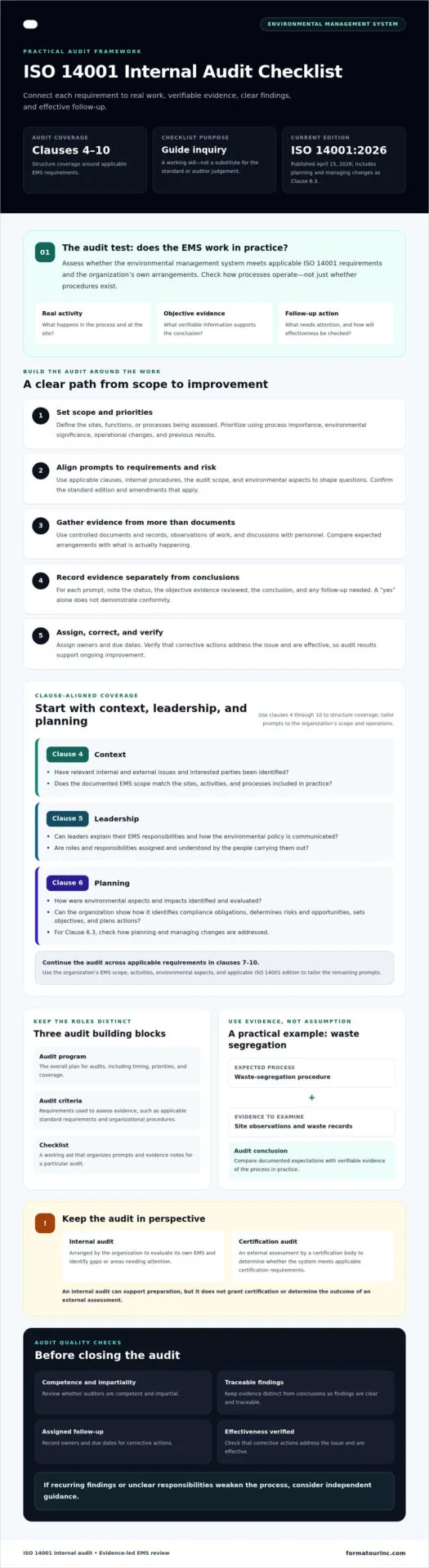
Evidence can include controlled documents and records, observations of work, and discussions with personnel. For example, a waste-segregation procedure describes the expected process, while site observations and waste records help show whether it is followed. Base conclusions on verifiable information, not assumptions or a completed checklist alone.
Internal audit versus certification audit
An internal audit is arranged by the organization to evaluate its own EMS. A certification audit is an external assessment conducted by a certification body to determine whether the management system meets applicable certification requirements. Internal auditors can identify gaps and provide useful insight, but an internal audit does not grant certification or determine the result of an external assessment.
The checklist is one tool in the audit process. Keep these elements distinct:
- Audit program: The overall plan for audits, including timing, priorities, and coverage.
- Audit criteria: The requirements used to assess evidence, such as applicable standard requirements and the organization’s procedures.
- Checklist: A working aid that organizes prompts and evidence notes for a particular audit.
A checklist can guide consistent inquiry, but it can’t replace the applicable ISO standard or auditor judgement. Tailor prompts to the audit’s scope, processes, and environmental risks. Treat each response as a starting point for gathering evidence, not as proof of conformity by itself.
ISO 14001 internal audit checklist by EMS clause
Use clauses 4 through 10 to structure audit coverage, then tailor each prompt to the organization’s EMS scope, activities, and environmental aspects. Before the audit, confirm which edition of ISO 14001 and which amendments apply. The current edition is ISO 14001:2026, which includes planning and managing changes as Clause 6.3.
Audit questions should reflect the organization’s scope and call for evidence that shows how its EMS works in practice. For each prompt, record the status, the objective evidence reviewed, and any follow-up needed. A “yes” response alone doesn’t demonstrate conformity. Note the record, observation, or interview that supports the conclusion.
Clauses 4-6: context, leadership, and planning
These clauses establish why the EMS exists, who directs it, and how environmental priorities are managed. Choose questions that connect documented arrangements to actual decisions and processes.
- Clause 4, context: Have relevant internal and external issues and interested parties been identified? Does the documented EMS scope match the sites, activities, and processes included in practice?
- Clause 5, leadership: Can leaders explain their EMS responsibilities and how the environmental policy is communicated? Are roles and responsibilities assigned and understood by the people carrying them out?
- Clause 6, planning: How were environmental aspects and impacts identified and evaluated? Can the organization show how it identifies compliance obligations, determines risks and opportunities, sets objectives, and plans actions? For Clause 6.3, check how proposed changes are assessed and managed.
Relevant evidence may include the scope statement, aspect evaluations, policy communications, assigned responsibilities, objective plans, and records showing how a process or operational change was reviewed. Follow the evidence trail rather than treating a completed form as proof that the process is effective.
Clauses 7-10: support, operations, evaluation, and improvement
These clauses test whether the EMS has the capability and controls to operate, evaluate performance, and respond to problems. For the activities in scope, sample records and observe relevant processes where practical.
- Clause 7, support: Do training or qualification records support the competence needed for relevant tasks? Can personnel describe applicable environmental responsibilities? Are communications and documented information controlled?
- Clause 8, operation: Are operational controls followed in the work area, including controls for relevant externally provided processes? Are emergency response arrangements maintained and tested as planned?
- Clause 9, evaluation: Do monitoring and measurement records show how performance is evaluated? Are internal audit results and management review outputs available and acted upon?
- Clause 10, improvement: When a nonconformity occurs, are the response, cause evaluation, corrective action, and effectiveness review documented?
Use the ISO 14001 internal audit checklist as a prompt set, not a fixed script. If you need independent input to shape clause-based audit questions around your EMS, you can contact Formatour about ISO 14001 support.
How to plan an ISO 14001 internal audit that tests real performance
A well-planned audit tests whether environmental controls work in practice, not just whether related documents are available. Build the audit program around process importance, environmental significance, operational changes, and previous results. ISO 14001 requires audits at planned intervals, but it doesn’t set one universal frequency for every organization. Set timing and coverage to suit your EMS, and verify requirements against the applicable edition and amendments. The current edition, ISO 14001:2026, was published on April 15, 2026.
Set audit objectives, scope, criteria, and sampling
Before using the ISO 14001 internal audit checklist, define what the audit needs to establish and where it will focus. A clear plan gives auditors a consistent basis for examining evidence and documenting conclusions.
- 1. Set the objective: State the intended outcome, such as assessing whether controls for a significant environmental aspect are implemented or checking progress on previous findings.
- 2. Define scope and criteria: Identify the locations, activities, processes, and period under review. Specify the applicable ISO 14001 requirements and relevant internal procedures or arrangements.
- 3. Prioritize areas for review: Use the aspects register, process changes, monitoring results, and previous audit findings to identify where closer attention is warranted. For example, a changed waste-handling process or a recurring control issue may merit focused testing.
- 4. Select samples: Choose records, work activities, and personnel relevant to the scope. Record why each sample was selected and what it can demonstrate.
Sampling makes an audit manageable, but it can’t establish that every transaction or instance is conforming. Select samples in proportion to process significance and risk, then expand the review if the evidence points to a concern.
Prepare auditors and evidence requests
Assign auditors with knowledge suited to the processes and environmental controls under review. Consider technical understanding, audit skills, and impartiality. Where practicable, avoid assigning someone to audit their own work to support objective conclusions.
Send focused evidence requests in advance. Depending on the scope, these might include relevant procedures, aspect evaluations, monitoring records, compliance-obligation registers, emergency response information, training records, and previous corrective-action records. During the audit, compare documents with observations and interviews rather than relying on records alone.
For broader implementation context, review Formatour’s ISO 14001 environmental management system support and consider whether independent guidance would help strengthen your audit planning.
How to record ISO 14001 audit evidence, findings, and corrective actions
A useful audit record lets another reader follow the path from the question asked to the evidence reviewed, the auditor’s conclusion, and any action required. Keep these elements distinct. Objective evidence is what the auditor observed or examined. Interpretation explains how that evidence relates to the audit criteria. A finding is the documented result under the organization’s audit process.
An audit finding should connect a defined criterion to verifiable evidence. Record what was sampled, where the evidence came from, and which requirement or internal arrangement was assessed. The example below is illustrative; classify results according to your criteria and documented process.
| Checklist question | Evidence | Conclusion | Finding | Owner | Due date |
|---|---|---|---|---|---|
| Are required operational inspection records maintained? | Sampled records for the selected period; one required record was not available. | Evidence does not demonstrate completion for the sampled instance. | Potential nonconformity against the applicable documented requirement; confirm and classify under the audit process. | Process owner | Assigned date |
Turn checklist responses into defensible audit findings
Use precise, neutral language. State the criterion, the sample reviewed, and the evidence supporting the conclusion. Avoid assumptions about why a gap occurred or who is to blame. A missing record may support a finding about evidence of implementation, but it doesn’t automatically prove that an activity never happened. Describe only what the audit established.
Record conformity when evidence supports the criterion. Document a nonconformity when evidence demonstrates that a requirement wasn’t met. Use an observation or improvement opportunity only if the organization’s procedure defines and permits that category. Don’t present it as a formal nonconformity without supporting evidence.
Verify corrective action and close the audit cycle
For a nonconformity, assign an accountable owner and planned completion date. The responsible team should address immediate correction where needed, assess the cause, and define action intended to prevent recurrence. Link the action plan to the original evidence and finding.
Don’t close a finding solely because an action was reported as complete. Check that the action was implemented and, where required by the organization’s process, verify its effectiveness using appropriate evidence. Carry unresolved or recurring issues into relevant management review and future audit planning. This follow-through turns audit records from a filing exercise into a practical improvement mechanism.
If you need support strengthening audit records and follow-up, contact Formatour about ISO 14001 support.
When ISO 14001 audit support can strengthen your checklist process
An internal audit process may need added capability when the same findings keep returning, responsibilities are unclear, records don’t adequately demonstrate how controls work, or operational changes make existing audit questions less relevant. These signals don’t automatically mean the EMS is failing. They do suggest it may be time to review whether audit planning, evidence collection, and follow-up match current needs.
Assess your internal auditors against the scope and complexity of the work. Do they understand the processes and environmental controls being examined? Can they gather and assess evidence objectively? Is there enough time and capacity to cover priority areas, and can auditors avoid reviewing their own work where practicable? If gaps emerge, independent guidance may help strengthen the process while management retains responsibility for the EMS and its decisions.
Choose between an internal-only approach and external guidance
For broader context on environmental management system implementation, review Formatour’s ISO 14001 environmental management system support. Confirm the scope of any advisory engagement directly rather than assuming it includes specific deliverables or certification responsibilities.
Prepare for a focused discussion about audit needs
A short set of current materials can make an initial conversation more productive. Gather the EMS scope, audit program, recent findings, action status, and a concise description of changes or recurring challenges. Identify what you want to improve, such as evidence quality, audit coverage, or the consistency of corrective-action follow-up.
Formatour is a Canadian advisory firm that offers ISO 14001 environmental management system support, including ISO standards implementation and auditing support. If you’re considering assistance, discuss your ISO 14001 audit support needs and clarify the scope that would fit your organization.
Turn audit insights into lasting EMS improvement
A strong ISO 14001 internal audit checklist does more than organize questions. It connects applicable clauses to your organization’s processes, environmental aspects, and operational evidence, helping auditors reach clear, supportable conclusions. Plan audits around system priorities and change, then record findings in a way that separates evidence from interpretation.
Most importantly, keep the audit cycle moving after the report. Assign responsibility for corrective actions, check that actions are implemented, and verify their effectiveness under your organization’s process. This follow-through helps turn audit results into practical improvements to the environmental management system.
When internal capability, impartiality, or recurring findings create challenges, independent guidance may help strengthen planning and follow-up while management retains ownership of the EMS. Formatour lists ISO 14001 environmental management system services and provides ISO standards implementation and auditing support. Confirm the scope of any engagement directly, as advisory support does not replace certification.
Discuss your ISO 14001 audit needs with Formatour and identify an approach suited to your organization. With a focused checklist and consistent follow-through, your audit process can become a dependable part of ongoing EMS improvement.
Frequently Asked Questions
What should an ISO 14001 internal audit checklist include?
An ISO 14001 internal audit checklist should cover applicable requirements across clauses 4 through 10, along with the organization’s own EMS processes and arrangements. Include prompts on context, leadership, planning, support, operations, performance evaluation, and improvement. Tailor questions to the audit’s scope and environmental aspects, then record each prompt’s status, objective evidence, conclusion, and follow-up needs. Check that the checklist reflects the ISO 14001 edition and amendments applicable to your organization.
How often should an ISO 14001 internal audit be conducted?
Conduct internal audits at planned intervals, setting the timing and coverage to fit your EMS rather than relying on a universal frequency. Prioritize processes based on environmental significance, operational change, previous audit results, and the importance of the activity. The audit program should define when and what to assess. Confirm the wording in the edition of ISO 14001 that applies to your system, including relevant amendments.
Can an organization use a checklist as its complete ISO 14001 audit program?
No. A checklist supports an individual audit, but it doesn’t replace the audit program. The program plans audit coverage, timing, and priorities across the EMS. Audit criteria define the requirements used to assess evidence, while the checklist organizes prompts and notes for a specific scope. A checklist alone can’t ensure complete coverage or prove conformity. Adapt it to your processes, risks, applicable requirements, and previous results.
Who can conduct an ISO 14001 internal audit?
Auditors should have the competence needed to assess the requirements and processes in their assigned scope, including relevant audit skills and understanding of environmental controls. They may be employees or external auditors, provided the organization addresses impartiality. Where practicable, avoid having someone audit their own work. Match auditor knowledge to the activity being examined, and ensure conclusions are based on objective evidence rather than assumptions.
What evidence should an ISO 14001 internal auditor review?
Review evidence relevant to the audit scope and criteria, such as procedures, environmental aspect evaluations, training or competence records, monitoring results, operational records, and corrective-action follow-up. Depending on the processes being audited, examine compliance-obligation information and emergency preparedness records as well. Compare documented information with observations and interviews. Record what was sampled, where the evidence came from, and how it supports the audit conclusion.
What happens if an internal audit finds a nonconformity?
Document the criterion that wasn’t met and the verifiable evidence supporting the finding. The responsible team should respond under the organization’s process, determine the cause, define corrective action, assign an owner, and set a planned completion date. Keep the action linked to the original finding. Before closure, verify that the action was implemented and assess its effectiveness as required by the organization’s process. Use recurring or unresolved issues to inform future audit planning.
Is an ISO 14001 internal audit the same as a certification audit?
No. An internal audit is an organization’s own assessment of its EMS against applicable requirements and internal arrangements. A certification audit is an external assessment conducted by a certification body to determine whether the system meets certification requirements. Internal audits can identify gaps and support improvement, but they don’t grant certification or guarantee a successful external assessment. Keep the roles distinct when planning audits and communicating results.
