

For a Canadian organization, a major operational disruption isn’t merely a technical setback. It’s a fundamental test of leadership that determines whether a brand maintains its integrity or dissolves under pressure. You likely understand that having a business continuity plan on paper is only the first step. The real anxiety stems from the uncertainty of whether that plan will survive a real-world crisis or a rigorous external certification audit. Utilizing professional ISO 22301 internal audit services Canada ensures your internal teams aren’t left struggling with a lack of objectivity or the specific expertise required to conduct a truly rigorous assessment.
This partnership transforms a standard compliance hurdle into a strategic stress test for your entire operation. This guide explores how a methodical audit process identifies hidden vulnerabilities and integrates the latest 2024 climate change amendments into your resilience strategy. You’ll discover how to build an audit-ready Business Continuity Management System (BCMS) that provides actionable insights for growth. We’ll examine the path toward demonstrable compliance that satisfies regulators and builds unwavering stakeholder confidence in your organization’s future.
Key Takeaways
- Identify why ISO 22301 serves as a vital safeguard for critical Canadian sectors; it ensures long-term structural integrity during periods of global volatility.
- Understand how professional ISO 22301 internal audit services Canada evaluate your Business Impact Analysis and Risk Assessment to ensure your plans remain actionable.
- Learn to distinguish between basic compliance checklists and strategic stress tests that transform business continuity management into a genuine competitive advantage.
- Gain a clear roadmap for audit preparation by focusing on executive alignment and the optimization of organizational resources for a seamless certification path.
- Discover the benefits of partnering with a strategic mentor who applies international benchmarks to the specific requirements of the Canadian business environment.
Strengthening Canadian Infrastructure: The Role of ISO 22301 Internal Audit Services
A systematic and independent evaluation of your Business Continuity Management System (BCMS) is the only way to ensure your organization remains standing when the unexpected occurs. For Canadian enterprises, professional ISO 22301 internal audit services Canada act as a strategic catalyst for long-term stability. While Clause 9.2 of the ISO 22301 Standard mandates these audits for compliance, the true value lies in proactive risk management. Canadian executives are shifting their focus toward Strategic Resilience. This is a state where the organization doesn’t just survive disruptions but uses its preparedness to demonstrate market leadership and reliability to stakeholders.
The Canadian Regulatory Landscape and ISO 22301
Resilience is a national priority. Public Safety Canada emphasizes the protection of critical infrastructure, particularly in the finance, energy, and healthcare sectors. While ISO 22301 is an international framework, it aligns closely with Canadian-specific guidelines like CSA Z1600. Organizations often find that a robust BCMS is no longer optional; it’s a prerequisite for trust. Supply chain partners across the country increasingly demand proof of resilience before finalizing high-value contracts. This shift reflects a collective move toward a more integrated and secure national economy, where every link in the chain must prove its structural integrity.
Internal Audit vs. External Certification: Clearing the Confusion
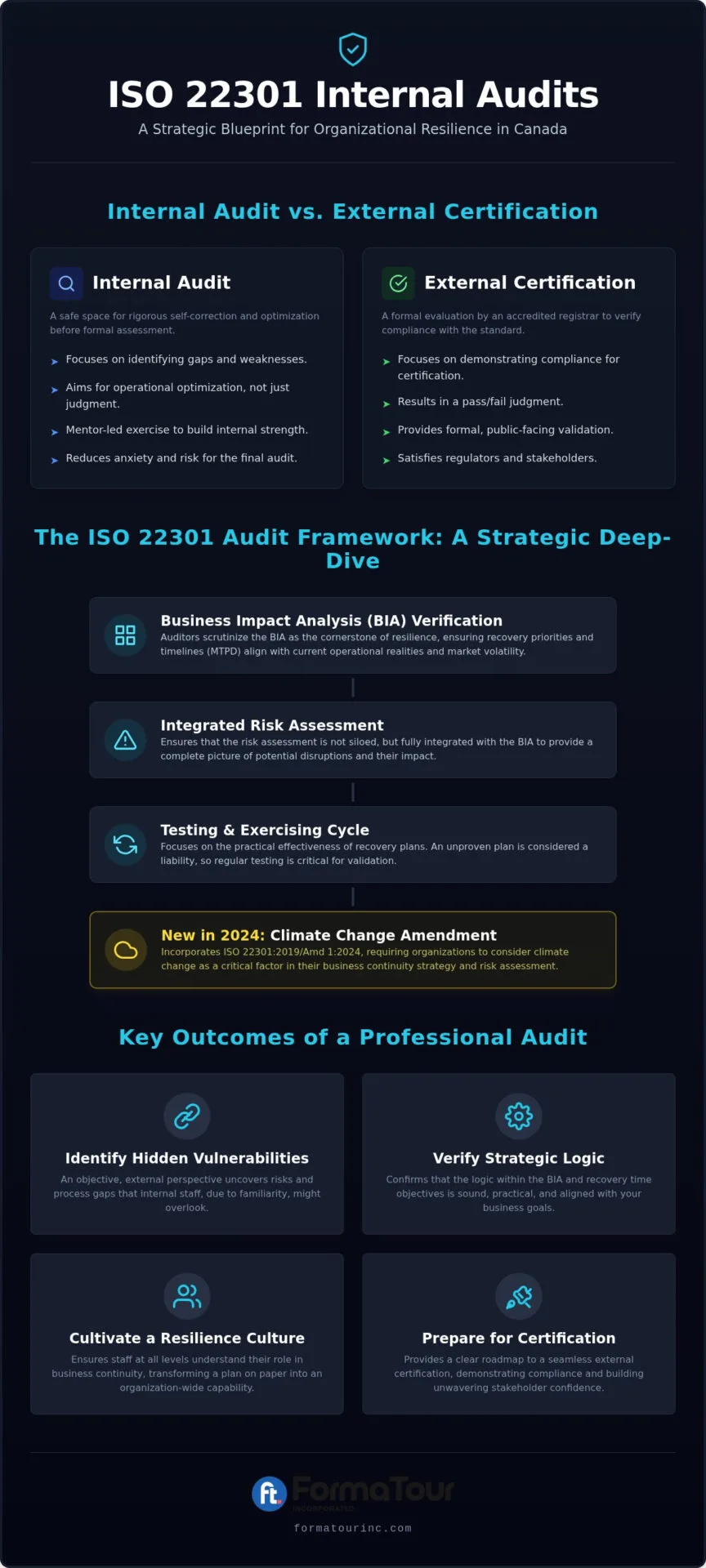
It’s helpful to view the internal audit as a safe space for rigorous self-correction. Unlike an external certification audit conducted by a registrar, the internal process focuses on identifying gaps and weaknesses without the immediate threat of a failed certification. This phase is about optimization rather than just judgment. Partnering with an impartial third-party advisor like Formatour Incorporated brings a level of objectivity that internal teams often lack. This external perspective ensures that your BCMS is not just compliant on paper but operationally sound. It provides the assurance that your team can execute complex recovery strategies under the pressures of a real-world crisis.
By treating the internal audit as a strategic mentor-led exercise, firms can achieve several outcomes:
- Identification of hidden vulnerabilities that internal staff might overlook due to familiarity.
- Verification of logic within the Business Impact Analysis (BIA) and recovery time objectives.
- Cultivation of a resilience culture where staff at all levels understand their role in continuity.
- Full preparation for the final external audit, reducing anxiety and the risk of non-conformities.
The ISO 22301 Internal Audit Framework: A Strategic Deep-Dive
A rigorous internal audit framework serves as the blueprint for organizational survival. It moves beyond checking boxes to perform a strategic deep-dive into the core pillars of your Business Continuity Management System (BCMS). The evolution from the 2012 version to the Official ISO 22301:2019 Standard reflects a shift toward less prescriptive, more outcome-oriented requirements. This means ISO 22301 internal audit services Canada now focus heavily on the practical effectiveness of your recovery plans. Auditors examine the Scope, BIA, and Risk Assessment to ensure they’re integrated rather than siloed. Central to this is the cycle of testing and exercising; an unproven plan is a liability. Modern audits also incorporate the ISO 22301:2019/Amd 1:2024 update, which requires organizations to consider climate change as a factor in their business continuity logic.
Verifying the Business Impact Analysis (BIA)
A BIA is the cornerstone of resilience that dictates recovery priorities. During a sophisticated audit, we ensure this analysis reflects current Canadian market volatility and the specific supply chain risks inherent to our geography. We scrutinize the Maximum Tolerable Period of Disruption (MTPD) for every critical function. If these metrics don’t align with current operational realities, the recovery strategy will fail when it’s needed most. The audit verifies that the BIA accurately identifies the minimum resources required to sustain essential services during a prolonged outage.
Assessing Recovery Strategies and Plans
Recovery strategies must be grounded in reality rather than aspiration. We evaluate whether Recovery Time Objectives (RTOs) are realistic and supported by confirmed resource allocations. A common vulnerability is the lack of integration between IT disaster recovery and broader business continuity. These two elements must operate in total synchronization to be effective. Additionally, we check communication protocols to ensure they’re robust enough for Canada’s modern, hybrid workforces. A plan that assumes physical proximity for all staff is no longer a viable solution for the current operational environment.
To ensure your BCMS is truly audit-ready and operationally resilient, you might discuss your specific requirements with a strategic mentor who understands these nuances.
Strategic Stress Testing vs. Box-Ticking: Why the Auditor Matters
Many executives view the audit process as a bureaucratic burden that drains resources without providing tangible value. This perception often stems from negative experiences with “commodity auditing,” where the focus is limited to verifying documentation and checking boxes. However, premium ISO 22301 internal audit services Canada adopt a different approach by testing the underlying logic and cultural readiness of the organization. A strategic auditor acts as a mentor, identifying opportunities for operational performance gains that extend far beyond a simple compliance check. This transformation turns a mandatory exercise into a high-level briefing on organizational health. It replaces the anxiety of failing an audit with the quiet confidence of knowing your systems are optimized for any eventuality.
The Value of Boutique Agility in Auditing
Large, high-volume firms often prioritize speed over depth, leading to missed nuances in complex operational environments. Boutique firms provide the agility needed to deliver deep insights tailored to specific regional challenges. An auditor who understands Canadian business culture and the logistical realities of our vast geography can provide more relevant feedback than a distant “cert mill.” By linking audit findings to strategic transformation consulting, organizations can align their resilience efforts with long-term growth objectives. This ensures that every dollar spent on compliance also contributes to the structural integrity of the business. This personalized approach fosters a partnership where the auditor becomes a visionary architect for your company’s stability.
Identifying Hidden Operational Risks
A strategic audit frequently uncovers functional silos and communication gaps that threaten daily performance, not just emergency response. These insights allow leadership to optimize processes before they lead to failure. Many organizations find that using ISO 22301 as a framework also simplifies ISO 9001 quality management implementation, creating a cohesive management system. Instead of isolated data points, the audit produces executive-level intelligence. This clarity empowers leaders to make informed decisions about resource allocation and risk appetite with unwavering confidence. It bridges the gap between high-level governance and daily operational excellence, ensuring that resilience is woven into the very fabric of the corporate culture. By turning compliance data into actionable intelligence, you transform a cost center into a strategic asset.
Preparing for Your ISO 22301 Internal Audit in Canada
Preparation is the bridge between a theoretical continuity plan and operational reality. It requires a structured approach that aligns your team with international benchmarks while respecting the specific nuances of the Canadian business environment. Success depends on more than just document availability; it demands a culture of readiness supported by executive leadership. While internal teams provide essential context, engaging external specialists for ISO 22301 internal audit services Canada brings the impartial objectivity required to identify critical gaps. This collaborative effort ensures your organization moves beyond basic compliance toward a state of structural integrity.
Step 1: Establishing the Audit Scope and Objectives
Clarity begins with defining the boundaries of your Business Continuity Management System (BCMS). You must determine exactly which business units, Canadian regional offices, and critical functions fall within the audit’s purview. Objectives should target the effectiveness of recovery logic rather than just checking for the existence of files. If you’re in the early stages of development, utilizing ISO 22301 business continuity consulting provides a solid foundation for this scoping exercise. This ensures that the audit remains focused on high-impact areas that affect your organization’s survival.
Step 2: Evidence Collection and Stakeholder Engagement
Auditors require tangible proof of your system’s maturity. You’ll need to organize exercise reports, incident logs, and training records into a coherent evidence package. Equally important is preparing your staff for interviews. They don’t need to memorize the standard; they need to demonstrate a clear awareness of their specific roles during a disruption. Integrating leadership training for digital transformation ensures that your management team views resilience as a core component of modern business operations. This alignment makes the audit process a collaborative growth opportunity rather than a stressful interrogation.
To finalize your preparation, follow these remaining steps:
- Step 3: Document Readiness Review. Ensure your BIA, Risk Assessments, and Business Continuity Plans are current and officially signed off by leadership.
- Step 4: Resource Allocation. Secure the necessary time from key personnel and provide the auditor with access to all required digital and physical systems.
- Step 5: Executive Alignment. Confirm that the executive team understands the audit’s strategic value and is prepared to act on the resulting insights.
If you’re ready to transform your continuity plans into a robust, audit-ready system, reach out to our strategic advisors to begin your resilience journey.
Formatour Inc: Your Partner for Premium ISO 22301 Auditing in Canada
Formatour Incorporated stands as the premier partner for Canadian organizations seeking more than just a compliance certificate. We provide professional ISO 22301 internal audit services Canada that blend over a decade of advisory experience with the personalized attention of a boutique consultancy. Our methodology ensures that your business continuity management system (BCMS) isn’t a static document but a living framework for survival. By combining big-firm standards with boutique agility, we offer the strategic depth required by large enterprises without the bureaucratic friction often found in global consultancies. We don’t just identify gaps; we co-develop solutions that align with your long-term vision for growth and stability.
A Multidisciplinary Approach to Resilience
Resilience is rarely a standalone achievement. It requires a holistic view of organizational health that encompasses information security, quality management, and operational continuity. We often integrate ISO 22301 with ISO 27001 implementation services to create a unified shield for both your physical operations and digital assets. Formatour’s auditors act as visionary architects, helping you build a structure that supports rapid digital transformation while mitigating systemic risk. As a Canadian-based firm with a global outlook, we apply international benchmarks to local logistical realities. This ensures your organization remains competitive and reliable on the world stage, regardless of the disruption.
Getting Started: The Road to Certification and Beyond
Our engagement process is methodical and deliberate, designed to provide maximum value at every stage. We move through a structured journey that transforms your preparedness into a demonstrable asset for stakeholders. The Formatour audit process includes:
- Strategic Discovery: We align our audit scope with your unique corporate objectives and risk appetite.
- Expert Execution: Our multidisciplinary team conducts a rigorous evaluation of your BIA, recovery plans, and exercise history.
- Actionable Debrief: We provide a comprehensive report that translates technical findings into executive-level intelligence.
We help you move from audit findings to tangible process automation and optimization. This ensures that your resilience strategy actually improves daily efficiency rather than adding administrative weight. Our role as a strategic mentor is to guide you through the complexities of international standards with quiet confidence. If you’re ready to secure your organization’s future and build a truly robust BCMS, Contact Formatour Inc for a Strategic Audit Consultation today.
Architecting a Future of Unwavering Stability
True organizational resilience transcends the simple act of surviving a crisis; it’s about building a foundation that thrives under pressure. By shifting from a “box-ticking” mentality to a strategic stress test, your leadership team gains the intelligence needed to optimize operations and protect stakeholder value. Utilizing professional ISO 22301 internal audit services Canada ensures that your Business Continuity Management System remains both compliant and operationally agile. This proactive approach identifies hidden risks before they become failures, allowing your organization to maintain its structural integrity in an increasingly volatile global landscape.
Formatour Incorporated serves as your strategic mentor, offering boutique agility combined with big-firm consulting standards. Our multidisciplinary expertise across ISO 9001, 27001, 22301, and 14001 allows us to view your resilience through a holistic lens of transformation and growth. We provide the expert guidance necessary to navigate international benchmarks with precision and quiet confidence. Secure Your Organization’s Future with Formatour’s Premium ISO 22301 Audit Services today. Your commitment to resilience is the most powerful investment you can make in your company’s enduring success.
Frequently Asked Questions
What is the difference between an internal audit and an external certification audit for ISO 22301?
Internal audits serve as a strategic self-evaluation to identify gaps and optimize the Business Continuity Management System before a certification body arrives. In contrast, an external audit is conducted by an independent registrar to verify compliance for official certification. While the internal process focuses on mentorship and improvement, the external audit is a formal assessment of conformity. Utilizing professional ISO 22301 internal audit services Canada provides a safe environment to correct weaknesses without the risk of losing certification status.
How often should a Canadian organization conduct an ISO 22301 internal audit?
Canadian organizations should conduct an internal audit at least once per year to maintain compliance with Clause 9.2 of the standard. However, frequency should increase following major organizational changes, such as digital transformations, mergers, or significant shifts in the supply chain. Regular assessments ensure that recovery strategies remain aligned with current operational realities. This methodical approach helps leadership maintain a state of constant readiness and demonstrates a serious commitment to long-term organizational resilience.
Can our own internal staff perform the ISO 22301 internal audit?
Internal staff can perform the audit provided they are competent and, most importantly, objective regarding the department they are evaluating. However, many Canadian firms find that internal teams often lack the specialized expertise or the necessary distance to identify deep-seated systemic issues. Engaging an external advisor ensures a completely impartial perspective and brings a global citizen outlook to your resilience strategy. This external oversight prevents the bias that frequently occurs when staff audit their own colleagues.
What are the most common non-conformities found during an ISO 22301 audit in Canada?
Common issues found during audits include outdated Business Impact Analyses (BIA) that fail to reflect current market volatility and supply chain risks. Many organizations also struggle with insufficient evidence of testing and exercising their recovery plans. Other frequent findings involve a lack of executive buy-in or resource allocation that doesn’t support the stated Recovery Time Objectives. Identifying these gaps early allows leadership to optimize their BCMS and ensure it provides genuine protection during a real-world disruption.
How long does a professional ISO 22301 internal audit typically take?
The duration of a professional audit typically ranges from three to ten days, depending on the size and complexity of the organization. A localized firm might require less time, while a national enterprise with multiple locations involves a more extensive review of documentation and stakeholder interviews. This timeframe includes the initial discovery phase, the site visit or remote assessment, and the delivery of a comprehensive strategic debrief. Precision and thoroughness are prioritized over speed to ensure high-quality insights.
What qualifications should I look for in an ISO 22301 internal audit service provider?
You should prioritize providers who hold ISO 22301 Lead Auditor certifications and possess a deep understanding of the Canadian regulatory landscape. Look for a partner with multidisciplinary expertise in related standards like ISO 27001 and ISO 9001 to ensure a holistic approach to resilience. A seasoned strategic mentor will offer more than just a checklist; they should provide actionable intelligence that drives operational performance. Reliability and a proven track record in big-firm consulting standards are essential indicators of quality.
Does an internal audit guarantee we will pass the external certification audit?
An internal audit does not provide a legal guarantee that you will pass the external certification, but it serves as the most effective preparation tool available. By identifying and resolving non-conformities in advance, you significantly reduce the risk of failure during the formal registrar’s visit. This process builds the quiet confidence required to face external auditors with proof of a mature, tested system. It transforms the certification journey into a predictable and manageable path toward success.
How does ISO 22301 integrate with other standards like ISO 27001 or ISO 9001 during an audit?
ISO 22301 is built on the Annex SL high-level structure, which makes it inherently compatible with ISO 27001 and ISO 9001. During an audit, we evaluate how these systems work together to create a unified shield for your organization. For example, business continuity plans must align with information security protocols to protect data during a recovery phase. This integrated approach reduces administrative duplication and ensures that your quality, security, and resilience efforts are perfectly synchronized for maximum efficiency.
