

If a significant data breach occurred tomorrow, would you be viewed as a victim of a sophisticated crime or the architect of a preventable governance failure? For most Canadian leaders, the answer depends entirely on how they perceive their role in the digital ecosystem. You likely recognize that cybersecurity is no longer a niche IT concern but a core pillar of organizational resilience. You may also feel the increasing pressure of personal liability as legislative frameworks like Bill C-26 and the CPPA redefine the standards of executive oversight.
This guide empowers you to master cybersecurity training for executives Canada by shifting your focus from technical defense to strategic governance. We promise to help you translate complex security vulnerabilities into clear financial and operational metrics that drive confident decision making. We will examine how to achieve alignment with international benchmarks like ISO 27001 and develop the vocabulary needed to lead your technical teams with authority. By the end of this analysis, you’ll possess a framework to transform cyber risk into a measurable strategic advantage for your organization.
Key Takeaways
- Identify how evolving regulations like Bill C-26 increase personal liability for directors and redefine cybersecurity as a mandatory governance discipline.
- Close the communication gap with technical teams by learning to translate security vulnerabilities into impactful financial and operational metrics.
- Evaluate the most effective cybersecurity training for executives Canada to move beyond technical oversight into a role of strategic digital leadership.
- Utilize international standards such as ISO 27001 to build a robust framework for organizational resilience and long-term compliance.
- Follow five actionable steps to seamlessly integrate cyber risk management into your broader enterprise risk management and governance strategies.
The 2026 Canadian Executive Cyber Landscape: Why Training is No Longer Optional
Cybersecurity training is no longer a peripheral technical requirement; it’s a fundamental discipline of modern governance. In 2026, the Canadian corporate landscape faces a paradigm shift where digital oversight is inseparable from fiduciary duty. Leaders must view cybersecurity training for executives Canada as a strategic investment in their own professional protection and the organization’s longevity. This evolution stems from a harsh reality: a breach is no longer a technical glitch but a major business continuity event that tests the core of executive competence. Boards that fail to treat cyber risk as a financial and operational metric risk more than just data; they risk their standing in the global market.
The stakes for Canadian directors have escalated significantly. Personal liability is now a tangible concern as courts and regulators increasingly scrutinize whether boards exercised due diligence in their cyber oversight. You can’t simply delegate this responsibility to the IT department and hope for the best. Instead, you must possess the foundational knowledge to challenge assumptions, validate security investments, and ensure that risk mitigation aligns with the company’s broader risk appetite. Effective training provides the framework to treat breaches as predictable business interruptions rather than unforeseen disasters.
Regulatory Evolution: From PIPEDA to CPPA and Bill C-26
Cybersecurity as a Pillar of Organizational Resilience
True maturity in this field involves shifting from a “prevention only” mindset to one of sustained operational performance. This approach links digital security directly to ISO 22301 Business Continuity Consulting. Resilience has become a primary metric for investors who prioritize organizations capable of maintaining critical functions during a crisis. By treating cybersecurity as a pillar of resilience, you ensure that your organization doesn’t just survive an attack but thrives through the recovery phase. This focus on “sustained operational performance” allows executives to make confident decisions about security investments that support long-term growth and stability.
Governance vs. Technicality: What Every Canadian Leader Must Master
Canadian executives often struggle with the “Translation Gap” between the boardroom and the Security Operations Center (SOC). Technical teams speak in terms of latency, patches, and threat vectors, while the C-suite focuses on EBITDA, market share, and operational continuity. Effective cybersecurity training for executives Canada isn’t about teaching leaders how to configure a firewall. It’s about empowering them to manage experts and govern risk. You don’t need to be a coder to be a visionary leader in the digital age, but you do need to understand how technical vulnerabilities impact the bottom line.
There’s a fundamental difference between cybersecurity and cyber risk management. Cybersecurity is a technical function focused on protecting assets. Cyber risk management is a strategic business function that evaluates the financial and reputational impact of potential failures. When you lead from the top, you foster a “Security-First” culture where protection isn’t an IT expense but a shared organizational value. This cultural shift reduces the success rate of social engineering and ensures that every department takes ownership of data integrity. ISO 27001 Implementation Services provide an ideal roadmap for this transition, offering a globally recognized structure for executive oversight.
The Executive Role in an Information Security Management System (ISMS)
Under the ISO 27001:2022 standard, “Leadership and Commitment” is a mandatory requirement. Executives must define the organization’s security policy and ensure it aligns with strategic objectives. This involves more than just signing a budget; it requires active resource allocation to ensure security initiatives have the human capital and technology they need to succeed. Your role is to set the tone, ensuring that security is integrated into every business process rather than bolted on as an afterthought. This commitment signals to stakeholders that the organization treats data protection as a core competency.
Communicating Risk to the Board
Boards don’t need to know the number of blocked intrusion attempts. They need to understand how those attempts translate into financial risk models. Shift your reporting from technical metrics to Key Risk Indicators (KRIs) that measure the health of your governance framework. For example, instead of reporting patch compliance percentages, report on the estimated financial exposure of unpatched critical systems. This approach builds a compelling business case for security investments by framing them as insurance for organizational stability. Comprehensive cybersecurity training for executives Canada focuses on this exact skill: turning data into actionable intelligence for the board. If you’re ready to bridge this gap, consider how specialized executive advisory can refine your leadership approach.
Evaluating Cybersecurity Training Options in Canada: A Comparative Analysis
The market for cybersecurity training for executives Canada has expanded to include a spectrum of options, ranging from rigid academic tracks to agile advisory-led sessions. Selecting the optimal path requires a clear assessment of your organizational objectives and your personal schedule. While certification-track programs like CISM or CRISC provide deep technical management skills, they often demand a time investment that is difficult for C-suite leaders to justify. The Canadian Centre for Cyber Security Learning Hub serves as a vital resource for threat awareness, yet it may lack the strategic depth needed for complex corporate governance. Successful leaders prioritize training that aligns with international standards like ISO 27001 while remaining grounded in the practical realities of the Canadian regulatory environment.
When evaluating your options, consider these primary criteria for selection:
- Industry Expertise: Does the provider understand the specific threat vectors of your sector?
- Canadian Context: Is the curriculum updated to reflect Bill C-26 and CPPA requirements?
- ISO Alignment: Does the training use a globally recognized framework for governance?
- Executive Relevance: Is the focus on strategic decision-making rather than technical execution?
Boutique Advisory vs. Large-Scale Boot Camps
Digital threats operate across borders, so your leadership vision must do the same. International business seminars offer an unparalleled platform to broaden your cyber vision and benchmark your organization against global ISO leaders. These seminars facilitate high-level networking with global peers, allowing you to exchange resilience strategies and witness how international benchmarks are applied in diverse markets. This “global citizen” approach helps you understand that cybersecurity is a universal language of trust and structural integrity. By engaging with international standards, you ensure your organization’s resilience is built on a foundation of globally recognized excellence, making your strategic decisions more robust and forward-thinking.
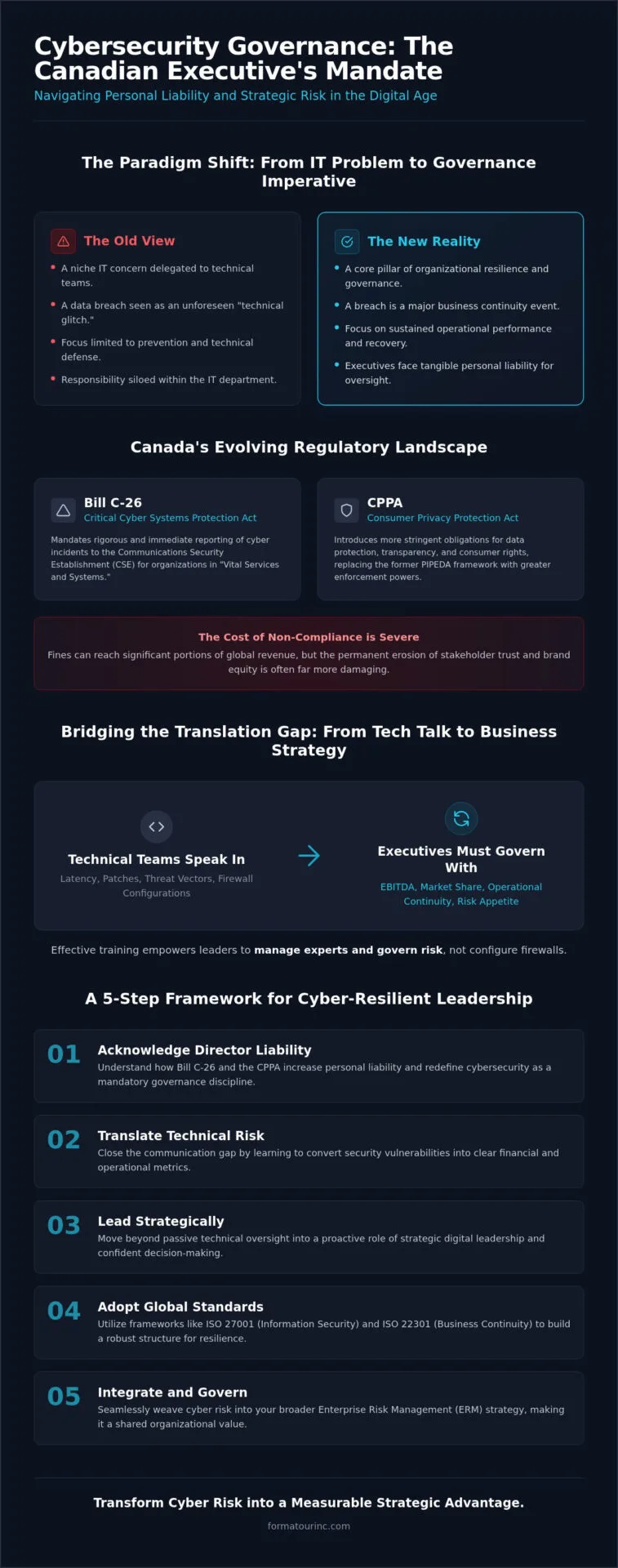
Building a Cyber-Resilient Executive Framework: 5 Actionable Steps
Resilience isn’t a static destination but a continuous state of organizational readiness. For Canadian leaders, this requires a structured transition from reactive technical patching to proactive strategic governance. Establishing a robust framework involves five specific actions that bridge the gap between leadership intent and operational execution. This process ensures that cybersecurity training for executives Canada translates into measurable stability and long-term compliance. By following these steps, you transform cyber risk from a looming threat into a manageable business metric.
- Assess: Conduct a comprehensive executive gap analysis to identify governance blind spots.
- Integrate: Embed cyber risk into the enterprise risk management (ERM) framework.
- Standardize: Implement quality management protocols to ensure process consistency.
- Empower: Support technical teams with advanced certifications to maintain high standards.
- Refine: Establish a continuous auditing cycle to adapt to the evolving threat landscape.
Step 1: The Executive Gap Analysis
You can’t effectively lead an organization through a crisis if you don’t understand the terrain. A high-level governance audit identifies specific blind spots in leadership security knowledge that could lead to poor decision-making. This analysis determines the necessary depth of training required for different C-suite roles. For example, the CFO requires a focus on financial exposure and cyber insurance, while the COO must prioritize supply chain integrity and operational uptime. Identifying these gaps early ensures your strategic roadmap is built on a foundation of verified competence rather than broad assumptions.
Once you’ve identified these gaps, integrate cyber risk into your broader ERM framework. This alignment ensures that digital threats receive the same level of executive scrutiny as financial or legal risks. To ensure consistency across all departments, standardize your security-related processes through ISO 9001 Quality Management Implementation. Quality management principles provide the structural integrity needed to maintain security protocols as part of everyday business operations, significantly reducing the likelihood of human error.
Step 4: Leading through Digital Transformation
Innovation must never outpace security. As you execute modern Digital Transformation Strategies, you must enforce “Security by Design” at every stage of development. This is particularly critical when managing the risks associated with AI and process automation, where vulnerabilities can scale just as quickly as the operational benefits. Integrating security into your organizational change management process ensures that your workforce remains resilient and informed throughout the transition. This approach turns potential points of failure into pillars of organizational strength.
The final step involves establishing a continuous auditing and improvement cycle. This ensures that your governance framework evolves alongside the shifting threat landscape. Empower your technical teams through specialized IT certification training to maintain peak operational standards. This cycle of assessment and refinement creates a culture of perpetual readiness. If you’re ready to build a more resilient organization, contact our advisory team to begin your executive gap analysis today.
Advisory-Led Training: The Formatour Approach to Cyber Governance
Formatour Incorporated redefines the concept of cybersecurity training for executives Canada by moving beyond generic workshops toward specialized advisory. We recognize that true governance requires a fusion of international standards and operational agility. Our methodology combines over a decade of ISO implementation experience with a deep understanding of Canadian organizational resilience. This approach ensures that your leadership team doesn’t just receive information but gains a functional framework for strategic oversight. We treat cybersecurity as a vital subset of our Executive Leadership Development Programs, ensuring that digital protection is woven into the very fabric of your corporate culture.
Our multidisciplinary advisory advantage lies in our ability to view security through the lens of business performance. We don’t sell software; we develop leaders who can manage the complexities of a global digital economy. By customizing your training to align with ISO 27001 Information Security Management, we provide a clear path from initial awareness to full-scale strategic transformation. This transition allows you to move from a state of technical anxiety to one of governed confidence, where every security investment is validated by its contribution to organizational stability.
Beyond Training: A Partnership for Strategic Transformation
We believe in co-developing security solutions that drive operational performance. Our advisory sessions often reveal that the most effective way to reduce your attack surface is through rigorous process automation and optimization. By streamlining workflows, you eliminate the inconsistencies that often lead to security breaches. Our executive leadership programs focus on creating a sustainable security culture where every director and manager understands their role in the defense of the organization. This holistic view ensures that your digital transformation remains secure, efficient, and aligned with your long-term growth objectives.
Securing Your Legacy in the Canadian Market
In the 2026 Canadian market, verified compliance is the ultimate currency of trust. Positioning your firm as a leader requires more than just meeting the minimum requirements of Bill C-26; it requires a commitment to international excellence. Achieving ISO 27001 certification provides a significant competitive advantage, signaling to stakeholders and investors that your governance framework is world-class. It protects your reputation and secures your professional legacy in an increasingly scrutinized environment. If you’re ready to master the transition to strategic cyber leadership, contact Formatour for a Strategic Executive Consultation and begin your journey toward organizational resilience.
Leading Your Organization into a Secure Digital Future
The evolution of the Canadian digital landscape demands a shift from technical awareness to strategic mastery. You now recognize that cybersecurity isn’t a cost center but a fundamental pillar of organizational resilience. By mastering the transition from technical oversight to active governance, you protect your professional legacy and ensure long-term stability in an increasingly complex regulatory environment. This journey transforms digital security from a looming threat into a governed business discipline.
Investing in specialized cybersecurity training for executives Canada allows you to translate technical vulnerabilities into clear financial and operational metrics. This strategic foresight ensures that every decision aligns with both international benchmarks and domestic regulations like Bill C-26. You now possess the framework to lead through digital transformation with confidence, turning potential risks into sustainable competitive advantages for your firm.
Formatour provides the steady, expert hand needed to navigate these complexities. With our ISO 27001 Lead Auditor Expertise and Canadian Premium Advisory Status, we focus on a Multidisciplinary Strategic Transformation that empowers your entire leadership team. Empower your leadership with Formatour’s Strategic Advisory Services and build a resilient foundation for your organization’s success.
Frequently Asked Questions
Is cybersecurity training for executives mandatory in Canada in 2026?
While there’s no universal law mandating training for every business owner, it’s effectively required for leaders in critical sectors under Bill C-26. Executives managing vital services must demonstrate active oversight to comply with federal reporting and security standards. For organizations outside these sectors, providing evidence of leadership training is often a prerequisite for obtaining cyber insurance or achieving compliance with international standards like ISO 27001.
How does Bill C-26 affect executive liability for cybersecurity?
Bill C-26 increases the personal accountability of directors by requiring rigorous reporting of cyber incidents to federal authorities. Failure to implement sufficient governance frameworks can lead to significant administrative monetary penalties for the organization. It shifts the burden of proof toward leadership to show they exercised due diligence. Executives must now prove they’ve taken proactive steps to protect vital systems and maintain operational continuity during a crisis.
What is the difference between a technical cyber certification and executive training?
Technical certifications focus on the execution of security tasks like network defense, encryption, or incident response. In contrast, cybersecurity training for executives Canada focuses on governance, risk management, and strategic decision making. It provides the vocabulary to lead technical teams effectively without requiring leaders to perform the technical tasks themselves. The goal is to move from technical oversight to high-level strategic leadership and financial risk modeling.
How long does a typical executive cybersecurity leadership program take?
Duration varies based on your organization’s current maturity and specific strategic goals. High-impact seminars often take two to three days for intensive delivery of core governance concepts. More comprehensive leadership development programs might span several weeks of modular sessions to ensure deep integration into daily operations. These programs are specifically designed to fit the demanding schedules of C-suite members while ensuring a measurable impact on organizational resilience.
Can ISO 27001 certification replace the need for executive training?
ISO 27001 certification doesn’t replace the need for training; it actually mandates it. The standard requires “Leadership and Commitment” as a core pillar of a successful Information Security Management System. Certification provides the structural framework for security, but training ensures that executives understand how to use that framework. It empowers leaders to drive operational performance and validate that the organization’s security posture aligns with its broader business objectives.
What are the most critical cyber risks Canadian executives should focus on in 2026?
Executives should prioritize risks associated with AI-driven social engineering, supply chain vulnerabilities, and the disruption of business continuity. Regulatory compliance with the CPPA and Bill C-26 is also a top priority for 2026. Focusing on these areas ensures that security investments protect both the organization’s data assets and its legal standing. Leaders must view these risks as financial and operational metrics that require the same scrutiny as any other business threat.
How much does cybersecurity training for executives typically cost in Canada?
Investment levels for cybersecurity training for executives Canada depend on the level of customization and the scope of the advisory services required. Programs ranging from brief strategic seminars to multi-month leadership transformations reflect different resource requirements. Organizations should evaluate providers based on their specific industry expertise and alignment with international standards. Focusing on the long-term value of risk mitigation and compliance often provides a much higher return than seeking standardized solutions.
