

Most executives view ISO 27001 as a defensive expense, yet in 2026, the most resilient Canadian firms treat it as their most valuable offensive asset. It’s natural to feel uneasy about the unpredictable nature of consultant fees or the potential for a hidden internal resource drain that pulls your best talent away from core operations. This strategic breakdown provides a clear path to a predictable budget; it ensures your ISO 27001 audit cost remains a transparent investment rather than a financial surprise.
You’ll discover the comprehensive cost structure of certification, ranging from the initial gap analysis to the realization of long-term organizational resilience. We’ll explore how to achieve certification without disrupting your daily operations by aligning security protocols with your broader business growth objectives. This guide examines the essential pillars of a 2026 security budget. It provides the clarity you need to move from a place of uncertainty to a position of quiet confidence and structural integrity, ensuring your compliance journey supports sustainable development and global competitiveness.
Key Takeaways
- Adopt a Total Cost of Ownership model to move beyond surface-level quotes and align your security investment with long-term business objectives.
- Understand the precise allocation of your ISO 27001 audit cost between internal labor, external advisory, and certification body fees within the Canadian landscape.
- Distinguish between the limitations of automated toolkits and the high-level value of strategic advisory for creating a truly resilient management system.
- Anticipate hidden expenses by budgeting for remediation efforts and the mandatory surveillance audits required in subsequent years.
- Leverage a multidisciplinary framework to prevent siloed security spending and ensure your certification serves as a foundation for organizational growth.
The ISO 27001 Investment Landscape: More Than Just a Certificate
Viewing the ISO 27001 audit cost as a simple line item on a ledger ignores the operational reality of modern governance. In 2026, forward-thinking Canadian executives adopt a Total Cost of Ownership (TCO) model that accounts for the full lifecycle of the management system. Fixed-price quotes often mask the true depth of the commitment, leading to expensive scope creep or significant operational gaps that surface during the final certification stage. Understanding the nuances of the ISO 27001 audit cost allows leadership to allocate funds with precision, ensuring that every dollar spent contributes to long-term resilience. Organizational maturity acts as the primary variable; a firm with established governance requires less remediation than a lean startup building from zero. By reframing security as a strategic asset, your organization transforms a compliance requirement into a competitive advantage that accelerates market entry and fortifies your brand’s reputation.
Scope, Size, and Complexity: The Variables of Value
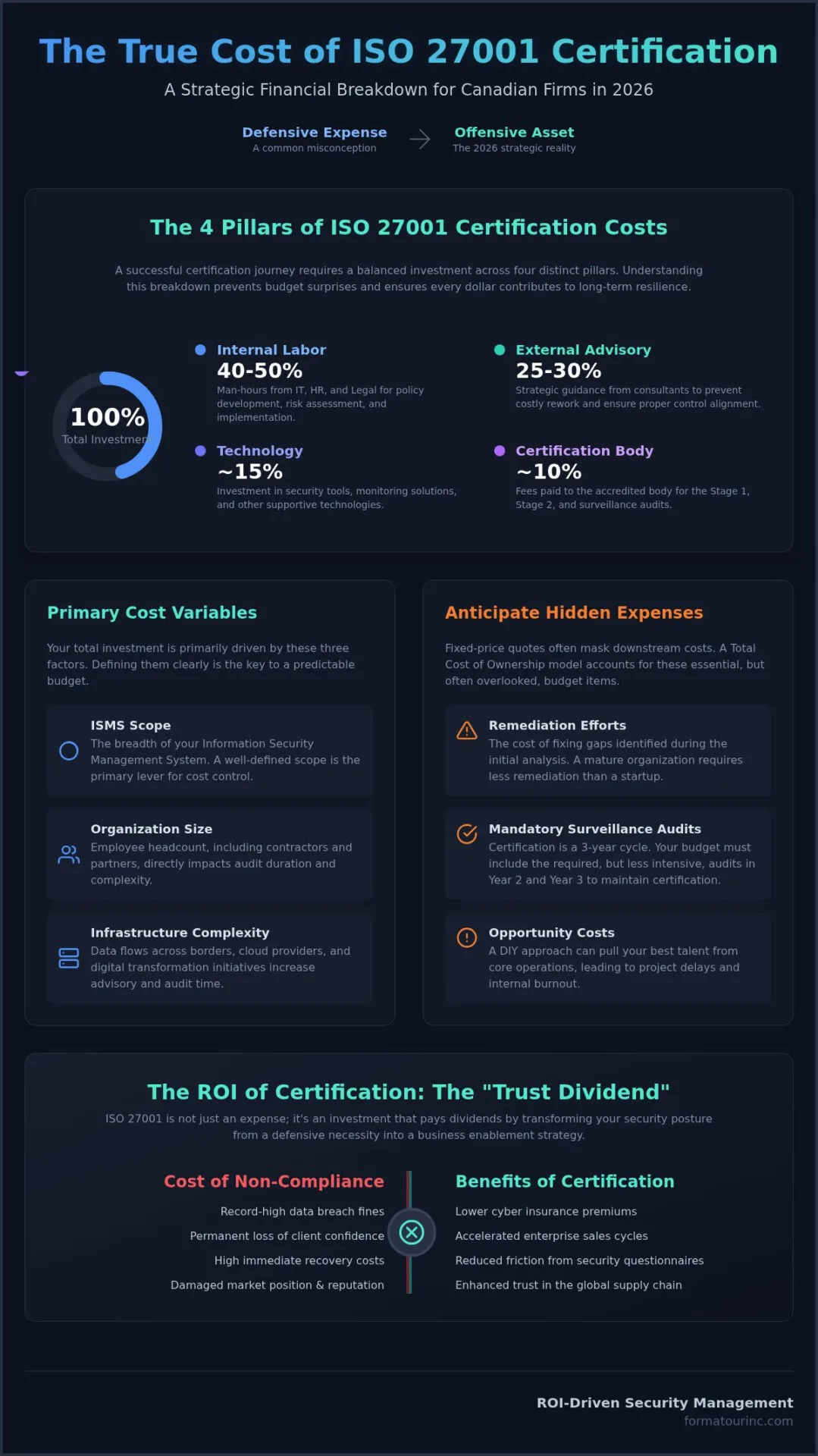
Employee headcount and the complexity of your digital infrastructure directly dictate the audit’s duration. The ISO/IEC 27001 standard requires a rigorous assessment of all individuals under your organization’s control, which now includes contractors and third-party partners. Designing an ISMS for a complex digital transformation journey demands more specialized advisory than a static environment. You must account for how your data flows across borders and cloud providers, as these technical nuances influence the auditor’s time. The definition of your ISMS scope remains the primary lever for controlling your total investment.
The Cost of Non-Compliance vs. Certification
The financial impact of a data breach in Canada has reached record highs, often dwarfing the total investment required for a multi-year certification program. Beyond immediate recovery costs, the loss of client confidence can permanently damage your market position. Achieving certification frequently results in tangible financial benefits, such as lower cyber insurance premiums and the removal of security friction that often stalls enterprise sales cycles. This “Trust Dividend” provides a quantifiable return by positioning your firm as a reliable partner in the global supply chain. When your security posture is verified by an international standard, you spend less time answering lengthy security questionnaires and more time closing high-value contracts. It’s a shift from a defensive posture to a proactive business enablement strategy that pays dividends long after the certificate is issued.
The 4 Pillars of ISO 27001 Certification Costs
Budgeting for international standards requires a granular understanding of where capital is actually deployed. While the ISO 27001 audit cost is the most visible expenditure, it represents only one component of a successful certification journey. A strategic breakdown of typical costs indicates that Canadian enterprises must balance their investment across four distinct pillars: internal labor, external advisory, technology, and certification body fees. In the Canadian market, internal labor typically accounts for 40 to 50 percent of the total investment, while external advisory services often comprise 25 to 30 percent. Technology solutions and actual certification fees generally split the remaining 20 to 30 percent. Engaging with professional ISO 27001 Implementation Services early in the process serves as a financial safeguard, as expert guidance prevents the costly rework that inevitably follows misinterpreted controls or misaligned documentation.
Internal Resource Allocation and Opportunity Costs
The most significant “hidden” cost involves the man-hours required from your IT, HR, and Legal departments. These teams must dedicate substantial time to policy development, risk assessment, and control implementation. Attempting a DIY approach often leads to internal burnout and the neglect of core business projects, which carries a high opportunity cost. Active executive leadership involvement is essential; it ensures that security protocols are integrated into the corporate culture rather than treated as a peripheral IT project. This high-level oversight actually reduces long-term maintenance costs by fostering a more efficient, unified approach to governance.
Certification Body (CB) Fees and Audit Costs
Your financial planning must account for the full three-year certification cycle. This cycle begins with a Stage 1 documentation review, followed by the Stage 2 main audit, and concludes with annual surveillance audits in years two and three. When reviewing contracts from a Certification Body, look beyond the daily rate. Many CB agreements include administrative fees and travel expenses that can inflate the total ISO 27001 audit cost if not negotiated upfront. Selecting a reputable, accredited CB is a prudent investment; a certificate from a globally recognized body carries more weight in enterprise procurement processes and provides a higher level of assurance to your stakeholders. If you need assistance determining which certification path fits your specific business model, you can speak with our advisory team for a tailored perspective on Canadian market conditions.
Automation vs. Strategic Advisory: Choosing the Right Model
Choosing the right implementation model is a pivotal decision that dictates both the speed of certification and the long-term viability of your security framework. Canadian organizations typically evaluate three distinct paths: the static toolkit, the automation-first platform, and the high-level strategic advisory approach. While software-driven automation offers impressive capabilities in evidence gathering and continuous monitoring, it cannot replace the nuanced judgment of a strategic mentor. Strategic transformation requires an understanding of human capital and organizational development that AI simply cannot replicate. Relying solely on automation often leaves leadership disconnected from the actual risks facing the firm. Formatour’s multidisciplinary approach provides the necessary middle ground. It utilizes modern technology for efficiency while grounding every decision in expert-led strategy. This balanced method ensures that your ISO 27001 audit cost is a one-time gateway to maturity rather than a recurring expense caused by technical debt or misaligned controls.
The Pitfalls of Compliance in a Box
Generic policy templates are often the most expensive “cheap” option a company can choose. These off-the-shelf toolkits frequently fail during rigorous Stage 2 assessments because they don’t reflect the actual practices of the organization. When an auditor discovers that your documented procedures don’t match your operational reality, the financial impact is immediate. The cost of remediation, combined with the fees for a follow-up visit, can easily double your initial ISO 27001 audit cost. Investing in tailored organizational resilience consulting ensures that your Information Security Management System (ISMS) is built on a foundation of reality. This bespoke approach creates genuine value by protecting your specific assets and ensuring that your governance structure supports, rather than hinders, your daily operations.
Maximizing ROI with Lead Auditor Training
True organizational maturity involves empowering your internal teams to manage compliance independently. By investing in professional development, you reduce your reliance on perpetual external consulting and create a self-sustaining culture of security. Training an internal team member to become a certified Lead Auditor provides a significant long-term cost benefit. This individual can oversee internal audits and maintain the ISMS with expert precision, effectively neutralizing the need for expensive third-party contractors during every surveillance cycle. This transition from external dependency to internal mastery is a hallmark of successful Leadership Training for Digital Transformation. It ensures that your security posture evolves in lockstep with your technological advancements, providing a sustainable and predictable return on your initial certification investment.
Hidden Costs and Budget Optimization Strategies
Budgeting for compliance requires a multi-year perspective that extends beyond the initial certification milestone. Many Canadian executives focus solely on the Year 1 ISO 27001 audit cost, inadvertently neglecting the mandatory surveillance audits and internal audit requirements of Years 2 and 3. These annual surveillance cycles typically cost between C$6,000 and C$15,000, yet they’re essential for maintaining the certificate’s validity. Remediation costs also represent a significant variable; fixing security gaps identified during the preparation phase demands both financial capital and internal focus. You can optimize these expenditures by phasing your implementation, spreading the investment across multiple fiscal years to align with your organization’s cash flow. By breaking the project into manageable milestones, you avoid the operational shock of a massive, single-year expenditure. Implementing process automation further lowers the “maintenance tax” of your ISMS, transforming manual evidence collection into a streamlined, cost-effective operation.
The Gap Analysis: An Essential Initial Investment
Skipping a formal gap analysis is the most expensive mistake an executive can make. Without this initial diagnostic, your implementation budget is based on guesswork rather than data, often leading to inflated consultant fees or missed deadlines. A precise gap analysis provides a roadmap for resource allocation, ensuring you only spend where necessary to meet the standard’s requirements. At Formatour, we utilize this foundational diagnostic to drive excellence across various frameworks, including ISO 9001 quality management. This evidence-based approach ensures that your security and quality objectives are strategically aligned from the start, preventing the siloed spending that often plagues complex organizations.
Maintenance and Continuous Improvement
Maintaining a certified posture requires a commitment to continuous improvement rather than a frantic rush before the auditor arrives. You must budget for annual risk assessments and management reviews to ensure the ISMS evolves alongside your business. Integrating strategic project management into your compliance lifecycle significantly reduces administrative overhead by treating security tasks as standard operational pillars. A living ISMS is fundamentally cheaper to maintain than one that lies dormant for months. When security becomes part of your daily rhythm, the “audit-ready” state is achieved through routine efficiency rather than expensive, last-minute remediation projects. This proactive stance not only preserves your budget but also strengthens your organizational resilience against emerging threats in the Canadian market.
To secure a predictable budget for your 2026 certification journey, schedule a strategic consultation with our advisory team.
The Formatour Advantage: ROI-Driven Security Management
Formatour Incorporated serves as a seasoned strategic mentor for Canadian organizations seeking more than a mere checklist. We balance the rigorous standards expected of global advisory firms with the boutique agility required to respond to your specific operational needs. This partnership ensures that your ISO 27001 audit cost is optimized through a multidisciplinary lens, preventing the silo effect that often leads to redundant spending. By co-developing a security management system that mirrors your unique organizational culture, we move beyond the certificate to achieve a true strategic transformation. Our goal is to empower your leadership team, providing a steady, expert hand that guides you through complex governance landscapes with quiet confidence and unwavering reliability. We don’t just help you pass an audit; we help you build a foundation for sustainable excellence.
A Multidisciplinary Approach to Resilience
True organizational health isn’t found in isolated compliance projects. We integrate ISO 27001 with quality management and business continuity frameworks to create a unified, cost-efficient ecosystem. This holistic strategy ensures that your investment in security also strengthens your operational efficiency and market readiness. Our strategic transformation expertise allows us to streamline compliance by identifying overlapping controls across multiple standards. This “Steady Expert Hand” model reduces executive anxiety by providing a clear, predictable delivery schedule, ensuring that your journey toward resilience is both methodical and deliberate. By aligning your security budget with broader business growth, we ensure every C$ spent contributes to your firm’s structural integrity.
Your Next Steps Toward Certification
Securing a predictable budget for 2026 starts with a deep understanding of your current maturity level and business objectives. A typical Formatour Incorporated-led implementation in Canada follows a structured timeline, moving from a comprehensive gap analysis to final certification in a way that respects your daily operations. We don’t offer off-the-shelf toolkits; instead, we provide tailored solutions that reflect your specific business context. This approach minimizes the risk of failing the audit after a significant spend and ensures your ISMS remains a valuable asset for years to come. To receive a detailed breakdown of the ISO 27001 audit cost for your organization and begin your path toward sustainable growth, we invite you to request a strategic consultation through our contact page. Our advisory team is ready to help you transform security into a cornerstone of your long-term success.
Securing Your Organization’s Strategic Future
Achieving certification in 2026 requires moving beyond a reactive mindset. You’ve seen that the true ISO 27001 audit cost is best managed through a Total Cost of Ownership model that prioritizes long-term resilience over short-term fixes. By integrating strategic advisory with internal team empowerment, you transform compliance from a financial burden into a sustainable competitive advantage. This proactive approach ensures your security posture evolves in lockstep with your business growth, providing the structural integrity necessary for global competitiveness in the Canadian market.
As a premium Canadian advisory firm, Formatour provides the multidisciplinary expertise needed to guide you through this complex landscape with quiet confidence. Our focus on strategic transformation ensures your investment delivers measurable ROI and organizational stability rather than just a certificate on the wall. We invite you to Contact Formatour for a Strategic ISO 27001 Budget Assessment to gain clarity on your specific requirements. Your path to a secure and prosperous 2026 begins with a single, deliberate step toward a partnership rooted in excellence and visionary architecture.
Frequently Asked Questions
What is the average cost of ISO 27001 certification for a mid-sized Canadian company in 2026?
Mid-sized Canadian organizations typically allocate between C$15,000 and C$60,000 for their first-year certification journey. This investment covers the initial gap analysis, implementation support, and the formal certification body fees. The specific ISO 27001 audit cost within this range depends heavily on the organization’s headcount and the complexity of its digital infrastructure. Firms must also account for internal resource allocation and potential remediation efforts to ensure a successful outcome that supports long-term growth.
Can we achieve ISO 27001 certification using only automation software?
Automation software serves as a powerful tool for evidence collection but cannot achieve certification in isolation. ISO auditors require evidence of a living management system that reflects your organization’s unique culture and risk profile. Software lacks the strategic foresight needed to align security objectives with business growth. A multidisciplinary advisory approach ensures that your system is not just a digital repository but a robust framework for organizational resilience and strategic transformation that satisfies rigorous external assessments.
How long does the implementation process take and how does it affect the price?
A typical implementation timeline for Canadian enterprises ranges from six to twelve months. Rushed projects often incur higher costs due to the need for intensive external support and the potential for operational disruption. Conversely, a prolonged process can lead to scope creep and the duplication of internal efforts. A methodical, well-paced implementation allows for the seamless integration of security controls into daily operations, which ultimately stabilizes your total investment and reduces the risk of expensive remediation.
Are there specific grants or tax credits in Canada for ISO 27001 implementation?
Canadian businesses may access various funding programs, such as the Canada Digital Adoption Program (CDAP), to offset the costs of digital transformation and security maturity. Some provincial initiatives also offer grants for organizational development and international competitiveness. It’s advisable to consult with a strategic advisor to identify current federal and provincial incentives that align with your certification goals. These programs can significantly reduce the net ISO 27001 audit cost by subsidizing implementation and professional training.
What are the ongoing costs after the initial certification is achieved?
Ongoing costs primarily include annual surveillance audits and the maintenance of your internal audit program. Certification bodies typically charge between C$6,000 and C$15,000 for these yearly check-ins to ensure continued compliance. Organizations must also budget for annual risk assessments and management reviews. Investing in internal Lead Auditor training can reduce long-term expenses by decreasing your reliance on external contractors for these recurring requirements, ensuring your management system remains a self-sustaining and efficient strategic asset.
How do external consultant rates differ from internal hiring costs for an ISMS manager?
Hiring a full-time compliance professional in Canada often requires an annual salary commitment of approximately C$90,000 plus benefits. In contrast, an external consulting engagement for implementation support typically ranges around C$30,000. While internal hires provide dedicated focus, boutique advisory firms offer specialized multidisciplinary expertise and agility without the long-term overhead of a permanent executive position. Many firms find that a hybrid model, combining internal ownership with expert external guidance, provides the highest return on investment.
Does ISO 27001 certification cost more if we are already ISO 9001 certified?
Existing ISO 9001 certification generally reduces the total cost of achieving ISO 27001. Your organization already understands the fundamental requirements of management systems, such as document control and management reviews. This maturity allows for an integrated management system (IMS) approach, which streamlines implementation and reduces the number of required audit days. By leveraging your current quality framework, you can achieve security certification more efficiently and avoid the redundant costs associated with building a new system from scratch.
What happens if we fail the audit? Are there additional costs for re-certification?
Failing an audit usually results in “non-conformities” that must be remediated before a certificate is issued. If major gaps are identified, the certification body may require a follow-up audit, which incurs additional daily rates and travel expenses. These unplanned costs can significantly inflate your budget. Engaging in a thorough gap analysis and internal audit before the formal assessment is the most effective way to prevent these setbacks and ensure a predictable, successful certification outcome on the first attempt.
