

The true value of an organizational standard isn’t found in a certificate on the wall; it’s realized in the precision of your operations and the strength of your market position. While many leaders view the ISO 9001 certification cost Canada as a necessary compliance burden, visionary firms recognize it as a strategic diagnostic for long-term health. We understand that opaque pricing from certification bodies and the fear of hidden implementation fees often stall progress. It’s frustrating to face a lack of clarity when you’re trying to build a scalable, efficient enterprise.
This executive guide will help you master the financial and strategic variables of the upcoming 2026 standard transition. You’ll gain a clear framework to transform a mandatory requirement into a high-yield operational investment that secures a competitive advantage in Canadian government and international tenders. We’ll explore the core components of certification investment, including audit day requirements under IAF MD5 guidelines and the synergy between quality management and digital transformation. By the end of this analysis, you’ll have the insights needed to ensure predictable costs and tangible efficiency gains for your organization.
Key Takeaways
- Navigate the complex financial landscape of Quality Management Systems by understanding the specific variables that influence the ISO 9001 certification cost Canada for the 2026 fiscal year.
- Transition from a compliance-heavy mindset to a strategic investment model that utilizes the audit process as a diagnostic tool for organizational health and resilience.
- Align your quality standards with digital transformation initiatives to optimize resource allocation and eliminate costly operational bottlenecks.
- Position your organization for growth by leveraging certification as a critical vendor pre-qualification requirement for high-value Canadian government and international tenders.
- Implement an executive-led framework for leadership commitment and gap analysis to ensure a seamless, high-yield certification journey.
The ISO 9001 Certification Cost Landscape in Canada
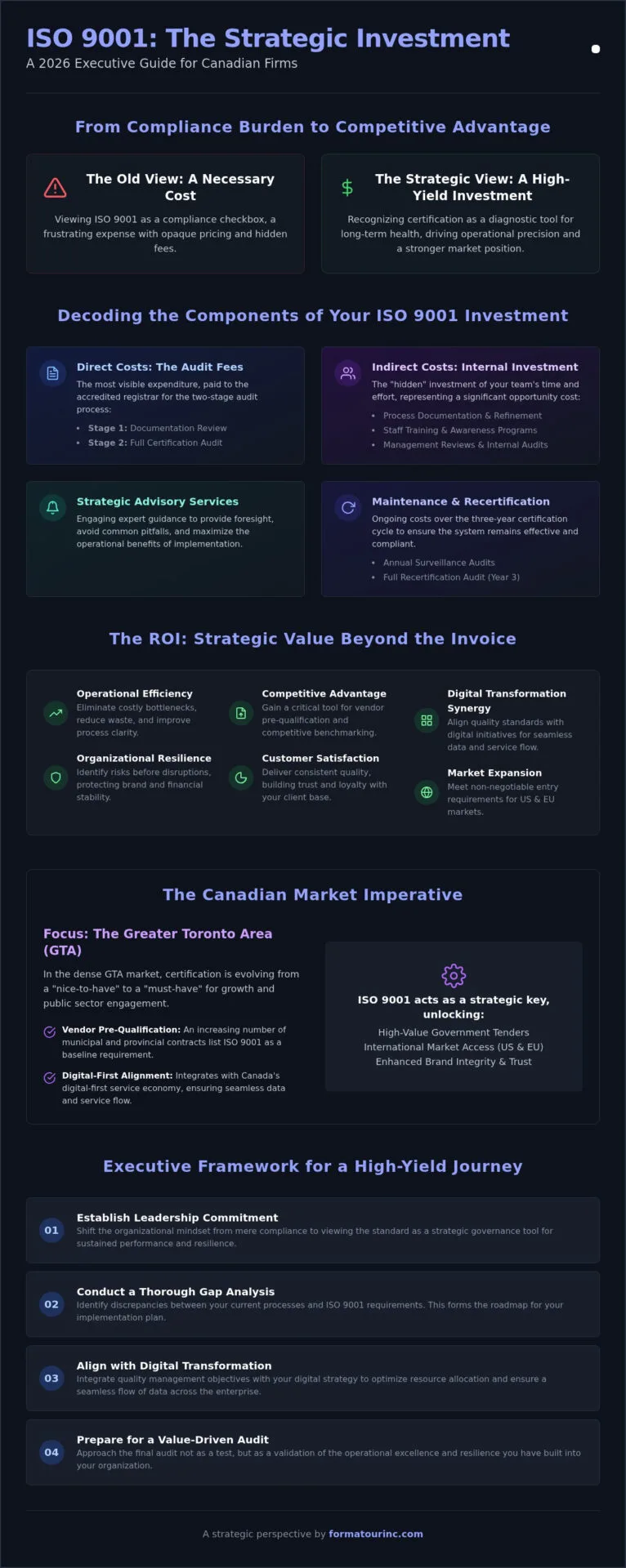
Canadian organizations are operating in an increasingly rigorous regulatory and commercial environment. The decision to pursue certification often stems from a need to stabilize internal processes while meeting external demands. When evaluating the ISO 9001 certification cost Canada, executives must look beyond the immediate audit fees. It’s essential to view this expenditure as a dual-track investment: the direct cost of the registrar and the indirect investment in organizational maturity. By adopting the ISO 9001 standard, firms establish a common language that facilitates expansion into the US and EU markets, where quality management is often a non-negotiable entry requirement.
Market Pressures in the Greater Toronto Area
In the Greater Toronto Area, the competitive environment is particularly dense. Many municipal and provincial contracts now include ISO 9001 as a baseline requirement for vendor pre-qualification. This shift ensures that public funds support businesses with proven, repeatable processes. For GTA firms, certification isn’t just about a badge; it’s a tool for competitive benchmarking. Your rivals are likely already using these standards to align with Canada’s digital-first service economy. Integrating quality management into your digital transformation strategy allows for a seamless flow of data and services, reducing the friction that often plagues growing enterprises.
Quality as a Foundation for Organizational Resilience
True leadership involves moving beyond compliance for compliance sake to find genuine value in global benchmarks. In a volatile market, quality management serves as the bedrock for sustained performance. ISO 9001 functions as a comprehensive strategic governance tool that empowers Canadian executives to maintain oversight while fostering operational autonomy. This approach directly supports a broader organizational resilience strategy. By identifying risks before they become disruptions, you protect your brand’s integrity and financial stability. The ISO 9001 certification cost Canada becomes a strategic insurance policy against the inefficiencies that derail less prepared competitors.
The distinction between certification fees and implementation investment is critical for accurate budgeting. Certification fees are paid to the accredited body for the audit itself, while implementation investment covers the internal work required to meet the standard. This includes process documentation, staff training, and the refinement of management reviews. Balancing these two components ensures that the final audit is a validation of existing excellence rather than a desperate scramble for compliance.
Decoding the Components of Your ISO 9001 Investment
Understanding the ISO 9001 certification cost Canada requires a granular look at both visible and hidden expenditures. Direct costs are typically the most straightforward to budget. These include the registrar’s fees for the Stage 1 documentation review and the Stage 2 certification audit. However, the true investment lies in the indirect costs, such as internal resource allocation. Your team will dedicate significant hours to process documentation and internal training to ensure the system is robust and sustainable. These hours represent an opportunity cost that must be factored into your financial planning.
Strategic advisory services represent another critical pillar of your investment. Engaging in a premium ISO 9001 quality management implementation provides the foresight needed to avoid common pitfalls. While certification is the goal, the operational benefits of conforming to the standard often outweigh the initial price. These benefits manifest as reduced waste, improved clarity, and higher customer satisfaction. Maintenance costs also factor into the ISO 9001 certification cost Canada over the full three-year cycle, as you’ll need to account for annual surveillance audits and a recertification audit every third year.
The Auditor vs. The Consultant: Budgeting for Both
Variables Influencing the Final Quote
Several factors dictate the final quote from a certification body. Organizational complexity, rather than simple headcount, is often the primary driver. A high-risk manufacturing facility with multiple production lines will require more audit days than a low-risk service provider. Multi-site organizations can often utilize sampling techniques to manage costs, provided their management system is centralized. Additionally, your current level of digital maturity plays a significant role. Firms with automated workflows and centralized data often experience a faster, more cost-effective implementation process. If you’re looking for a clear roadmap to navigate these variables, you can speak with our advisory team to discuss your specific operational needs.
Beyond the Invoice: Calculating ROI and Strategic Value
Executives often view the invoice from a certification body as the final word on their investment. However, viewing the ISO 9001 certification cost Canada through the lens of a static fee ignores the high yield potential of strategic quality management. A well-implemented system identifies operational bottlenecks and manual errors that silently erode profit margins. By standardizing processes, firms can measurably reduce customer churn and warranty claims. This ensures that the operational waste often hidden in unstandardized workflows is permanently eliminated. In the premium Canadian B2B sector, this certification acts as a powerful signal of reliability. It enhances brand equity and opens doors to high-tier partnerships that remain closed to uncertified competitors.
Quality Audits as a Diagnostic for Automation
The audit process serves as a rigorous diagnostic tool for your digital transformation strategy. Specifically, Clause 7.5 regarding documented information provides a blueprint for streamlining digital workflows. During the internal audit phase, leaders can identify repetitive manual tasks that are ripe for automation. This transition from paper-heavy or fragmented digital records to a cohesive, automated QMS provides the C-suite with real-time data for strategic decision-making. It turns a compliance exercise into a roadmap for technological advancement. By utilizing the audit as a discovery phase, the organization gains a clear view of where digital tools will provide the highest impact on productivity.
Integrated Management Systems: Saving via Synergy
Smart organizations maximize their investment by pursuing integrated management systems. Combining quality management with ISO 27001 implementation services creates a holistic framework for governance and security. Integrated audits allow firms to address quality, information security, and environmental standards simultaneously. This reduces the total time and expense of multiple separate assessments. Risk-Based Thinking is defined as a proactive approach that identifies, evaluates, and mitigates potential organizational threats to ensure long-term business sustainability in the Canadian market. This integrated approach ensures that the ISO 9001 certification cost Canada is spread across multiple strategic pillars. It delivers a much higher return on every dollar spent by aligning disparate departments under a single, unified governance model.
Executive Checklist: Preparing for a Cost-Effective Audit
Achieving a lean, effective audit requires more than just paperwork; it demands high-level commitment. Clause 5 of the standard emphasizes Leadership and Commitment as the primary engine of the management system. Without executive buy-in, the ISO 9001 certification cost Canada can balloon due to organizational friction and repeated non-conformities. Performing a rigorous Gap Analysis early in the journey allows you to identify these risks before they impact your budget. This proactive step ensures that your documentation prioritizes operational agility rather than creating unnecessary bureaucratic bloat. It’s about building a system that serves the business, not the other way around.
Phase 1: Scoping and Strategic Alignment
Defining the context of your organization is the first step in avoiding over-auditing. This boundary-setting prevents “scope creep” where too many processes are audited, which unnecessarily drives up registrar fees. You’ll need to set measurable quality objectives that align directly with your 2026 business goals. This alignment ensures the system delivers commercial value rather than just a certificate. Training is the foundation of this progress. Investing in leadership development programs empowers your team to own the quality journey. It reduces your reliance on external resources and prepares your staff for the rigors of a professional audit.
Phase 2: Execution and Continuous Improvement
Treat your internal audit as a high-stakes dress rehearsal. This phase is where you uncover the minor issues that could lead to major non-conformities during the actual certification process. Use these findings to update your strategic project management roadmap. This ensures that corrective actions aren’t just temporary fixes but are integrated into daily operations. The Management Review shouldn’t be a checklist chore. Instead, it must serve as a strategic tool for growth where executives evaluate the system’s ability to support the firm’s long-term vision. It provides the steady, expert hand needed to guide the organization through complex operational landscapes.
Selecting a multidisciplinary partner with deep roots in the Canadian market ensures your QMS reflects local regulatory realities while meeting global standards. This expertise helps you manage the ISO 9001 certification cost Canada by focusing on what truly drives results. To begin your streamlined path to certification, contact our advisory team for a strategic consultation.
Formatour Inc.: Premium ISO 9001 Advisory with Boutique Agility
Formatour Incorporated provides a sophisticated alternative to impersonal, volume-based certification providers. We recognize that for Canadian executives, the ISO 9001 certification cost Canada represents a significant investment in organizational structural integrity. Our team balances high-level authority with a responsive, boutique approach that prioritizes your specific strategic goals. We don’t just help you pass an audit; we co-develop solutions that enhance your governance and human capital. This multidisciplinary perspective links quality management to information security and environmental standards, creating a unified framework for sustainable growth and operational stability.
Our Integrated Auditing and Implementation Process
We design tailored roadmaps that respect your operational rhythm and minimize disruption to your daily activities. Our process integrates ISO requirements into your existing workflows, ensuring that compliance feels like a natural extension of your business. You’ll receive expert guidance on resolving non-conformities and optimizing processes before the formal registrar assessment begins. This oversight comes directly from senior advisors who understand the complexities of Canadian operational performance and resilience. We provide the steady hand needed to move beyond the certificate and deliver actionable business intelligence that fuels your digital maturity and long-term success.
Partner with a Visionary Architect for Your QMS
Choosing a partner is about finding a visionary architect for your organizational health. Our approach combines international benchmarks with a deep understanding of the unique Canadian business context. We focus on strategic transformation rather than mere documentation. This methodology helps organizations realize tangible gains, such as a 15% increase in operational efficiency through strategic alignment with the standard. We ensure your quality management system is a driver of competitive advantage in a volatile market. If you’re ready to transform your compliance requirements into a high-yield investment, request a strategic consultation for ISO 9001 certification.
Our commitment to excellence ensures that your organization remains grounded in practical application while reaching for global standards. We act as an active participant in your progress, helping you navigate complex organizational landscapes with confidence. By choosing a partner that values precision and intelligence, you secure a future defined by efficiency and structural integrity. Let us help you build a management system that reflects your leadership and supports your vision for the future of your firm.
Transforming Quality into a Strategic Asset
Mastering the ISO 9001 certification cost Canada requires shifting your perspective from viewing it as a compliance fee to seeing it as a strategic capital allocation. We’ve established that while direct audit costs are predictable, the true return on investment stems from optimized workflows and the elimination of operational bottlenecks. By aligning your quality management system with your broader business objectives, you secure a competitive advantage that resonates in both domestic and international markets. It’s an opportunity to refine your firm’s structural integrity and human capital simultaneously.
Formatour Incorporated offers over a decade of expertise in international standards and strategic transformation. Our boutique agility ensures you receive big-firm standards without the bureaucratic overhead, providing a steady hand through complex organizational landscapes. As specialists in multidisciplinary organizational resilience, we co-develop solutions that integrate quality, security, and efficiency into a single governance model. It’s time to move beyond the certificate and build a legacy of excellence. Secure Your Strategic ISO 9001 Audit with Formatour Incorporated to ensure your firm is positioned for sustainable growth in the 2026 economy.
Frequently Asked Questions
What is the average cost of ISO 9001 certification for a Canadian SME in 2026?
Industry data indicates that a typical Canadian SME might invest between C$12,000 and C$40,000 over a full three-year cycle. This total encompasses the initial implementation and the certification audit itself. The exact ISO 9001 certification cost Canada depends on your operational complexity and existing digital maturity. It’s best to view this as a strategic allocation for long-term efficiency rather than a one-time expense. This investment secures your position in high-value tenders.
How long does the ISO 9001 audit process typically take in Toronto?
The duration of the audit process varies based on your organization’s size and complexity. For a standard Toronto-based firm, the implementation phase usually spans three to six months. The actual certification audit, divided into Stage 1 and Stage 2, typically requires two to five days of assessment. This timeline ensures a thorough diagnostic of your management system without causing undue disruption to your daily operations. It allows for a steady, expert hand to guide your progress.
Can we combine ISO 9001 and ISO 27001 audits to save on costs?
Can we combine ISO 9001 and ISO 27001 audits to save on costs?
Hidden costs often arise from internal resource allocation and necessary process refinements. Your team will dedicate significant hours to documentation and training that aren’t visible on a registrar’s invoice. Additionally, if your current systems lack digital maturity, you might need to invest in process automation tools to meet the standard’s requirements. Factoring in these indirect expenses early ensures that your ISO 9001 certification cost Canada remains predictable and provides a genuine return on your investment.
Is remote auditing an option for ISO 9001 certification in Canada?
Remote auditing is a recognized and increasingly common option for Canadian organizations. Accreditation bodies use information and communication technology to conduct interviews and document reviews virtually. While some high-risk sectors may still require a physical site visit, many service-based firms in the GTA utilize remote audits to reduce travel expenses and logistical friction. This approach maintains the same level of rigor as on-site assessments while offering greater flexibility for your leadership team and staff.
How do I choose between a boutique advisory firm and a global registrar?
You must distinguish between the body that audits you and the partner that guides your implementation. A global registrar provides the final certificate, but a boutique advisory firm offers the personalized responsiveness needed for a successful transformation. Boutique partners act as visionary architects, helping you build a system that reflects your leadership. This collaborative approach ensures that your management system delivers actionable business intelligence rather than just meeting the bare minimum for compliance requirements.
What happens if our organization fails the Stage 2 certification audit?
Failing an audit usually means the auditor identified major non-conformities that must be resolved before certification is granted. You’ll receive a detailed report outlining where your system falls short of the standard’s requirements. Your organization then has a specific timeframe to implement corrective actions. Once these are verified, the certificate is issued. Working with an experienced advisor helps you identify these risks during a gap analysis, significantly reducing the likelihood of such operational setbacks.
Does ISO 9001 certification expire, and what are the renewal costs?
ISO 9001 certificates are valid for a three-year cycle. To maintain your status, you must undergo annual surveillance audits in the second and third years. At the end of the three-year period, a full recertification audit is required to issue a new certificate. Renewal costs typically mirror the initial audit fees but may be slightly lower if your management system has remained stable and effective. This rhythmic consistency helps build a sense of trust and predictable excellence.
