

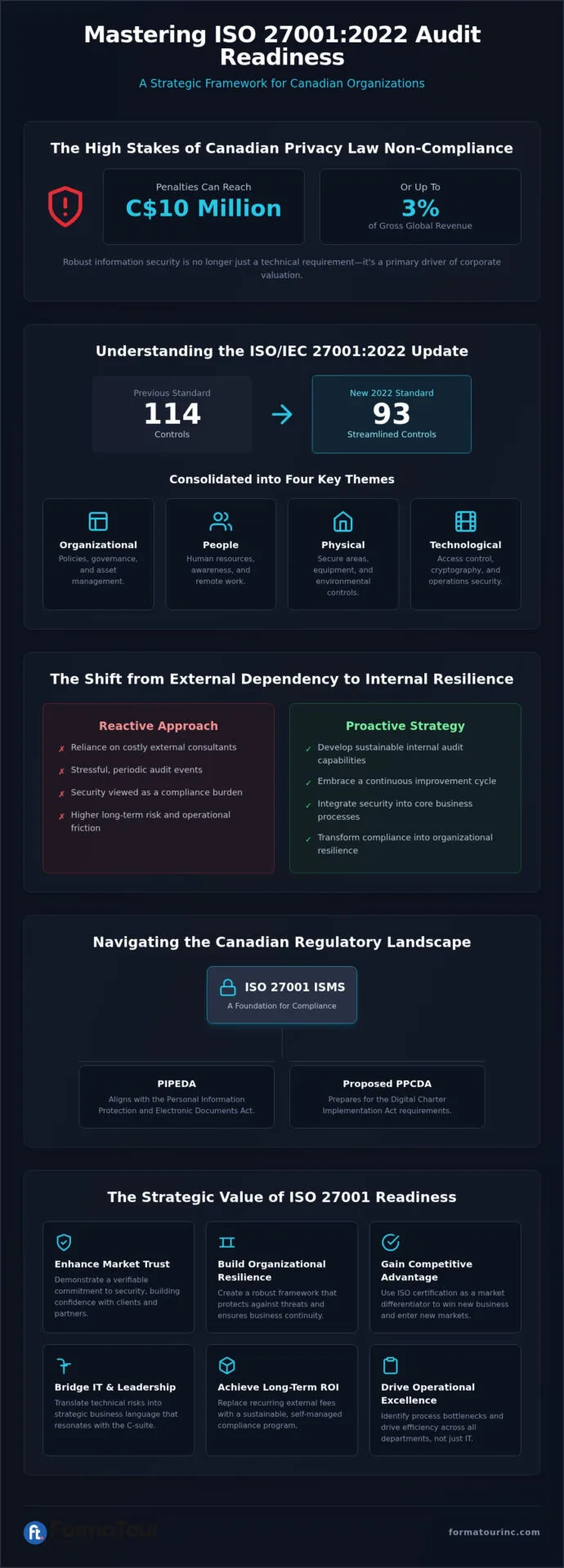
Proposed penalties for non-compliance with Canada’s new privacy laws can reach the greater of C$10 million or 3% of gross global revenue, making information security a primary driver of corporate valuation. You likely feel the pressure of rising cybersecurity threats and the mounting complexity of the ISO 27001:2022 transition. Securing a comprehensive ISO 27001 audit readiness assessment Canada is the most effective way to bridge the gap between your current state and a successful certification. This guide promises to help you master these complexities and ensure your organization is fully prepared for the audit process using a framework designed for the Canadian market.
We will examine how to align your ISMS with regulations like PIPEDA and the proposed PPCDA while building internal capabilities that last. You’ll learn about the latest climate action amendments and the shift toward proactive security controls. This roadmap provides the strategic foresight required to turn rigorous compliance into a foundation for organizational resilience and enhanced market trust.
Key Takeaways
- Understand how a comprehensive ISO 27001 audit readiness assessment Canada serves as a strategic asset to ensure full compliance with the updated ISO/IEC 27001:2022 standard.
- Learn to cultivate a professional auditor mindset characterized by objectivity and evidence-based thinking. This approach helps identify organizational vulnerabilities before they become liabilities.
- Discover the long-term ROI of developing internal Lead Auditor capabilities to replace recurring external fees with sustainable, self-managed organizational resilience.
- Navigate the evolving Canadian regulatory landscape by aligning your security framework with PIPEDA and preparing for the requirements of the Digital Charter Implementation Act.
- Explore how integrating international standards into executive leadership programs transforms technical compliance into a powerful driver of operational excellence and market trust.
The Strategic Importance of ISO 27001 Audit Readiness in Canada (2026)
In 2026, the Canadian business environment demands more than passive compliance. The transition to the 2022 standard is now complete, and an ISO 27001 audit readiness assessment Canada has evolved into a mandatory strategic exercise. Organizations no longer view information security as a back-office IT function; it’s now a pillar of corporate governance. By adopting ISO/IEC 27001, firms establish a robust Information Security Management System (ISMS) that addresses modern threats like cloud vulnerabilities and supply chain compromises. This systematic approach ensures that every layer of the organization is synchronized with international benchmarks.
The shift from reactive security to proactive, audit-driven resilience is essential for survival. Relying solely on external consultants creates a dependency that increases long-term risk and operational costs. Developing internal auditing expertise allows firms to maintain continuous compliance, significantly reducing the friction of certification through better preparation and optimized internal processes. This internal capability transforms the audit from a stressful annual event into a continuous improvement cycle that identifies process bottlenecks and drives efficiency across all departments. It’s about building a foundation that supports sustainable growth rather than just surviving a technical inspection.
The Evolution of Digital Trust in Canadian Business
Digital trust has become the primary currency for Canadian firms operating in a globalized economy. As the average cost of data breaches continues to climb, partners and clients demand proof of security before entering into long-term contracts. The Lead Auditor acts as a strategic guardian, architecting trust across the entire supply chain. This role ensures that security isn’t just a policy on paper but a lived operational reality. By integrating the 2024 Climate Action Amendment, auditors also ensure that the ISMS accounts for environmental changes, reflecting a truly modern and comprehensive approach to risk management that protects both data and reputation.
Bridging the Gap Between IT and Executive Leadership
A structured ISO 27001 audit readiness assessment Canada empowers IT professionals to translate technical vulnerabilities into strategic business risks that resonate with the C-suite. Instead of discussing firewall logs, they discuss organizational resilience and market competitiveness. For mid-market Canadian firms, the boutique agility offered by specialized advisors ensures that the audit process is efficient and tailored to specific business goals. This alignment ensures that executive leadership views ISO certification as an investment in growth. It provides the clarity needed to navigate new regulations like the Protecting Privacy and Consumer Data Act (PPCDA), turning compliance into a distinct competitive advantage.
Core Competencies of the ISO 27001:2022 Readiness Framework
The official ISO/IEC 27001 standard underwent a significant evolution with the 2022 update, consolidating 114 controls into 93 streamlined entries across four themes. Mastering these clauses during an ISO 27001 audit readiness assessment Canada requires more than a checklist approach. It demands a deep understanding of how technological, physical, people, and organizational controls interlock to protect sensitive assets. Effective auditors develop a specific mindset characterized by objectivity and professional skepticism. They don’t just look for the presence of a policy; they seek evidence of its operational effectiveness. This evidence-based thinking ensures that the audit drives genuine performance rather than mere paper compliance.
Reporting represents the final, critical step in the readiness framework. High-impact audit reports shouldn’t just list non-conformities. Instead, they should communicate findings in a way that catalyzes strategic transformation. By highlighting the link between a technical gap and a potential business disruption, the auditor provides leadership with the clarity needed to authorize meaningful change. This transparency builds trust and ensures that the audit serves as a roadmap for future growth.
Risk Assessment and Treatment Methodologies
Identifying information security risks within a Canadian corporate context involves analyzing both global trends and local regulatory pressures. Using ISO 27005 principles allows auditors to enhance their analytical depth, moving beyond basic threat identification to sophisticated risk treatment plans. These plans must be evaluated for their effectiveness in mitigating modern challenges like cloud-based data leaks or sophisticated phishing campaigns. When you assess these risks, you’re not just checking a box; you’re ensuring the organization’s survival against potentially devastating penalties under evolving privacy laws. It’s a proactive stance that prioritizes long-term stability.
Audit Management and Team Leadership
Leading a multidisciplinary audit team through complex organizational structures requires exceptional soft skills and technical authority. Conflict management is often necessary when high-stakes internal audits uncover significant gaps. By aligning audit programs with ISO 9001 Quality Management objectives, organizations create a unified governance structure that promotes both security and operational excellence. This synergy ensures that the audit process supports broader business goals rather than acting as a siloed technical hurdle. If you’re ready to refine your organization’s internal oversight, you can connect with our advisory team to discuss a tailored approach.
Business Value: Internal Auditing as a Catalyst for Organizational Resilience
Building internal expertise through a Lead Auditor program represents a high-yield investment for Canadian enterprises. While external surveillance audits typically cost between C$5,000 and C$7,500 annually, the true financial advantage of internalizing this skill lies in the elimination of recurring advisory fees. An ISO 27001 audit readiness assessment Canada conducted by in-house experts ensures that the organization remains in a state of permanent preparedness. This shift reduces the friction of certification and allows the firm to redirect capital toward strategic growth initiatives. By strengthening the human capital element of information security, organizations transform compliance from a cost center into a driver of operational efficiency.
Internal audits do more than verify security; they serve as a diagnostic tool for identifying process bottlenecks. When an auditor reviews the flow of information, they often discover redundancies that hinder productivity. This dual focus on security and efficiency makes internal auditing a critical mechanism for ISO 22301 Business Continuity plans. It ensures that the organization can maintain essential functions during a disruption while protecting the integrity of its data. It’s a method of turning a technical requirement into a comprehensive business advantage.
Reducing Organizational Vulnerability
Structured internal oversight is the most effective way to identify shadow IT and unmanaged risks. These hidden vulnerabilities often escape the notice of high-level external reviews but are easily spotted by an internal Lead Auditor who understands the organization’s unique operational nuances. This role is vital during incident response and recovery, providing the technical and strategic guidance needed to restore systems securely. Success starts with executive leadership fostering a culture where security awareness is integrated into every business decision. This top-down approach ensures that resilience is woven into the very fabric of the corporate identity.
Enhancing Market Competitiveness in Canada
In the Canadian marketplace, ISO 27001 certification serves as a powerful differentiator. It’s often a prerequisite for high-value government and enterprise RFPs, where proof of robust data protection is non-negotiable. A resilient brand attracts investors who prioritize stability and long-term viability. Organizations can leverage a Digital Transformation Strategy to automate evidence collection, further reducing the administrative burden of compliance. This technological integration allows the firm to scale its security efforts alongside its business growth, maintaining a competitive edge in an increasingly digital economy. It’s about being a leader that others feel secure partnering with.
Navigating the Canadian Regulatory Landscape and Compliance Standards
Canadian businesses operate within a dense web of federal and provincial privacy mandates. An ISO 27001 audit readiness assessment Canada provides the structural integrity needed to meet these evolving obligations. While PIPEDA has long been the baseline, the introduction of Bill C-36 in June 2026 signals a definitive shift toward the Protecting Privacy and Consumer Data Act (PPCDA). This new legislation introduces stringent rules for consent and transparency in automated decision-making. ISO 27001 serves as a foundational framework that simplifies this transition by mapping technical controls directly to these new legal requirements.
Compliance as a Strategic Advantage
Moving beyond a check-the-box mentality allows firms to treat data governance as a competitive asset. The Lead Auditor ensures that privacy by design isn’t just a concept but a documented operational reality. This proactive approach significantly reduces the risk of heavy penalties, which can reach C$10 million or 3% of global revenue under the new federal guidelines. By aligning internal audits with these regulatory benchmarks, organizations demonstrate a level of maturity that satisfies both government regulators and international partners. It’s a bridge to regulatory excellence that builds long-term market confidence.
Sector-Specific Auditing Challenges
The Canadian financial sector faces unique pressures from the Office of the Superintendent of Financial Institutions (OSFI). Auditors must ensure that the ISMS meets specific resilience and third-party risk requirements mandated for federally regulated financial institutions. In healthcare, navigating Ontario’s PHIPA or similar provincial acts requires a specialized lens to protect sensitive patient data. Many forward-thinking organizations are now integrating these efforts with ISO 14001 to manage environmental and security risks through a single, cohesive management system. This integrated approach optimizes resource allocation and provides a holistic view of organizational health.
Regional nuances add another layer of complexity that auditors don’t often overlook. Quebec’s Law 25 already enforces strict requirements that frequently exceed federal standards, while Alberta and British Columbia maintain their own PIPA regulations. ISO 27001 provides a reliable framework for cross-border data transfers, ensuring that Canadian firms can securely exchange information with global markets. This alignment is essential for maintaining the “substantially similar” status required for international data flow. If your organization needs to harmonize these complex requirements, reach out to our senior advisors for a comprehensive regulatory mapping and readiness strategy.
Elevating Your Organization with Formatour’s Professional Development
Formatour Incorporated stands as a premier advisory firm, bridging the gap between high-level international standards and the specific operational realities of the Canadian market. We provide the big-firm standards of a global consultancy while maintaining the boutique agility necessary to pivot with your organization’s unique needs. An ISO 27001 audit readiness assessment Canada isn’t merely a technical review; it’s the starting point for a strategic partnership that values precision and long-term growth. Our approach focuses on empowering your internal teams, ensuring that the knowledge required to maintain a robust ISMS remains within your walls.
We believe that security shouldn’t exist in a vacuum. By integrating Lead Auditor training into a broader Executive Leadership Program, we empower your management team to treat information security as a core business driver. Our multidisciplinary trainers bring over a decade of experience in organizational resilience, ensuring that the guidance you receive is rooted in real-world Canadian implementation. This expertise allows us to co-develop solutions that harmonize various standards, providing a holistic view of your governance and structural integrity.
Customized Solutions for Canadian Enterprises
Every industry faces distinct challenges, whether it’s the high-stakes environment of the financial sector or the innovative tech hubs across the country. We tailor our readiness curriculum to your specific risk profile, ensuring that every control discussed is relevant to your daily operations. Our delivery models remain flexible, offering both on-site and virtual options that never compromise our premium standards. Following the assessment, we provide robust support to guide you through ISO 27001 implementation, ensuring your path to full certification is clear, structured, and manageable.
The Formatour Difference: From Compliance to Transformation
Choosing a strategic partner means finding a mentor who understands that compliance is the foundation, not the final goal. Formatour acts as an architect for your organizational health, creating a powerful synergy between auditing, implementation, and operational performance. We don’t just help you pass an audit; we help you build a more resilient, efficient, and trustworthy brand. This transformation ensures that your organization is not just ready for the regulatory challenges of 2026 but is positioned to lead within them. Consult with a Formatour expert to design your ISO 27001 roadmap.
Securing Your Strategic Future Through Information Governance
Transitioning to the ISO/IEC 27001:2022 standard is no longer just a technical milestone; it’s a fundamental requirement for digital trust in the Canadian market. By conducting a thorough ISO 27001 audit readiness assessment Canada, your organization establishes the internal architecture needed to withstand rising cybersecurity threats while ensuring alignment with regulations like PIPEDA and the forthcoming PPCDA. This proactive approach reduces long-term operational risks and positions your firm as a resilient leader in the global economy. It’s about moving from a state of reactive defense to one of strategic foresight.
Formatour Incorporated brings a decade of experience in Canadian strategic transformation, offering multidisciplinary expertise in ISO standards with the boutique agility your business deserves. We move beyond simple checklists to co-develop solutions that integrate seamlessly into your executive leadership goals. Now is the time to transform your compliance journey into a sustainable competitive advantage. Partner with Formatour for Premium ISO 27001 Lead Auditor Training and build the internal expertise your organization needs to thrive. Success is well within your reach when you lead with foresight and precision.
Frequently Asked Questions
What are the prerequisites for ISO 27001 Lead Auditor training in Canada?
There are no formal legal prerequisites; however, a foundational understanding of information security management is highly recommended. Participants usually benefit from having professional experience in IT governance or risk management before pursuing Lead Auditor status. This background ensures you can effectively interpret the ISO/IEC 27001:2022 clauses within a Canadian business context. The training focuses on the application of the standard rather than just memorizing technical specifications, making it accessible for dedicated professionals.
How long does an ISO 27001 audit readiness assessment typically take?
A comprehensive ISO 27001 audit readiness assessment Canada typically spans two to four weeks for small to mid-sized organizations. This timeline depends on the complexity of your current Information Security Management System and the size of your operational scope. The process involves a deep dive into your existing documentation, interviews with key personnel, and a gap analysis against the 93 controls of the 2022 standard. This structured approach provides a clear roadmap for remediation before the final certification.
Is the ISO 27001:2022 exam difficult for non-technical managers?
The ISO 27001:2022 exam is designed to test your understanding of management system principles rather than deep technical coding skills. While it requires rigorous study, non-technical managers often excel because the standard focuses on governance, risk assessment, and organizational processes. Success depends on your ability to apply the Auditor Mindset, including objectivity and professional skepticism, to various business scenarios. With professional guidance, managers can master these concepts and lead their teams through successful audits.
What is the difference between an Internal Auditor and a Lead Auditor?
An Internal Auditor focuses on verifying that the organization’s processes comply with its own internal policies and the ISO standard. In contrast, a Lead Auditor has the authority to manage an entire audit team and oversee the full audit program for complex organizations. Lead Auditors are often responsible for reporting directly to executive leadership and ensuring that the audit results drive strategic transformation. This higher level of certification is essential for those architecting trust across global supply chains.
How does ISO 27001 training help with Canadian privacy law compliance?
ISO 27001 training provides a structured framework that directly aligns with Canadian privacy mandates like PIPEDA and the proposed PPCDA. By mastering the 2022 controls, you learn how to implement privacy by design and manage data consent and transparency effectively. This alignment is crucial in 2026 as organizations face potential penalties of up to C$10 million for non-compliance. The training ensures your security posture meets the substantially similar requirements for international and cross-border data transfers.
Can ISO 27001 readiness assessments be conducted for remote teams?
Yes, an ISO 27001 audit readiness assessment Canada can be conducted effectively for remote and distributed teams. Modern auditing relies on virtual evidence collection, secure document sharing, and remote interviews to verify control implementation. Auditors use digital transformation tools to observe processes and examine technical logs without needing a physical presence. This flexibility allows Canadian firms with national or global operations to maintain high security standards regardless of where their workforce is located.
What is the career outlook for ISO 27001 Lead Auditors in Canada in 2026?
The career outlook for ISO 27001 Lead Auditors in Canada is exceptionally strong for 2026. As federal privacy reform under Bill C-36 increases the legal liability for data breaches, organizations are aggressively seeking certified professionals to manage their ISMS. The 22% increase in certification applications observed over the last decade continues to accelerate. Certified auditors are positioned as strategic mentors who can bridge the gap between technical IT requirements and high-level executive governance.
Does Formatour provide support after the readiness assessment is completed?
Formatour provides extensive post-assessment support through tailored implementation services and executive leadership development programs. We don’t just identify gaps; we act as a strategic partner to help you remediate vulnerabilities and build internal capabilities. Our multidisciplinary team remains available to guide you through the final certification process and ensure your management system drives operational performance. This ongoing collaboration ensures that your organization remains resilient as global standards and Canadian regulations continue to evolve.
