

What if the most significant threat to your organization’s resilience isn’t a sophisticated breach, but a simple lack of executive signature? In 2025, the global average cost of a data breach climbed to $4.44 million, yet many security initiatives remain stalled in the boardroom. The disconnect often lies in communication; leaders frequently view compliance as a costly technical hurdle rather than a driver of competitive advantage. Understanding how to get management buy-in for ISO 27001 is about shifting this perception. It’s the process of reframing a rigorous security standard as a strategic pillar for long-term growth and global trust.
It’s understandable to feel frustrated when vital security investments are sidelined by budget constraints or labeled as bureaucratic friction. You recognize that ISO 27001:2022 is more than a checklist; it’s a foundation for operational excellence. This framework empowers you to bridge the gap between technical requirements and executive priorities. You’ll master the art of translating technical risks into tangible financial impact and secure the commitment your program deserves. This guide outlines a clear roadmap to win approval by aligning security with corporate strategy and building a compelling business case for transformation.
Key Takeaways
- Understand why a top-down mandate is the essential catalyst for building a sustainable and resilient Information Security Management System.
- Shift the executive narrative from loss prevention to market enablement by positioning certification as a strategic global passport for growth.
- Master the specific communication techniques required for how to get management buy-in for ISO 27001 by effectively addressing common operational objections.
- Implement a structured five-step framework to align technical security controls with your organization’s overarching corporate growth strategy.
- Explore how boutique agility bridges the gap between complex compliance standards and high-level strategic transformation.
Why Management Buy-In is the Critical Path to ISO 27001 Success
Management buy-in is the primary catalyst for any successful information security initiative. It represents the active commitment of financial resources, personnel, and cultural influence from the highest levels of the organization. Without this foundation, implementation often devolves into a fragmented IT project rather than a cohesive corporate strategy. The ISO/IEC 27001 standard is designed to be a top-down framework, requiring leadership to define the scope and objectives of the Information Security Management System (ISMS). When executives view security as a tool for strategic transformation, they move beyond the mindset of technical checkboxes and toward a vision of organizational excellence.
The Cost of “Passive” Approval vs. Active Commitment
There’s a profound difference between a board that allows a project to exist and one that champions its success. Passive approval often leads to project stagnation because middle management lacks the mandate to prioritize security over competing operational tasks. This creates a “Commitment Gap,” defined as the disconnect between leadership’s desire for security and their willingness to allocate the resources necessary to achieve it. When a board merely “allows” ISO 27001, they risk a failed implementation that wastes time and capital. Knowing how to get management buy-in for ISO 27001 means demonstrating that active commitment is the only way to bridge this gap and ensure the project delivers its promised value.
ISO 27001 as a Pillar of Organizational Resilience
True resilience is the ability to maintain operations during and after a disruptive event. ISO 27001 serves as a critical foundation for this capability by identifying and mitigating risks to essential data assets before they can cause catastrophic failure. This security framework directly supports more specialized resilience measures, such as ISO 22301 Business Continuity Consulting, by creating a culture of systematic risk management. When information security is positioned as a fundamental requirement for operational performance, it becomes clear that a robust ISMS protects the organization’s very ability to generate revenue. Learning how to get management buy-in for ISO 27001 involves showing that security is the bedrock of long-term stability in an increasingly volatile global market. It isn’t just about protection; it’s about building a business that can thrive under pressure.
Translating ISO 27001 into Executive Value and ROI
To successfully navigate the complexities of how to get management buy-in for ISO 27001, the conversation must shift from loss prevention to market enablement. Executives prioritize revenue and market share; therefore, security should be presented as a strategic asset. When framed as a global passport, certification becomes a tool for international trade rather than a technical burden. It signals to potential partners that your organization adheres to a globally recognized standard, which is vital when the global average cost of a data breach reached $4.44 million in 2025. This proactive stance accelerates sales cycles by drastically reducing the time spent on repetitive security questionnaires, allowing your sales team to focus on closing enterprise contracts.
Competitive Advantage and Market Expansion
Certification often serves as the invisible barrier to entry for lucrative Tier-1 vendor status. Many global enterprises and government bodies now mandate ISO 27001:2022 as a prerequisite for bidding. In the Canadian advisory and tech landscape, this distinction provides a clear competitive edge, separating established leaders from the rest of the field. By achieving certification, you demonstrate a commitment to protecting client data that resonates far more deeply than any marketing claim. It transforms security from a cost center into a powerful brand differentiator that fosters long-term customer trust in a digital era where supply chain breaches have doubled in frequency.
Operational Efficiency and Process Optimization
The ISMS framework is fundamentally about structure and clarity. It requires organizations to identify and eliminate redundant processes, which naturally leads to leaner, more efficient operations. This alignment is highly compatible with Business Process Optimization Services, as both disciplines focus on maximizing performance through disciplined governance. Instead of reactive firefighting, a risk-based approach allows leadership to allocate capital toward innovations that drive growth. This strategic foresight ensures that your infrastructure scales alongside your ambitions, rather than becoming a bottleneck for future expansion.
Effective leadership recognizes that the long-term cost savings of a proactive security posture far outweigh the initial investment. Mastering how to get management buy-in for ISO 27001 requires demonstrating that this framework is a catalyst for operational integrity. By integrating these high-level concepts into daily operations, you build a foundation for sustainable development. If you are ready to align your security objectives with your corporate growth strategy, you may wish to consult with a strategic advisor to refine your business case. This approach ensures your implementation is not just compliant, but truly transformative.
Addressing the 3 Primary Executive Objections to ISO 27001
Resistance from leadership often stems from valid concerns about resource allocation and operational tempo. To master how to get management buy-in for ISO 27001, you must address these objections with strategic foresight rather than technical jargon. The most frequent hurdle is the belief that certification will slow down core business operations by introducing rigid protocols. Executives also frequently argue that existing security measures are sufficient, questioning the necessity of a formal certificate. Finally, the perceived length of the implementation period often creates hesitation regarding the immediate return on investment. Handling these objections effectively requires a framework that pairs data-driven risk analysis with a clear vision of future organizational health.
Myth-Busting: The “Bureaucracy” vs. “Agility” Debate
A common misconception is that an Information Security Management System (ISMS) introduces unnecessary layers of red tape. In reality, a well-structured system increases agility by providing clear decision-making protocols and defined roles. This clarity is a core component of Digital Transformation Consulting, where the integration of ISO standards ensures that new technologies are adopted securely and efficiently. Formatour Incorporated leverages boutique agility to minimize operational friction during this process. We ensure that compliance supports your workflow instead of obstructing it, allowing your team to remain focused on innovation while maintaining a robust security posture.
Quantifying the Risk of Non-Compliance
The cost of remaining uncertified extends far beyond the risk of a single breach. While the global average cost of a data breach reached $4.44 million in 2025, the opportunity cost of lost enterprise contracts is often much higher. In 2026, third-party and supply chain breaches have doubled, now representing 30% of all recorded incidents. This shift means that potential partners view your lack of certification as a direct risk to their own stability. ISO 27001 serves as a strategic insurance policy; it protects your brand reputation and ensures you aren’t excluded from high-value bids. Understanding how to get management buy-in for ISO 27001 involves presenting the standard as a safeguard against the projected $10.5 trillion global cybercrime economy. It is a necessary investment in the structural integrity and long-term viability of your organization.
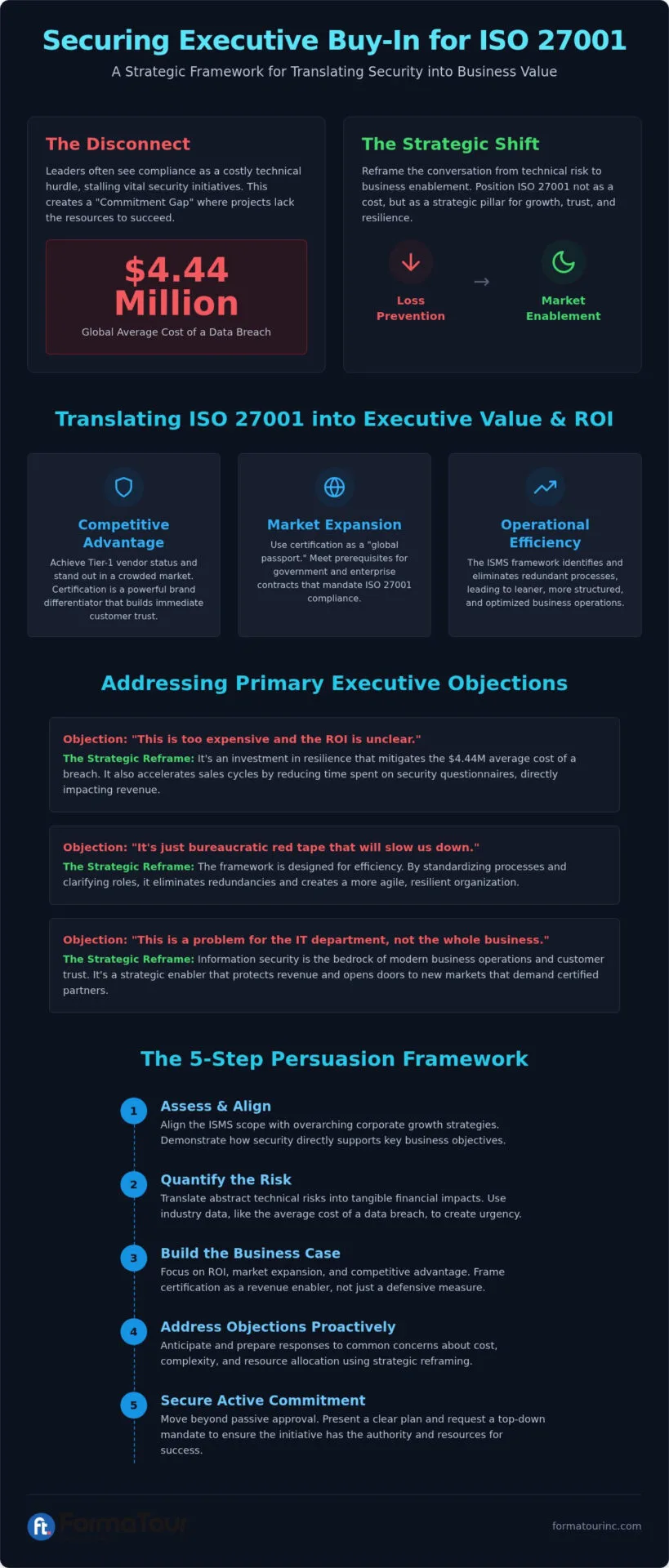
The 5-Step Persuasion Framework for Management Buy-In
Securing executive commitment is a deliberate internal marketing campaign rather than a single presentation. Success requires a methodical progression from data gathering to strategic alignment. Mastering how to get management buy-in for ISO 27001 requires a structured approach that emphasizes business value over technical compliance. This framework provides the tactical depth needed for how to get management buy-in for ISO 27001 by transforming security from an IT concern into a leadership priority. By following these five steps, you can bridge the gap between technical necessity and corporate vision.
- Step 1: Conduct a Gap Analysis to define the current versus desired state of security.
- Step 2: Map ISO 27001 controls to specific corporate strategic goals, such as market expansion or operational efficiency.
- Step 3: Develop a phased implementation roadmap that highlights “quick wins” to maintain project momentum.
- Step 4: Present a “Risk Appetite” report to the board that focuses on business impact rather than a generic list of vulnerabilities.
- Step 5: Propose a pilot program or a dedicated ISMS steering committee to distribute accountability across departments.
Step 1 & 2: Building the Evidence Base
The foundation of your case rests on a preliminary audit that uncovers high-impact risks to the organization’s core functions. This data allows you to identify a “Strategic Anchor,” which is the one business goal that ISO 27001 supports most effectively. For example, if the company aims to enter the European market, the anchor is the requirement for international security standards. Your executive summary should lead with a punchy declaration: “Implementing ISO 27001:2022 will streamline our procurement cycles by 25% and provide the structural integrity required to pursue high-security enterprise contracts.” This approach links security directly to performance outcomes that resonate in the boardroom.
Step 4 & 5: Mastering the Boardroom Pitch
When presenting to the board, you must use the language of governance and resilience. Avoid technical jargon like “bits and bytes” in favor of “capital preservation” and “market enablement.” It’s essential to present a Risk Appetite report that illustrates how certification reduces the potential for catastrophic financial loss. Introducing an external advisory partner at this stage provides third-party credibility and validates your internal findings with global benchmarks. Formatour Incorporated offers this seasoned perspective, helping you structure the “Ask” around budget, time, and visible leadership support. If you’re ready to build a persuasive case for your organization, consider a strategic consultation to refine your implementation roadmap. A well-structured pitch ensures that leadership views the ISMS not as a cost, but as a catalyst for sustainable growth.
Partnering for Performance: How Formatour Accelerates Buy-In
Formatour Incorporated serves as the vital bridge between technical security requirements and high-level strategic vision. We understand that knowing how to get management buy-in for ISO 27001 requires more than just a list of controls; it demands a narrative of transformation. Our firm provides the expertise necessary to translate complex compliance standards into the language of executive leadership. By positioning your Information Security Management System (ISMS) as a driver of growth, we help you secure the resources and cultural mandate required for long-term success. We act as a seasoned strategic mentor, ensuring that your security objectives are seamlessly integrated into the daily operations of your organization.
Our “Boutique Agility” is a defining characteristic of our approach. We combine big-firm standards with the flexibility to adapt to your specific organizational culture. This ensures that the implementation of ISO 27001:2022 does not disrupt your daily operations or stifle innovation. Instead, we work alongside your team to optimize processes and enhance structural integrity. This collaborative model makes Formatour the premium choice for ISO 27001 Implementation Services, as we focus on delivering tangible business value at every stage of the journey. We don’t just provide a service; we co-develop solutions that foster stability and long-term growth.
The Formatour Difference: Strategic Transformation
Next Steps: Secure Your Organization’s Future
Securing your organization’s future begins with a clear understanding of your current readiness. Formatour assists you in drafting the internal business case required to win over your board, providing the data-driven insights and strategic foresight that executives demand. We support your leadership through professional development and Lead Auditor training, ensuring your team possesses the internal capability to maintain excellence. If you are ready to master how to get management buy-in for ISO 27001 and transform your security posture into a competitive advantage, we invite you to take the next step. Consult with Formatour for Strategic ISO 27001 Implementation to begin your journey toward a more resilient and globally minded future. Our partnership ensures that your investment in security delivers the high-level impact your organization deserves.
Securing Your Organization’s Strategic Future
Achieving international certification is a journey that begins with a fundamental shift in perspective. You’ve seen that success depends on translating technical requirements into a compelling narrative of growth and market enablement. By framing security as a tool for strategic transformation, you move beyond the role of a gatekeeper and become a visionary architect of organizational health. Mastering how to get management buy-in for ISO 27001 requires a structured approach that pairs data-driven risk analysis with a clear vision of resilience. This framework ensures your leadership views the ISMS as a catalyst for sustainable development rather than a bureaucratic burden.
As a premium multidisciplinary advisory firm, Formatour Incorporated provides the expert implementation, auditing, and certification services needed to navigate this complex landscape. We specialize in strategic transformation and organizational resilience, offering the boutique agility required to align global standards with your unique operational goals. If you’re ready to secure executive commitment and elevate your security posture, Partner with Formatour for Strategic ISO 27001 Advisory today. Your organization’s stability and future growth are within reach when you pair professional expertise with a clear strategic mandate.
Frequently Asked Questions
What is the most effective way to explain ISO 27001 to a CEO?
Frame ISO 27001 as a strategic tool for market expansion and competitive differentiation. CEOs prioritize growth and brand reputation; therefore, explain the standard as a framework that validates your organization’s commitment to protecting client assets. This validation is often a prerequisite for enterprise contracts and international trade. By emphasizing how the standard streamlines procurement and mitigates catastrophic operational risks, you align security directly with the CEO’s vision for long-term stability.
How much does management buy-in affect the success rate of ISO 27001?
Active leadership commitment is the single most important factor in the success of an Information Security Management System. Research indicates that projects lacking executive sponsorship often suffer from resource stagnation and cultural resistance. When leadership champions the initiative, it ensures the allocation of necessary capital and personnel. Understanding how to get management buy-in for ISO 27001 is essential because it transforms the project from a technical silo into a unified corporate mandate.
Can we achieve ISO 27001 certification without a full board mandate?
While a department might achieve localized compliance, a full certification requires a top-down mandate to define the organizational scope. ISO 27001:2022 demands that leadership demonstrates commitment to the ISMS. Without board-level approval, you’ll likely face insurmountable obstacles regarding budget and cross-departmental cooperation. A formal mandate provides the authority needed to integrate security controls into core business processes, ensuring the system remains resilient and auditable over the long term.
What are the main financial benefits of ISO 27001 for a CFO?
CFOs value the standard for its ability to reduce the total cost of ownership for security operations. Certification often leads to lower cyber insurance premiums and significantly faster sales cycles by eliminating repetitive security questionnaires. It also provides a structured approach to capital allocation, ensuring that investments are prioritized based on verified risks. By preventing the financial devastation of a major data breach, ISO 27001 acts as a strategic safeguard for the organization’s bottom line.
How does ISO 27001 support digital transformation initiatives?
The standard provides the governance framework necessary to adopt new technologies without increasing the organization’s risk profile. It ensures that digital transformation is not just fast, but also secure and compliant with global benchmarks. By identifying risks early in the transformation process, ISO 27001 allows for the seamless integration of cloud services and AI tools. This structural integrity prevents technical debt and ensures that modern infrastructure supports sustainable operational performance.
What role does management play during the ISO 27001 audit process?
Auditors specifically interview senior management to verify their active involvement in the ISMS. Leadership must demonstrate their understanding of the organization’s risk profile and show how security objectives align with corporate strategy. This participation proves that the system isn’t just a paper exercise but a lived part of the organizational culture. Effective management engagement during the audit reinforces the credibility of the entire security program and facilitates a smoother certification process.
How can I demonstrate the ROI of ISO 27001 before we start the project?
Demonstrating ROI involves mapping the certification to specific revenue-generating opportunities and cost-saving measures. Start by identifying the number of enterprise contracts lost or delayed due to a lack of formal security credentials. Combine this with a gap analysis that uncovers inefficient, redundant processes that the ISMS will streamline. This data-driven approach is a key tactic for how to get management buy-in for ISO 27001, as it presents the standard as a high-yield strategic investment.
What are the risks of losing management buy-in mid-project?
Losing executive support mid-project often leads to immediate budget freezes and the reassignment of critical personnel. This stagnation creates a “Commitment Gap” that can demoralize the implementation team and lead to project failure. Without consistent leadership, the ISMS becomes a fragmented collection of technical controls rather than a cohesive strategy. This loss of momentum not only wastes the initial investment but also leaves the organization vulnerable to the very risks the project intended to mitigate.
