

The true cost of a major operational disruption in Canada isn’t measured in hours of downtime, but in the permanent loss of stakeholder trust. For many executive leaders, the pressure to maintain seamless operations while deciphering complex international frameworks feels like an uphill battle. You understand that resilience is vital, yet the difficulty of aligning continuity plans with high-level corporate strategy often leads to a checkbox approach to compliance. Specialized ISO 22301 business continuity consulting changes this dynamic by shifting the focus from mere survival to strategic optimization.
We agree that your organization deserves more than a static binder of emergency procedures. You need a living system that protects your reputation and fuels growth during periods of volatility. This guide provides a clear roadmap for 2026, showing you how to turn mandatory standards into a powerful engine for reliability and performance. We’ll examine the core pillars of the standard and outline how a structured approach to resilience builds lasting value for your Canadian enterprise.
Key Takeaways
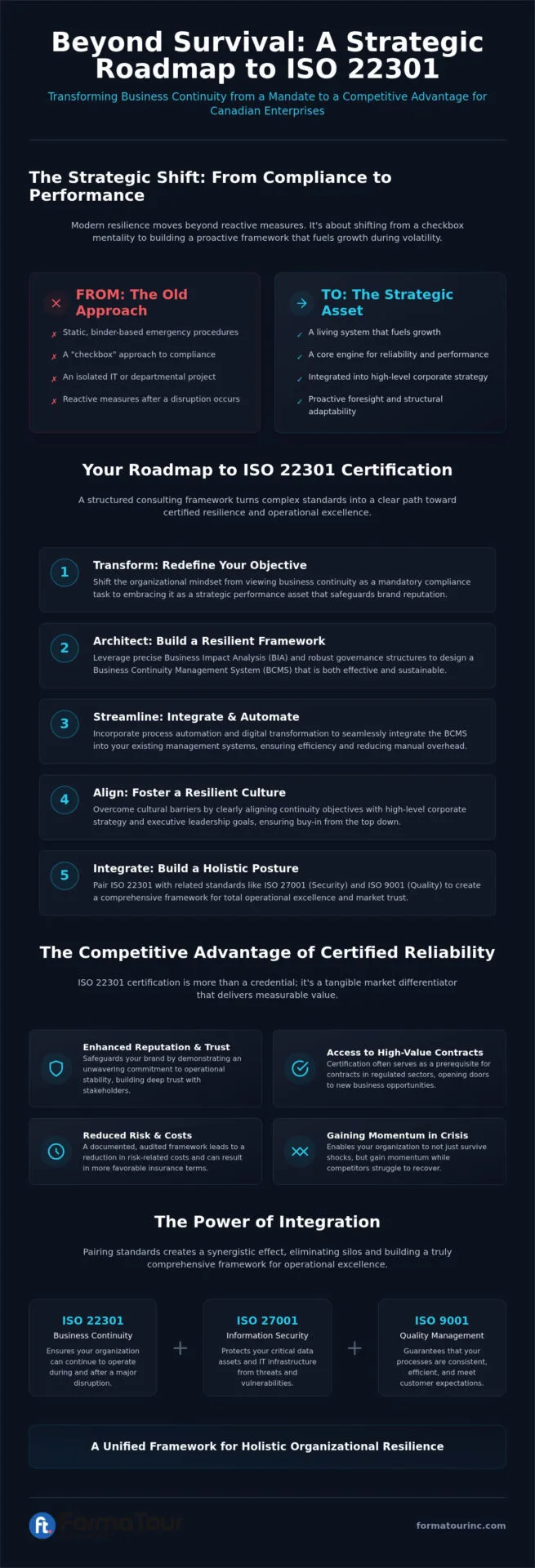
- Transform business continuity from a compliance mandate into a strategic performance asset that safeguards your brand’s reputation across Canada.
- Leverage ISO 22301 business continuity consulting to architect a resilient framework through precise Business Impact Analysis and robust governance structures.
- Streamline your path to certification by integrating process automation and digital transformation into your existing management systems.
- Overcome cultural barriers to resilience by aligning continuity objectives with high-level corporate strategy and executive leadership goals.
- Build a holistic security posture by pairing ISO 22301 with ISO 27001 and ISO 9001 to ensure comprehensive operational excellence and market trust.
The Strategic Value of ISO 22301 Business Continuity Consulting
ISO 22301:2019 stands as the definitive international benchmark for Business Continuity Management Systems (BCMS). While many organizations equate continuity with simple disaster recovery, this standard demands a more comprehensive integration into the corporate DNA. Professional ISO 22301 business continuity consulting acts as the bridge between technical requirements and executive vision. It ensures that resilience isn’t an isolated IT project but a core strategic performance asset that stabilizes operations during unforeseen disruptions. By aligning these standards with organizational goals, leaders transform a compliance necessity into a foundation for sustainable growth.
Redefining Resilience in a Volatile 2026 Market
The Competitive Advantage of Certified Reliability
Certification provides a tangible market differentiator that resonates with sophisticated stakeholders. When you engage in ISO 22301 business continuity consulting, you’re investing in a credential that signals unwavering reliability to international partners and domestic clients alike. This recognized compliance fosters deep trust, often serving as a prerequisite for high-value contracts in regulated sectors. Beyond reputation, the practical application of the standard yields direct financial benefits. Canadian firms often see a reduction in risk-related costs and more favourable terms from insurance providers who value the documented, audited rigor of an ISO-certified framework. It’s a clear signal that your organization is built for the long term. Working with a premium partner like Formatour Incorporated ensures this process is both efficient and strategically aligned with your broader vision.
Architecting a Robust Business Continuity Management System (BCMS)
Designing a resilient BCMS is akin to engineering a skyscraper; it must be flexible enough to sway during a storm but rigid enough to support daily growth. Expert ISO 22301 business continuity consulting focuses on creating a framework that doesn’t just sit on a shelf. It must integrate into the daily rhythm of the organization. This requires a governance structure that remains stable even during executive transitions. By establishing clear roles and responsibilities, the BCMS becomes a legacy of stability rather than a project tied to a single individual. It ensures that the knowledge required to protect the firm is institutionalized and accessible.
A truly resilient organization recognizes the synergy between data protection and operational uptime. This is why we often recommend aligning your BCMS with ISO 27001 implementation services to create a unified security and continuity posture. When these standards work in tandem, you eliminate operational silos. You ensure that your technical recovery capabilities directly support your business survival goals. This holistic approach is what transforms a standard compliance exercise into a powerful tool for organizational performance.
Risk Assessment and Business Impact Analysis (BIA)
Developing Incident Management and Recovery Strategies
Strategy must translate into action through clear, accessible playbooks. These documents outline specific responses for diverse disruptive scenarios, from cyber incidents to physical infrastructure failures. Effective communication protocols are the most vital component during high-stress events. You need established channels that keep employees, clients, and partners informed without causing panic. Technical recovery must never exist in a vacuum; it must be calibrated to meet the specific requirements identified in your BIA. If you’re ready to build a framework that protects your future, you can consult with our strategic advisors to begin your transformation.
The Roadmap to ISO 22301 Certification: A Consulting Framework
Achieving certification requires more than just following a checklist. It’s a structured journey that demands precision at every turn. Professional ISO 22301 business continuity consulting provides the necessary architecture to navigate this path without disrupting your core operations. We bring big-firm standards to the table but deliver them with boutique agility. This means your roadmap is customized to your specific Canadian market footprint and organizational culture. We don’t just hand over templates; we co-develop solutions that reflect your unique operational reality. The team at Formatour Incorporated guides you through the complexities of Stage 1 and Stage 2 audits, ensuring your documentation is robust and your implementation is effective.
Phase 1: Gap Analysis and Strategic Alignment
The process begins with a rigorous benchmarking of your current capabilities against the ISO 22301:2019 requirements. We don’t just look for missing documents; we analyze how your existing workflows handle pressure. This diagnostic phase identifies “low-hanging fruit”, which are immediate adjustments that boost resilience before the formal implementation even begins. These quick wins build momentum and demonstrate value to stakeholders early in the journey. By aligning the BCMS scope with your firm’s strategic transformation goals, we ensure that compliance supports your long-term vision rather than becoming a bureaucratic hurdle. This alignment is vital for securing executive commitment and ensuring the system scales as you grow. It transforms the certification process from a technical project into a strategic evolution.
Phase 2: Implementation and Process Optimization
Once the strategy is set, we move to integrate continuity controls into your actual business processes. We don’t believe in manual, cumbersome systems that drain resources. Instead, we leverage a digital transformation strategy to automate monitoring and reporting. This reduces the administrative burden on your team and provides real-time visibility into your resilience posture. Automation ensures that your business continuity management system stays current without constant manual intervention. Before the external auditors arrive, we conduct thorough internal audits and management reviews. These rehearsals ensure your team is confident and your system is ready for the formal Stage 1 documentation review and the Stage 2 effectiveness audit. Stage 2 audits focus on the practical application of your plans, requiring verifiable evidence of testing and maintenance. It’s about building a system that works every day, not just when the auditor is in the room.
Overcoming Implementation Challenges: Leadership and Culture
Many organizations assume that a robust BCMS is purely a technical challenge. In reality, the most significant barrier to organizational resilience is culture. A system that lives only on a server or in a binder cannot protect a firm during a crisis. It requires a fundamental shift in how every employee, from the front line to the C-suite, perceives risk and responsibility. Expert ISO 22301 business continuity consulting addresses this by focusing on the human architecture of the business. We help organizations move beyond passive compliance to a proactive, resilience-first mindset. This cultural evolution ensures that when disruptions occur, the response is instinctive rather than frantic.
Securing executive buy-in is the first step in this cultural transformation. Leaders must see continuity not as a defensive cost, but as a strategic driver of growth and stability. A resilient organization can pursue more aggressive market opportunities in the Canadian landscape because its foundation is secure. This alignment is most effective when paired with leadership training for digital transformation. By equipping executives with the tools to navigate both technological and operational shifts, you create a leadership team that views resilience as a competitive advantage rather than a burden.
Executive Education and Leadership Synergy
Empowering the C-suite to lead during disruptive events requires more than a briefing. It demands the integration of resilience principles into established executive leadership development programs. This creates a synergy where strategic foresight and operational continuity become inseparable. A clear and committed leadership vision is the primary catalyst that drives BCMS success and ensures long-term organizational health. When the top tier of the firm prioritizes these standards, the rest of the organization follows suit with confidence.
Training and Professional Development for Continuity Teams
On the operational level, you must build a multidisciplinary team that understands the intersection of IT and business processes. This team needs specialized seminars and certifications to maintain the high standards required by ISO 22301:2019. We focus on developing internal expertise so your organization remains self-sufficient and compliant over the long term. This includes equipping your internal audit team with the skills to identify vulnerabilities before they become crises. If you want to transform your corporate culture into a shield for your business, reach out to our consultants today to begin developing your customized resilience roadmap.
Partnering for Resilience: Why Formatour Incorporated is the Executive Choice
Selecting the right advisory partner is as critical as the resilience framework itself. Formatour Incorporated provides a unique blend of big-firm rigor and boutique agility, ensuring that your continuity objectives are never treated as isolated compliance tasks. We understand that for Canadian executives, resilience is about more than just checking a box; it’s about optimizing operational performance and safeguarding the firm’s legacy. Our multidisciplinary approach integrates ISO 9001, ISO 27001, and ISO 22301 into a unified management ecosystem. This ensures that your quality, security, and continuity goals don’t compete for resources but instead reinforce one another. With over a decade of experience in strategic transformation, we bring a global perspective that remains grounded in the practical realities of the Canadian market. Our experts work as active participants in your progress, ensuring that every resilience measure contributes to your firm’s structural integrity.
Boutique Agility Meets Global Standards
Many organizations fall into the trap of using “certification mills” that offer generic, one-size-fits-all templates. These models often fail because they don’t account for the unique operational nuances of your specific industry or corporate culture. Our personalized advisory model provides direct access to senior advisors who have navigated complex global systems and understand the high stakes of executive leadership. We prioritize strategic project management that respects your daily operations, ensuring that the implementation of your BCMS doesn’t become a source of disruption itself. By focusing on your specific industry footprint in Canada, we deliver a system that is as agile as it is robust. This high-touch consulting approach ensures that your leadership team remains informed and empowered throughout the entire certification lifecycle. You get the depth of a global consultancy with the responsiveness of a dedicated partner.
Securing Your Future with Formatour Incorporated
A partnership with Formatour Incorporated is an investment in the long-term stability and growth of your organization. We don’t just prepare you for an audit; we build the structural integrity required to thrive in a volatile 2026 market. Our focus on operational performance optimization means that your resilience framework will continue to deliver value long after the initial certificate is issued. We invite you to begin this journey with a customized resilience assessment that identifies your current strengths and uncovers hidden vulnerabilities. This diagnostic start ensures that our ISO 22301 business continuity consulting is perfectly calibrated to your needs. When you’re ready to transform your continuity plan into a strategic asset, reach out to our experts for ISO 22301 business continuity consulting. Together, we’ll architect a future where your organization remains unwavering in the face of any challenge.
Securing Your Organizational Legacy through Strategic Resilience
True resilience is the result of a deliberate cultural shift that elevates continuity from a technical requirement to a core leadership priority. By integrating a robust Business Continuity Management System with your broader digital transformation goals, you ensure that your firm remains stable and competitive in the face of any disruption. We’ve explored how a data-driven approach to Risk Assessment and Business Impact Analysis provides the necessary clarity to protect your most vital operations. As a premium Canadian firm with over a decade of expertise, Formatour offers the multidisciplinary advisory needed to harmonize ISO 9001, 27001, and 22301 standards into a single, high-performance framework.
The path to sustainable growth requires a partner who balances big-firm standards with boutique agility. Our ISO 22301 business continuity consulting is designed to empower your C-suite and build a resilient workforce that views challenges as opportunities for optimization. You have the vision to lead; we provide the architectural rigor to ensure your success is permanent. Take the next step toward comprehensive organizational health and secure your organization’s future with expert ISO 22301 consulting. We’re ready to help you architect a future that remains unwavering through 2026 and beyond.
Frequently Asked Questions
What is the primary difference between ISO 22301 and standard disaster recovery?
ISO 22301 focuses on the entire business continuity management system (BCMS), covering people, processes, and governance. Standard disaster recovery is typically a technical subset focused on IT systems restoration. ISO 22301 ensures the organization can maintain critical operations during a crisis, whereas disaster recovery is about getting technical infrastructure back online after a failure. It’s about total organizational survival, not just data recovery.
How long does the ISO 22301 certification process typically take with a consultant?
The timeline generally ranges from six to twelve months depending on organizational complexity. Engaging in professional ISO 22301 business continuity consulting often accelerates this by streamlining the gap analysis and documentation phases. Smaller organizations might achieve readiness faster; larger enterprises require more time to embed the BCMS across multiple departments and conduct necessary internal audits to ensure compliance and effectiveness.
Can ISO 22301 be integrated with my existing ISO 9001 or ISO 27001 systems?
Yes, ISO 22301 is designed to be fully compatible with other management standards. It shares the same Annex SL high-level structure as ISO 9001 and ISO 27001, allowing for a unified approach to governance. This integration reduces administrative overlap and ensures that quality, security, and continuity objectives are managed through a single, efficient executive framework. It’s a strategic way to consolidate your compliance efforts across the organization.
What are the most common risks identified during an ISO 22301 gap analysis?
Common findings include a lack of documented recovery time objectives (RTOs) and insufficient resource allocation for critical functions. Many Canadian firms also discover gaps in their supply chain dependencies and internal communication protocols. A gap analysis often reveals that while technical backups exist, the organizational procedures to maintain operations without those tools are either missing or outdated. Identifying these weaknesses is the first step toward true resilience.
How does business continuity consulting improve my organizational performance?
Professional ISO 22301 business continuity consulting identifies inefficiencies in how resources are allocated during disruptions, leading to more streamlined operations. By clarifying critical paths and dependencies, your organization becomes leaner and more responsive. This foresight reduces the high costs associated with unplanned downtime and enhances market trust, which is a significant driver of long-term financial growth and stakeholder confidence in the competitive Canadian landscape.
What is a Business Impact Analysis (BIA) and why is it critical for ISO 22301?
A BIA is a systematic process that determines the potential consequences of disrupting business functions. It’s critical because it establishes the recovery priorities and timelines needed to maintain viability. Without a BIA, an organization cannot accurately allocate resources or set realistic recovery objectives, making it impossible to build a BCMS that meets international standards. It provides the essential data needed to make informed executive decisions during a crisis.
Is ISO 22301 certification mandatory for Canadian businesses in 2026?
Certification isn’t legally mandatory for all firms, but it’s increasingly required by procurement contracts in sectors like finance, healthcare, and government. Many Canadian organizations treat it as a de facto requirement to remain competitive in international markets. It serves as a recognized mark of reliability that satisfies the due diligence requirements of insurers and major corporate partners. It’s a powerful tool for demonstrating operational maturity and market differentiation.
How often should a Business Continuity Management System be audited and updated?
Organizations should conduct internal audits at least annually or whenever significant structural changes occur. ISO 22301 requires regular management reviews to ensure the BCMS remains effective as the business evolves. Frequent testing through exercises and simulations is also vital to verify that recovery strategies work in practice and that the team remains prepared for disruptive events. It’s a living system that needs constant attention to remain relevant.
