

For Canadian executives in 2026, ISO 27001 certification has shifted from a discretionary badge of honor to a non-negotiable requirement for operational legitimacy. As cyber threats intensify across the domestic financial and technology sectors, the cost of inaction is no longer just a security risk; it’s a direct threat to market access. You likely feel the weight of aligning international security standards with the specific demands of Quebec’s Law 25 and the transition from PIPEDA to the proposed federal penalties under Bill C-36, where administrative fines can now reach C$25 million.
We understand the concern that a comprehensive security overhaul might become a multi-year, million-dollar burden on your internal resources. This article provides a structured ISO 27001 implementation plan Canada leaders can use to master these complexities through a phased, strategic roadmap. By following this executive guide, your organization can achieve certification readiness within six to twelve months while ensuring total alignment with the evolving Canadian regulatory landscape. We’ll examine how Formatour Incorporated transforms these global benchmarks into a practical framework that empowers your team, optimizes your governance, and secures your long-term growth through a steady, expert hand.
Key Takeaways
- Master the Plan-Do-Check-Act cycle to build a resilient foundation for your information security management system.
- Follow a structured 6-phase ISO 27001 implementation plan Canada leaders use to secure certification within six to twelve months.
- Align your security controls with Canadian privacy legislation like PIPEDA and Law 25 to mitigate the risk of high-value administrative penalties.
- Evaluate the cost-benefit of boutique advisory partnerships to prevent staff burnout and ensure a streamlined path to compliance.
- Navigate the nuances of Stage 1 and Stage 2 audits to successfully meet the evidence requirements of Canadian-accredited certification bodies.
What is an ISO 27001 Implementation Plan in the Canadian Context?
An effective ISO 27001 implementation plan Canada organizations adopt is a comprehensive strategy designed to protect the confidentiality, integrity, and availability of sensitive information. At its core, What is ISO 27001 represents a global standard for establishing, maintaining, and continually improving an Information Security Management System (ISMS). In the modern Canadian business environment, this plan serves as a shield against the rising tide of AI-driven data breaches and ransomware threats that have increasingly targeted our financial and technology sectors. It’s no longer just about IT; it’s about ensuring your business remains operational and trustworthy in a volatile digital economy.
The foundation of any successful implementation is the Plan-Do-Check-Act (PDCA) cycle. This iterative four-step management method ensures that security measures aren’t just installed and forgotten. Instead, they’re planned with precision, executed with care, monitored for effectiveness, and adjusted to meet new challenges. This cycle fosters deep organizational resilience, allowing firms to pivot quickly when new vulnerabilities emerge in the domestic landscape. By embedding this cycle into your daily operations, you create a culture of continuous improvement that outlasts any single audit cycle.
The Core Components of a Canadian ISMS
For non-technical executives, an ISMS is best understood as a structured framework of policies and controls that manage data risks through a unified approach. It moves security from a siloed IT concern to a core business function. Clause 5 of the standard emphasizes Leadership Commitment, which is particularly critical in Canadian corporate governance. Without active C-suite involvement, security initiatives often lack the resources and cultural weight needed to succeed. A key output of this process is the Statement of Applicability (SoA). Think of the SoA as a customized security menu where your organization identifies which specific controls are necessary to mitigate your unique risks, ensuring your defense is both efficient and targeted.
Why Canadian Firms are Prioritizing ISO 27001 in 2026
Canadian procurement contracts are undergoing a significant shift toward “Security by Design.” Whether you’re bidding on government projects or partnering with major enterprises, demonstrating a mature security posture is now a prerequisite. ISO 27001 acts as a powerful competitive differentiator, especially for those operating within the North American tech corridor. It provides an immediate level of trust that facilitates cross-border trade and simplifies vendor risk assessments. By integrating these standards, firms don’t just comply; they transform their security into a marketable asset. To understand how this fits into your broader growth strategy, explore our ISO 27001 Implementation Services Pillar for a deeper look at organizational resilience.
The 6-Phase ISO 27001 Implementation Roadmap for 2026
Executing a successful ISO 27001 implementation plan Canada organizations rely on requires a methodical, six phase approach that balances technical rigour with operational agility. The journey begins with Phase 1: Project Initiation and Resource Allocation. During this stage, the primary objective is securing C-suite buy-in by demonstrating how a mature security posture directly supports business growth and regulatory compliance. Phase 2 involves defining the ISMS scope. For complex Canadian firms, this step is vital to prevent scope creep, which can inflate costs and delay certification. By clearly delineating which departments, locations, and data types are included, you ensure a lean and effective implementation.
Phase 3 transitions into the risk assessment framework, where we identify threats specific to the Canadian market, such as evolving ransomware tactics targeting mid-sized firms. This leads to Phase 4, the implementation of controls. Here, you align Annex A requirements with your daily business operations to ensure security becomes an enabler rather than a hurdle. Phase 5 centers on the internal audit and management review. This is your organization’s opportunity to verify that the system works as intended before moving to the final stage. Phase 6 concludes the roadmap with the formal external certification audit, where an accredited body validates your compliance.
Conducting a Modern Risk Assessment
A contemporary risk assessment must look beyond traditional server rooms and office perimeters. In Canada, where remote and hybrid work models are now the standard, your assessment needs to evaluate the unique vulnerabilities of distributed teams and home office environments. We utilize a structured matrix to evaluate risk impact against likelihood, ensuring your resources are allocated to the most critical areas first. A robust risk assessment in 2026 must account for both human error and automated adversarial AI attacks. This proactive stance is essential for Aligning ISO 27001 with Canadian Privacy Laws, as it provides the documented “due diligence” required by federal and provincial regulators.
The Statement of Applicability (SoA)
The SoA is the definitive document that outlines which Annex A controls you’ve selected and, equally important, which ones you’ve excluded. It’s not enough to simply list controls; you must provide a clear justification for every decision to satisfy Canadian auditors. This document acts as your primary evidence during the certification process. When properly executed, the SoA ensures that your security framework supports your broader Digital Transformation Strategies, allowing for rapid innovation without compromising data integrity. If you’re ready to refine your organizational roadmap, you might consider how to consult with a strategic advisor to streamline this transition.
Aligning ISO 27001 with Canadian Privacy Laws (PIPEDA & Law 25)
For organizations operating within Canadian borders, information security is inextricably linked to privacy compliance. A well-structured ISO 27001 implementation plan Canada firms deploy acts as a robust bridge between technical safeguards and legal mandates. As of August 2026, the regulatory environment has intensified with the introduction of Bill C-36, the Protecting Privacy and Consumer Data Act. This legislation proposes administrative penalties reaching up to C$10 million or 3% of gross global revenue for non-compliance. By adopting an ISO 27001 implementation plan, you don’t just satisfy an IT checklist; you establish a defensible position against the rigorous “Safeguarding” principles required by both federal and provincial legislation.
PIPEDA vs. ISO 27001: The Overlap
The standard’s focus on access control and accountability aligns with PIPEDA’s requirements for individual consent and organizational responsibility. An ISMS provides the necessary workflow to manage mandatory data breach notifications. It ensures that incidents are reported to the Privacy Commissioner within the required timeframes. Additionally, Annex A controls facilitate the oversight of third-party vendors. This is a critical component for Canadian firms managing cross-border data transfers under the new, stricter federal framework proposed in 2026. It’s no longer a suggestion; it’s a core requirement for stable growth.
Quebec Law 25 and the Privacy Officer Role
In Quebec, Law 25 has set a high bar for data transparency and portability. Penalties for non-compliance are severe, reaching up to C$25 million or 4% of worldwide revenue. ISO 27001 supports the legally mandated “Privacy Officer” role by providing a clear governance structure for oversight and reporting. Through automated process controls, firms can more efficiently handle complex “Right to be Forgotten” requests and data portability requirements that are now fully in effect. Aligning your ISO 27001 implementation plan Canada with these requirements is a form of Strategic Change Management. This multidisciplinary approach ensures that your legal and technical teams work in harmony to mitigate risk.
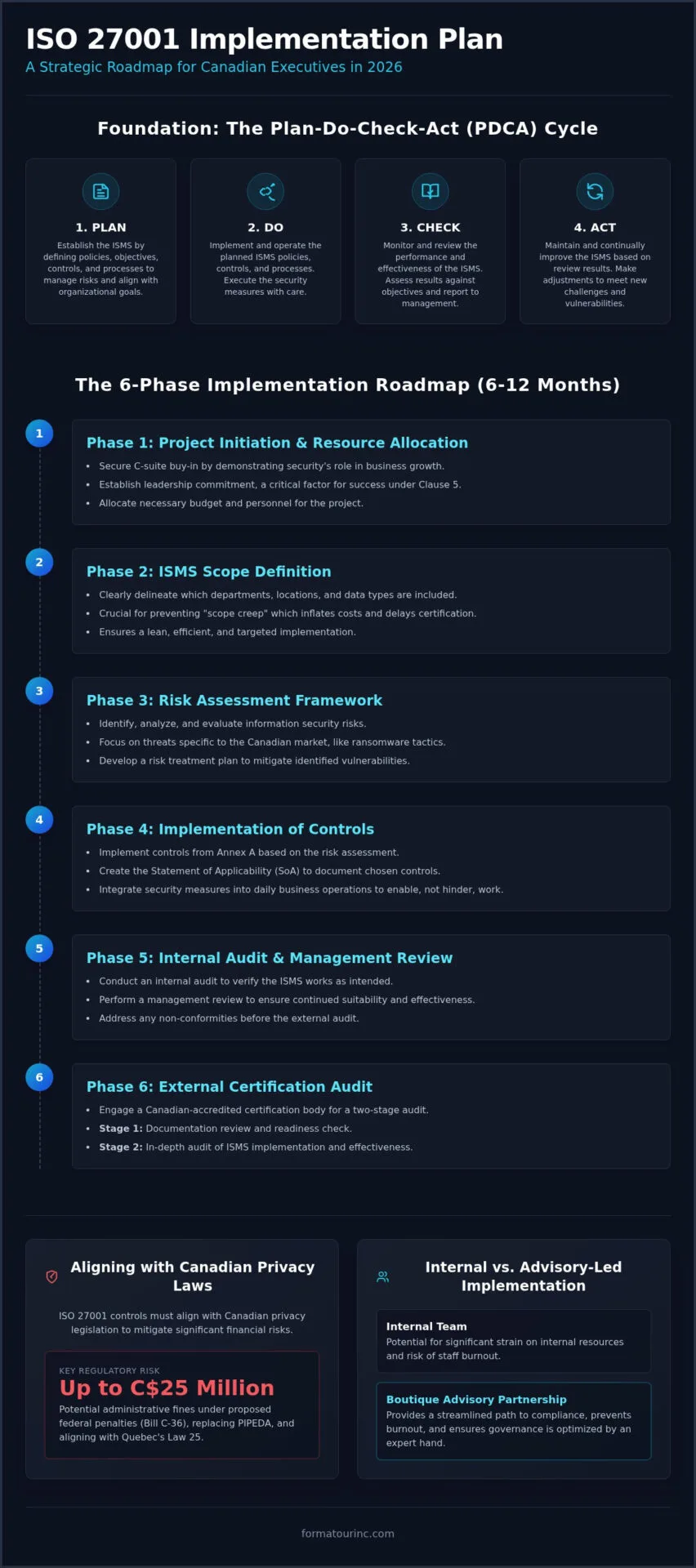
Internal vs. Advisory-Led Implementation: A Cost-Benefit Analysis
The “Boutique Advantage” offers a compelling alternative to the bureaucratic overhead of the “Big Four” consulting firms. Formatour Incorporated provides the same high-level standards as global firms but with the agility required by Canadian SMEs. We integrate Executive Leadership Training into our process, ensuring the ISMS becomes a permanent part of your corporate governance rather than a one-time project. This leadership-first approach ensures that the system evolves as your organization scales.
When to Hire an ISO 27001 Consultant in Canada
Certain operational signals suggest that your internal resources are reaching their limit. If your team has struggled to move past a failed gap analysis or if documentation remains in a perpetual state of “draft,” external intervention is likely necessary. An “External Eye” provides an objective assessment, uncovering risks that internal staff might miss due to operational familiarity. Formatour Incorporated acts as a strategic mentor, offering the technical depth needed to navigate the complexities of the certification process without the bloat of traditional consulting.
The ROI of ISO 27001 Certification
The financial benefits of certification extend well beyond risk mitigation. Canadian firms often see a tangible reduction in cyber insurance premiums, as underwriters favor organizations with a validated management system. Additionally, being certified acts as a powerful sales accelerator. It drastically reduces the time spent on vendor risk assessments when targeting enterprise clients or government contracts. ISO 27001 certification is not an expense; it is a strategic investment that pays dividends in market trust and operational efficiency.
If you’re ready to move forward with a streamlined roadmap, book a strategic consultation to discuss how we can accelerate your path to certification.
Finalizing Your Plan: Certification Audits and Next Steps
The final phase of your ISO 27001 implementation plan Canada journey involves the formal certification audit, a rigorous process divided into two distinct stages. Stage 1 is primarily a documentation review. During this phase, the auditor verifies that your ISMS framework and policies meet the mandatory requirements of the 2022 standard. Stage 2 is the evidence audit, where the focus shifts from what is written to what is practiced. The auditor will look for tangible proof that your controls are functioning as intended within your daily operations. To ensure your certification has the necessary domestic and international standing, it’s vital to select a certification body accredited by the Standards Council of Canada.
Achieving your certificate is a significant milestone, but it’s not the end of the process. Clause 10 of the standard mandates Continuous Improvement, requiring your organization to constantly refine its security posture. Maintaining this standard requires regular oversight and a commitment to evolving alongside new threats. Many firms find that the most efficient way to sustain compliance is through professional ISO Internal Audit Services. These regular check-ups identify minor non-conformities before they can escalate into major issues during your annual surveillance audits.
Common Pitfalls in the Stage 2 Audit
Many Canadian organizations encounter difficulties during Stage 2 because they’ve developed a “paper-only” ISMS. Auditors are trained to look past the documentation to find evidence of control effectiveness. Common pitfalls include:
- Lack of documented management review records that prove leadership is actively involved in security governance.
- Employees who are unable to explain their role in the security framework or are unaware of basic information security policies.
- Missing evidence of historical testing for incident response and business continuity plans.
Get Started with Formatour Incorporated
Formatour Incorporated provides a multidisciplinary advisory approach that combines strategic transformation with technical resilience. We understand that every Canadian firm has a unique risk profile, and a one-size-fits-all approach often leads to operational friction. We customize your implementation plan to suit your specific industry, size, and growth objectives, acting as a steady mentor throughout the certification process. Our goal is to ensure your ISMS provides a foundation for long-term stability and market trust. To take the first step toward securing your organization’s future, contact our advisory team for a gap analysis today.
Securing Your Strategic Resilience in the Canadian Market
The journey toward certification represents a fundamental shift from reactive security to proactive organizational resilience. By synthesizing the phases of a structured ISO 27001 implementation plan Canada executives can navigate the intricate balance between global standards and domestic privacy requirements without disrupting their growth trajectory. We’ve mapped the path from initial resource allocation to the successful completion of the Stage 2 audit, providing a framework that turns compliance into a competitive asset.
Formatour Incorporated serves as your premium multidisciplinary partner, combining the technical depth of international standards with the boutique agility required by the Canadian market. Our focus on strategic transformation ensures that your ISMS is not just a repository of documents, but a living system that drives efficiency and market trust. Begin your ISO 27001 journey with a strategic consultation from Formatour Incorporated to secure your position as a trusted leader in the digital economy. Your organization is ready for this evolution, and we’re dedicated to guiding you through every step of the process.
Frequently Asked Questions
How much does ISO 27001 implementation cost for a Canadian business?
Implementation costs vary based on organization size and complexity. For small Canadian firms with fewer than 50 employees, first-year costs typically range from C$12,000 to C$38,000. Mid-sized companies should budget between C$35,000 and C$100,000. These estimates include internal effort and external support but exclude annual surveillance audits, which generally cost between C$6,000 and C$15,000. This investment reflects the necessity of securing domestic operations against 2026 threats.
Can we implement ISO 27001 alongside ISO 9001?
Yes, organizations frequently integrate these standards to create a unified management system. Since both utilize the High-Level Structure, they share common requirements for leadership, planning, and performance evaluation. Combining them into a single ISO 27001 implementation plan Canada strategy reduces documentation redundancy and streamlines the audit process. This integrated approach enhances both quality management and information security simultaneously while optimizing resource allocation across the entire organization.
How long does the ISO 27001 certification process take in Canada?
Most organizations achieve a successful ISO 27001 implementation plan Canada within six to twelve months. The timeline depends on your current security maturity and the availability of internal resources. While a DIY approach can stretch beyond 18 months, an advisory-led project often reaches readiness in six to nine months. This duration includes the mandatory Stage 1 and Stage 2 audits required by accredited certification bodies to validate your management system.
What is the difference between PIPEDA compliance and ISO 27001?
PIPEDA is a federal law governing personal information handling, while ISO 27001 is an international standard for security management. Compliance with the law is mandatory, whereas the standard is a voluntary framework. However, the technical controls within the standard directly satisfy the Safeguarding principles of PIPEDA and Quebec’s Law 25. Implementing the standard provides documented evidence of due diligence to regulators and clients alike in an increasingly scrutinized environment.
Does ISO 27001 require us to hire a full-time Chief Information Security Officer (CISO)?
The standard does not explicitly mandate a full-time CISO, but it does require clearly defined security roles and responsibilities. Small and mid-sized Canadian firms often utilize a Fractional CISO or assign these duties to an existing executive. The key requirement is that the individual has the authority and resources to manage the ISMS effectively. Leadership commitment remains the most critical factor for success in maintaining long-term security standards.
What happens if we fail our ISO 27001 certification audit?
Failing an audit usually results in non-conformities rather than an immediate dismissal. If an auditor identifies a major non-conformity, you must implement a corrective action plan and undergo a follow-up visit before the certificate is issued. Minor non-conformities don’t prevent certification but must be addressed within a specified timeframe. This process ensures your management system is robust and functioning as intended to protect your organization’s sensitive information assets.
Is ISO 27001 mandatory for Canadian government contractors?
While not universally mandatory, it is increasingly becoming a prerequisite for high-value federal and provincial government contracts. Government agencies often require bidders to demonstrate a mature security posture to protect sensitive public data. Holding this certification simplifies the procurement process and provides a significant competitive advantage. It acts as a recognized benchmark for trust in the public sector supply chain and aligns with modern procurement standards.
How often do we need to recertify for ISO 27001?
The certification cycle lasts three years. After the initial certification, your organization must undergo annual surveillance audits in years two and three to ensure the system is maintained. At the end of the third year, a full recertification audit is required to renew the certificate for another cycle. This continuous cycle supports the Plan-Do-Check-Act philosophy of long-term organizational resilience and ensures compliance with the latest security standards.
