

Governance is often viewed as the anchor that slows progress, yet in the current regulatory environment, it’s actually the only engine capable of sustaining long-term speed. For leaders seeking strategic transformation consulting Canada offers a unique set of challenges, particularly as the 2026 revision of ISO 9001 and the complexities of Bill C-36 redefine what it means to be a compliant, digital-first organization. You’ve likely seen the friction yourself. High failure rates for digital initiatives often stem from a deep disconnect between ambitious innovation and the structural integrity required to survive modern audits and market shifts.
It’s frustrating to watch internal resistance or regulatory hurdles stall a visionary project. We understand that your goal isn’t just to change, but to evolve into a more resilient version of your organization. This guide provides a clear roadmap for integrating international ISO standards with agile digital strategy to ensure your transformation is both resilient and compliant. We’ll examine how to balance innovation with governance, improve your operational performance, and build the sustained resilience your stakeholders expect in an increasingly complex global market.
Key Takeaways
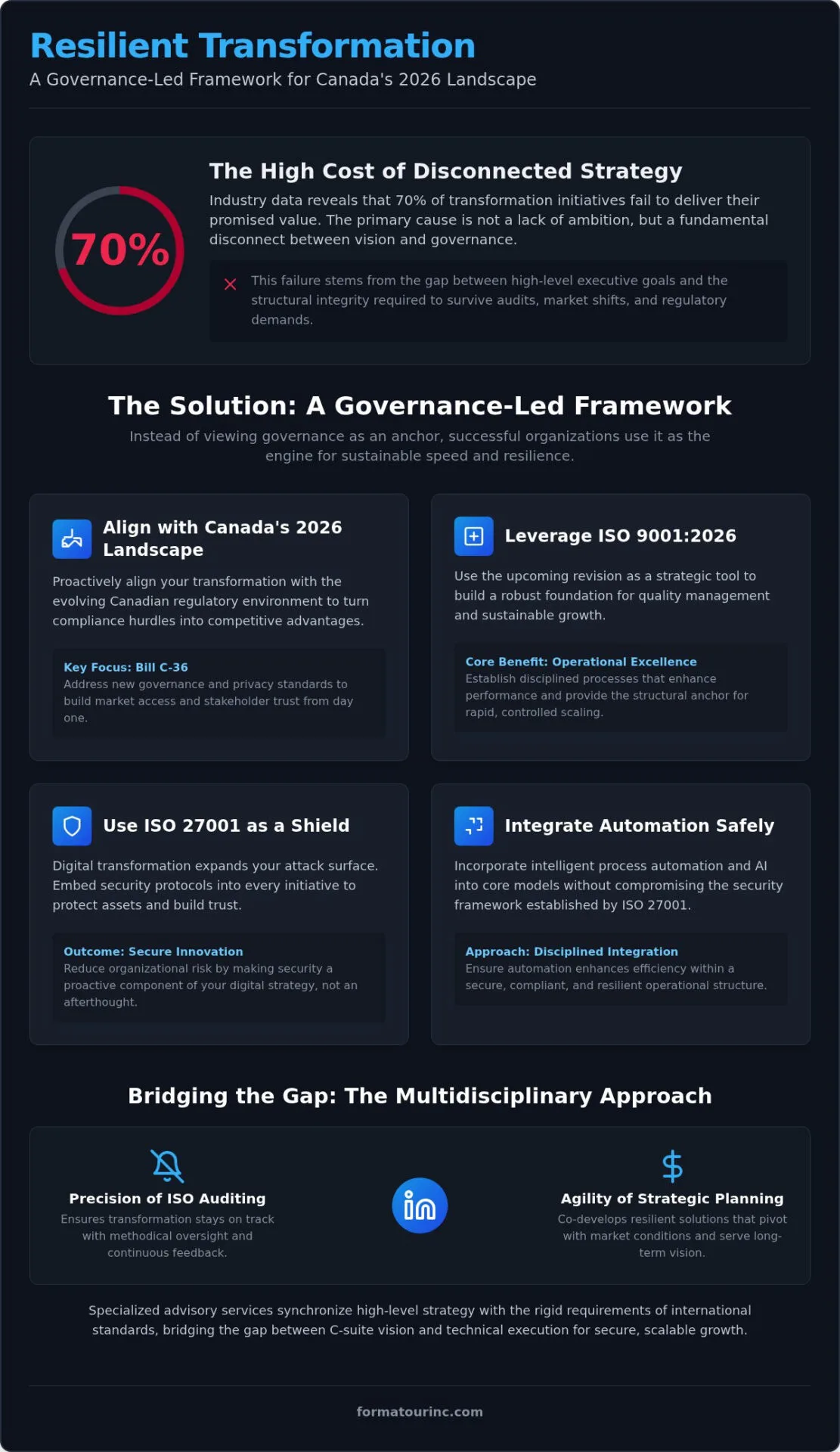
- Align your organizational evolution with the 2026 Canadian regulatory landscape, specifically addressing the governance requirements of Bill C-36.
- Leverage the ISO 9001:2026 revision as a strategic tool to enhance operational performance and establish a foundation for sustainable growth.
- Integrate intelligent process automation into your workflow without compromising security by using ISO 27001 as a protective shield for digital initiatives.
- Bridge the gap between technical execution and executive vision through specialized strategic transformation consulting Canada, ensuring C-suite alignment on all resilience goals.
- Adopt a multidisciplinary advisory approach that combines the precision of international ISO auditing with the agility of high-level strategic planning.
Navigating Strategic Transformation Consulting in Canada (2026)
Strategic transformation represents a fundamental structural evolution rather than a simple shift in business tactics. It requires a deep alignment with Strategic Management Principles to ensure that every operational change serves the long-term vision of the enterprise. In the current Canadian market, this evolution is no longer optional; it’s a survival mechanism. Organizations that treat transformation as a series of isolated software updates often find themselves lagging behind competitors who have redesigned their entire governance architecture.
The Shift from Reactive Change to Proactive Evolution
Canadian enterprises are increasingly moving away from the “break-fix” mentality. They’re now focused on architecting futures that integrate intelligent process automation and AI directly into their core business models. This shift has changed the consulting market significantly. In 2026, boutique agility often outperforms traditional big-firm consulting because specialized firms can pivot faster and offer more nuanced, hands-on guidance. Organizations don’t just need a report; they need a partner to co-develop solutions that remain resilient as market conditions shift.
Regulatory Drivers of Transformation in Canada
Provincial and federal governance now dictate the pace of corporate strategy more than ever before. The 2026 Canadian landscape is defined by the implementation of Bill C-36 and evolving privacy standards that demand total transparency. Aligning a transformation with international benchmarks from the very first day is a necessity for market access and stakeholder trust. Within this framework, strategic transformation consulting Canada is defined as a multidisciplinary advisory service that synchronizes high-level strategy with the rigid requirements of ISO standards to facilitate secure, scalable growth. By embedding compliance into the strategy itself, firms like Formatour Incorporated help leaders turn regulatory hurdles into competitive advantages.
The Governance-Led Framework: Integrating ISO Standards into Transformation
For many organizations, strategy and compliance exist in separate departments. This siloed approach often leads to transformation efforts that are technically impressive but structurally fragile. By integrating international ISO standards directly into the growth roadmap, businesses create structural anchors that support rapid scaling. In the context of Canada’s Digital Economy, where regulatory expectations are tightening, this governance-led framework ensures that innovation doesn’t outpace security or quality.
Integrated auditing is the mechanism that keeps this evolution disciplined. It provides a continuous feedback loop, ensuring that transformation stays on track without disrupting the daily operations that fund the journey. This methodical oversight provides the quiet confidence boards require when approving large-scale changes. When governance leads, the path to growth becomes predictable and resilient. It’s a shift from checking boxes to building a foundation for excellence.
ISO 27001 as the Shield for Digital Initiatives
Digital transformation inherently expands an organization’s attack surface. Utilizing ISO 27001 implementation services provides a proactive shield for these new digital assets. This framework reduces organizational risk by embedding security protocols into every new process. It’s about more than just data protection; it’s about building the stakeholder trust necessary for bold market moves. When security is baked into the transformation journey, leaders can innovate with the assurance that their digital foundations remain impenetrable. This is a core pillar of effective strategic transformation consulting Canada, where data sovereignty and protection are paramount.
Operational Excellence through ISO 9001
The ISO 9001:2026 revision reflects a changing business landscape by incorporating considerations for quality culture and ethical leadership. By prioritizing ISO 9001 quality management implementation, Canadian firms can refine their process automation to eliminate deep-seated operational silos. This standardized approach to quality governance allows for a measurable ROI on compliance-led transformation. It turns quality from a reactive metric into a proactive driver of efficiency. Standardizing these processes ensures that as the company grows, the quality of output remains consistent and scalable.
A successful transformation isn’t just about the destination; it’s about the integrity of the journey itself. If you’re ready to align your operational goals with international benchmarks, consider discussing your governance roadmap with a specialist who understands the Canadian regulatory environment.
Accelerating Digital Transformation and Process Automation
Moving from manual legacy systems to intelligent process automation has become the primary operational mandate for Canadian executives. This transition isn’t merely a technical upgrade; it’s a fundamental redefinition of how an organization delivers value. Integrating AI and machine learning within a compliant governance framework allows firms to automate complex decision-making while remaining strictly within regulatory boundaries. Achieving this balance requires a multidisciplinary digital transformation strategy that aligns technological investment with long-term business objectives. When these systems are implemented correctly, they act as a catalyst for growth, allowing teams to focus on high-value strategic tasks rather than repetitive data entry.
Strategic project management serves as the essential bridge between high-level vision and tangible results. It ensures that digital initiatives deliver on specific KPIs, such as reduced cycle times or improved data accuracy, rather than becoming open-ended cost centers. By utilizing strategic transformation consulting Canada, organizations can navigate the complexities of system integration with a clear, audited roadmap. This authoritative guidance helps prevent the common pitfalls of digital adoption, ensuring that every new tool strengthens the overall structural integrity of the firm. Successful leaders don’t just buy technology; they invest in the governance structures that make technology effective.
Process Optimization and Automation
Identifying high-impact automation opportunities is essential for maintaining a competitive edge in Canadian supply chains and service sectors. We utilize “Intelligent Organization” studies to perform rigorous pre-automation planning, ensuring that workflows are streamlined before technology is applied. Automating an inefficient process only serves to accelerate operational friction. By focusing on optimization first, leaders can achieve a harmonious balance between technological speed and the operational stability required to serve existing clients without interruption. These studies provide a diagnostic view of the organization, revealing hidden bottlenecks that could undermine the success of new automated systems.
Building Resilient Digital Infrastructures
Rapid digital scaling requires a robust safety net to protect the organization from systemic volatility. Integrating ISO 22301 business continuity consulting into the transformation journey provides a framework for resilience that supports continuous operation even during periods of intense change. This approach prevents catastrophic downtime during major system overhauls and ensures that the digital infrastructure can withstand external shocks. The executive’s role is to oversee this resilience, ensuring that business continuity isn’t an afterthought but a foundational element of the digital architecture. This foresight builds confidence among investors and customers alike, as it proves the organization is prepared for any contingency.
Overcoming Resistance: Executive Leadership and Resilience
Aligning an executive team requires a methodical approach to ensure that every leader understands their role in the new architecture. We utilize a five-step process to achieve this synchronization:
- Define a shared “North Star” vision that transcends departmental silos.
- Quantify the specific risks of maintaining the status quo.
- Establish a multidisciplinary governance board to oversee progress.
- Allocate resources to human capital development, not just hardware.
- Model resilient behavior to set the tone for the entire organization.
Addressing “change fatigue” is equally critical. Constant evolution can exhaust a workforce, leading to decreased productivity and high turnover. Integrating specialized leadership training for digital transformation provides executives with the tools to manage this fatigue effectively. By focusing on resilience training and professional development, leaders can transform a weary culture into one that is energized by the prospect of growth and improvement.
Executive Leadership Development Programs
Our programs are designed to help executives cultivate a “Visionary Architect” persona. This involves moving beyond functional expertise to understand how complex global systems interact. Through international seminars, leaders can broaden their perspectives and learn from international benchmarks, ensuring their organization remains competitive on a global scale. We bridge the gap between technical IT certifications and high-level executive vision, creating a leadership team that is as comfortable discussing data architecture as they are discussing market expansion.
Organizational Resilience and Sustainable Change
Sustainable change occurs when an organization views ISO compliance as a strategic asset rather than a bureaucratic burden. This cultural shift is particularly important during high-stakes events like mergers or large-scale digital shifts, where “human capital” risk is at its peak. Organizations that achieve total executive alignment report a 3x higher rate of transformation success compared to those with siloed leadership. By embedding resilience into the company’s DNA, you ensure that the organization can withstand external shocks while continuing to innovate. Secure your leadership alignment today to ensure your transformation remains on track.
The Formatour Approach: Premium Advisory for Canadian Enterprises
Formatour Incorporated operates at the intersection of boutique agility and big-firm standards. By blending the technical precision of ISO auditing with high-level strategic advisory, we provide a multidisciplinary advantage that traditional firms often struggle to replicate. Our approach is rooted in the belief that organizational health is a continuous journey rather than a one-time project. As a Canadian-based firm with national coverage, we possess a deep understanding of the unique economic and regulatory pressures facing domestic enterprises. This local expertise allows us to move beyond the role of a standard consultant, becoming a dedicated strategic partner focused on your long-term success.
In the field of strategic transformation consulting Canada, the value of a steady, expert hand cannot be overstated. We help leaders integrate complex governance structures into their daily operations without sacrificing the speed needed to compete in a digital economy. This partnership model ensures that as your organization evolves, its structural integrity remains uncompromised. We don’t just provide a roadmap; we walk the path with you, ensuring that every milestone is met with precision and intelligence. This collaborative process fosters a sense of security, allowing your team to embrace change with confidence rather than hesitation.
Integrated ISO and Transformation Services
Our “One-Stop” advantage streamlines the path from initial gap analysis to final certification and executive leadership training. This integrated model eliminates the friction of managing multiple vendors and ensures that your quality, security, and environmental goals are perfectly aligned with your growth strategy. For instance, our ISO 14001 certification services are frequently utilized by forward-thinking firms to drive sustainable growth while meeting ESG expectations. Every engagement is characterized by a commitment to precision, intelligence, and structural integrity, providing the assurance that your systems are world-class.
Your Roadmap to Strategic Growth
The journey toward a governance-led future begins with an initial diagnostic and strategic alignment session. This phase is designed to identify your specific operational pillars and align them with both federal resources and international standards. By leveraging these benchmarks through strategic transformation consulting Canada, you can scale your organization with the confidence that your processes are optimized for global competition. We invite you to explore the Formatour Incorporated homepage to learn more about how our premium advisory services can support your evolution. Together, we can architect a future that is secure, compliant, and positioned for sustained excellence in an ever-changing market.
Architecting a Resilient Future for Canadian Enterprise
The path to organizational evolution in 2026 requires a seamless blend of visionary leadership and rigid structural governance. We’ve explored how integrating ISO standards serves as a foundation for digital acceleration, ensuring that your move toward intelligent automation is both secure and compliant. Success depends on bridging the gap between high-level executive vision and operational execution. By prioritizing resilience and quality management today, your firm can navigate the complexities of the Canadian regulatory environment with total confidence. For executives seeking strategic transformation consulting Canada offers a landscape where governance-led growth is the only sustainable way forward.
Formatour Incorporated provides a premium multidisciplinary advisory approach that combines boutique agility with big-firm standards. With certified ISO auditing expertise and over a decade of experience in Canadian organizational resilience, we’re prepared to guide your team through every phase of the journey. It’s time to transform regulatory challenges into competitive advantages and build a legacy of sustained excellence. Partner with Formatour Incorporated for your 2026 strategic transformation and secure the future of your organization today. We look forward to co-developing the solutions that will define your next decade of growth.
Frequently Asked Questions
What is strategic transformation consulting and how does it differ from traditional business coaching?
Strategic transformation consulting is a fundamental structural evolution that redesigns an organization’s core architecture to achieve long-term growth. While traditional business coaching often focuses on individual performance or tactical advice, transformation consulting integrates international ISO standards with digital strategy. It provides a comprehensive roadmap for architectural change, ensuring that every operational shift is supported by a robust governance framework and measurable KPIs.
How do ISO standards like ISO 27001 support digital transformation in Canada?
ISO 27001 acts as a strategic shield by embedding information security directly into the digital adoption process. It provides a globally recognized framework that ensures data integrity and privacy as organizations transition from legacy systems to automated environments. This foundation is essential for meeting the heightened security expectations of the Canadian market in 2026, where data sovereignty and protection are primary executive concerns.
What are the common pitfalls of strategic transformation for Canadian firms in 2026?
The most common pitfall is treating transformation as a technical project rather than a leadership mandate. Many firms fail because they ignore the regulatory complexities of Bill C-36 or suffer from deep-seated executive misalignment. Without a multidisciplinary roadmap that balances innovation with governance, organizations often face high failure rates, internal resistance to change, and significant operational friction during the implementation phase.
How long does a typical strategic transformation process take with a multidisciplinary advisory firm?
A comprehensive transformation typically spans 12 to 24 months, depending on the organization’s initial maturity and complexity. This timeline allows for a methodical diagnostic phase, the implementation of relevant ISO standards, and the full integration of automated processes. The goal is a steady and deliberate evolution that builds deep credibility and long-term impact without disrupting the daily operations that fund the journey.
Why is executive leadership development critical for organizational resilience?
Leadership development is the engine that drives sustainable change and overcomes the pervasive issue of “change fatigue.” Resilient organizations require leaders who can act as visionary architects, balancing complex global systems with human capital stability. Our programs bridge the gap between technical execution and high-level vision, which is a core component of effective strategic transformation consulting Canada. This ensures that the C-suite remains aligned throughout the evolution.
What is the impact of Bill C-36 on strategic transformation consulting in Canada?
Bill C-36 mandates stricter digital governance and transparency requirements, making compliance a non-negotiable pillar of any growth strategy. Within the context of strategic transformation consulting Canada, this legislation has shifted the focus from simple technology adoption to a governance-first architecture. Consultants must now prioritize these regulatory pillars from day one to ensure that digital initiatives are both legally compliant and structurally resilient against external audits.
Can a boutique consulting firm handle large-scale ISO certification and auditing?
Boutique firms like Formatour Incorporated offer the specialized focus and agility required for complex, large-scale ISO implementations. We provide the same rigorous standards as larger firms but with a more customized, hands-on approach that integrates seamlessly into your daily operations. This multidisciplinary capability ensures that ISO auditing and strategic advisory are perfectly synchronized, providing a holistic picture of organizational health and expertise.
How do you measure the ROI of a strategic transformation initiative?
ROI is measured through improved operational performance, reduced cycle times, and a significantly enhanced compliance posture. Organizations often see tangible returns in the form of lower risk-related costs and increased efficiency through intelligent process automation. Beyond financial metrics, success is indicated by sustained organizational resilience and the ability to scale rapidly without compromising the structural integrity or quality of the output.
